


Somewhere in a storage facility in Reno, Nevada, sit 5,626 bags of crushed rock.
A limestone company drilled them out of a hillside about 140km northeast of Las Vegas in 2009 and 2010, looking for feed for a cement plant. The lab got half of every sample and the other half went into storage.
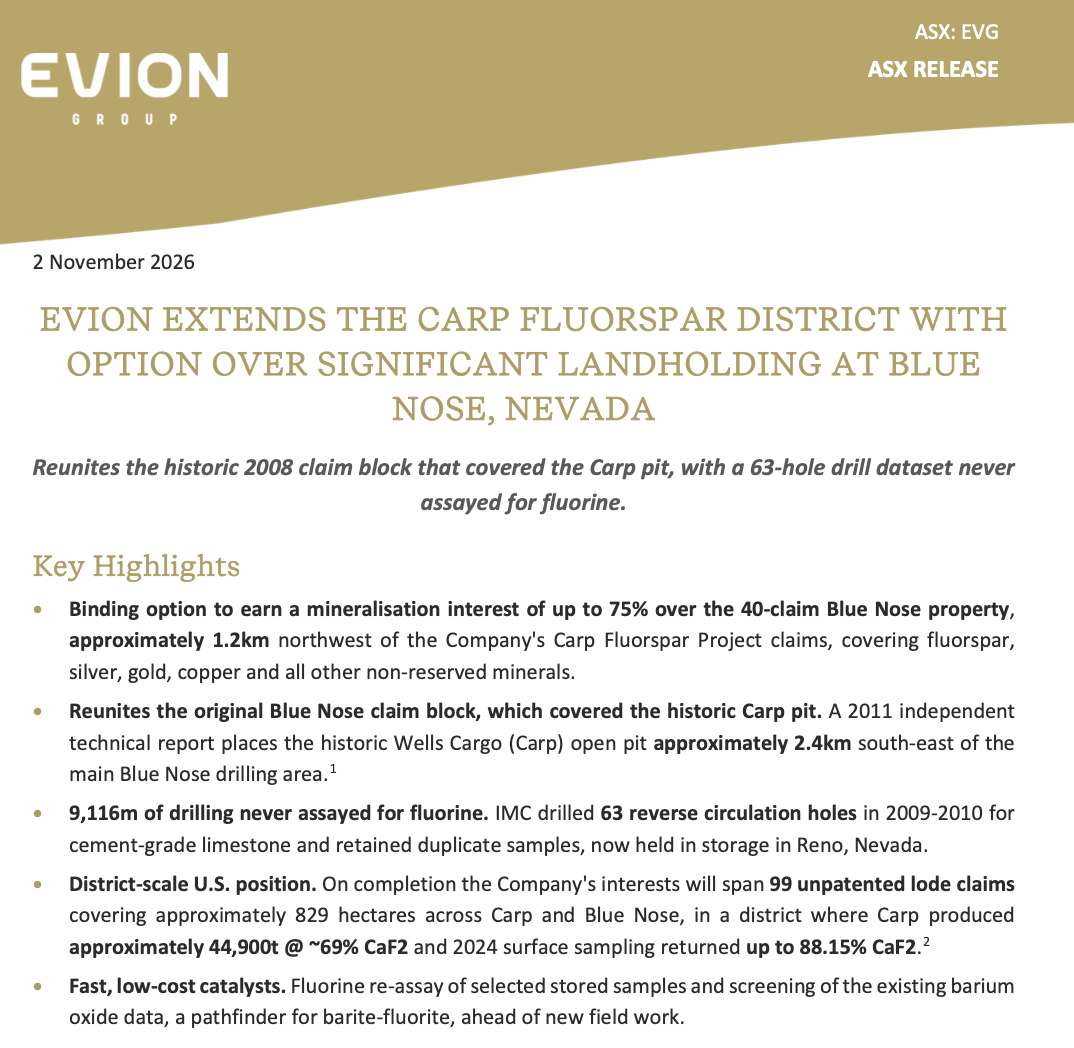
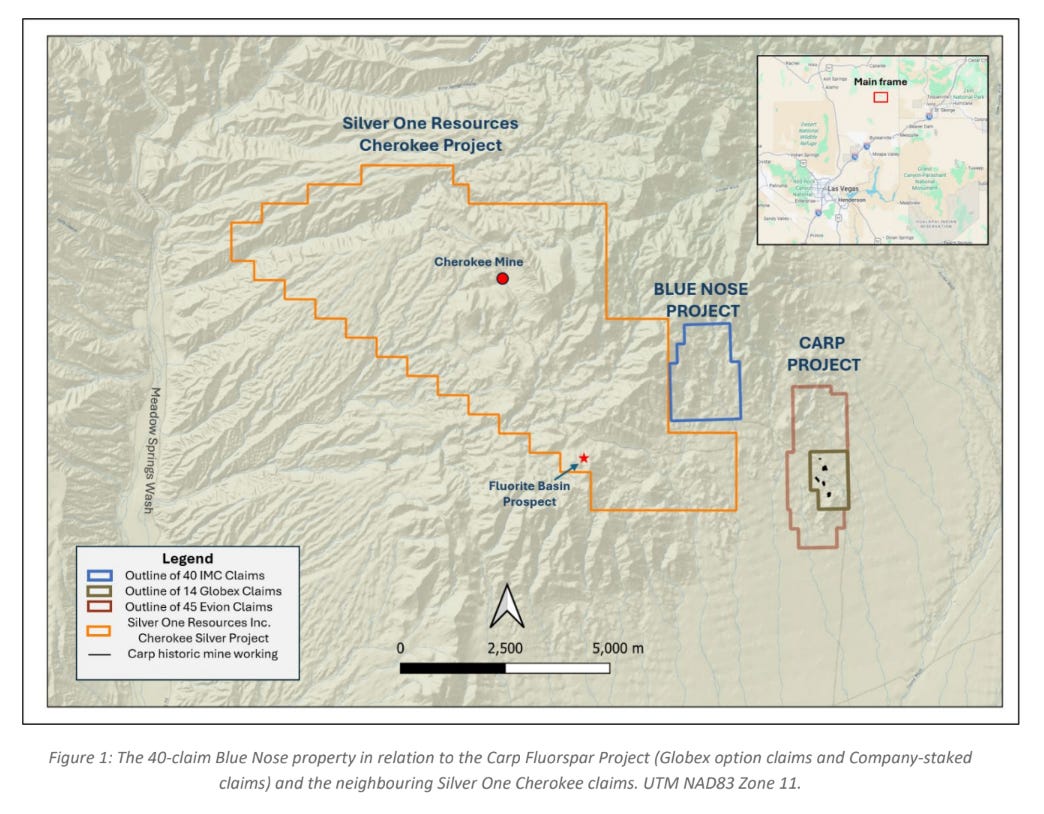
Sixteen years later the fluorspar and graphite company in our portfolio, Evion Group (ASX: EVG), has signed an option over the hillside. The property is called Blue Nose and it sits 1.2km from Carp, the old fluorspar mine EVG optioned in May. The bags come with it.
The opportunity EVG saw is that nobody ever asked the lab to check for fluorine, which is the element inside fluorspar. They did check for barium, which is often the giveaway for barite, and we wrote in September that barite sat beside the fluorspar in every pit the old miners dug at Carp.
Still with us?
So EVG can read 5,626 barium numbers before it opens a bag and send only the intervals with barite in them back to the lab for fluorine.
The limestone company paid for nine kilometres of drilling in 2009, and EVG gets to go back through it with a lab fee.
At 1.3c EVG is worth about $11 million with $5.7 million in the bank, with three results landing over the next couple of months. Assays on 41 rock chips from Carp are due through November. The drone magnetic survey EVG flew over Carp recently comes back in about a month.
And now EVG gets its first fluorine numbers from the bags in Reno.
There’s a lot of opportunity to re-rate in a commodity that Western countries are desperate to get their hands on.
Round Told Us He Wanted More Nevada
David Round runs EVG, and he told us last month that the company was “not being shy” about Nevada.
Blue Nose is the first piece of ground to land since, and the second EVG has picked up in Nevada this year.
The first was Carp in May, where between 1958 and 1971 the old crew dug 44,900 tonnes of fluorspar out of four shallow pits and trucked it to Kaiser Steel at about 69% purity. The surface samples EVG had verified in May ran as high as 88.15%, which is higher than anything the mine ever sold.
The buyer Round most wants is the US government. The US hasn’t had a working fluorspar mine since 1995 and imports every tonne it uses for a stack of vital jobs, like etching computer chips and making the fuel for nuclear reactors.
Such is its keenness on the commodity, the Pentagon paid US$169 million to get just one old mine in Utah going again in January.
EVG has joined two of the Pentagon’s buying groups this year, meaning it can bid when the next contract comes up. Round has already sat across from senior people at the Department of War with former ambassador to the US Arthur Sinodinos. He told us US industry has written to the government saying it will buy EVG’s product if Washington backs the company.
Here he is on the letters, and on a defence show in Philadelphia where everything on the floor had graphite in it:
We think the bid is a lot easier to make with 829 hectares behind it than with one pit.
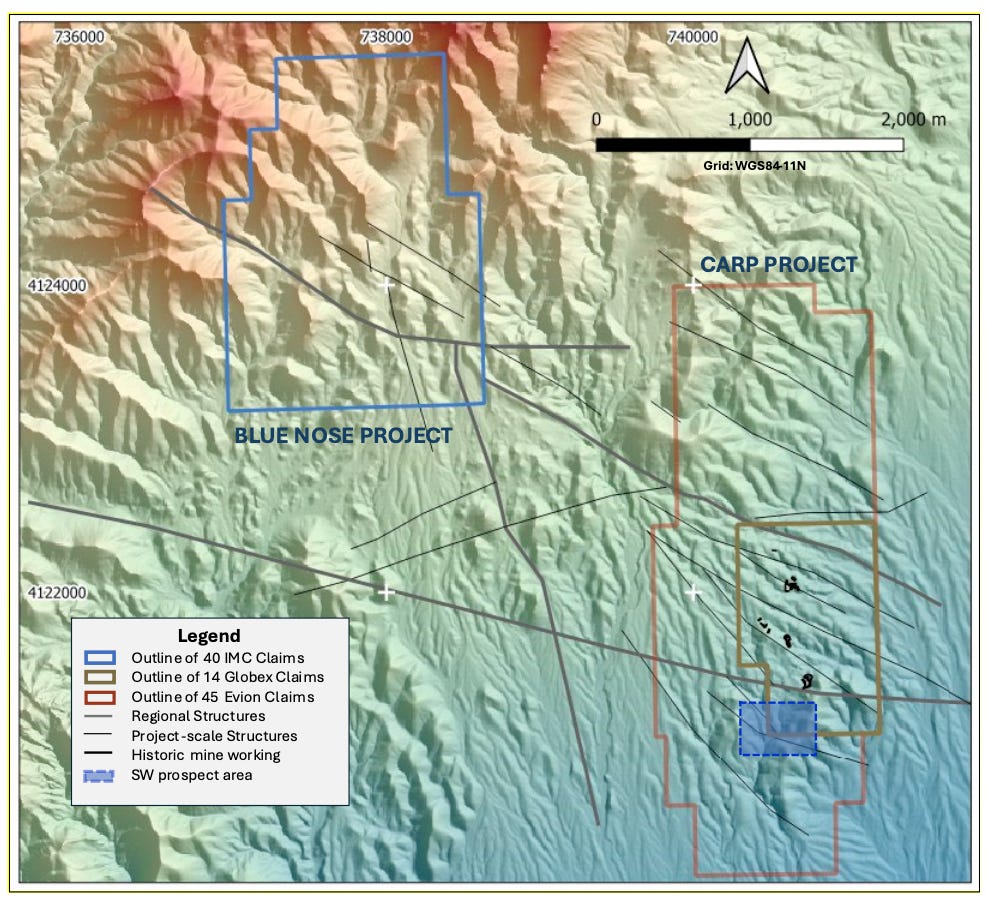
Blue Nose and Carp started life as one block. IMC, the limestone company from the intro, staked both in 2008 with the Carp pit in the south-east corner. EVG optioned the Carp end in May and this deal puts the two ends back together. On completion EVG holds 99 claims across the district, up from 59.
To underline his confidence, Round bought a million EVG shares on market at 1.8c in September, while he waits for the lab.
The Bags in Reno
IMC drilled 63 holes into Blue Nose between March 2009 and August 2010, chasing limestone clean enough to feed a cement kiln. All of them went straight down to somewhere between 91 and 305 metres, and the crew bagged a sample every metre and a half on the way.
Two superpowers are in a trade war over critical minerals like this one. IMC drilled nine kilometres through it looking for concrete.
Nobody has ever gone looking for fluorspar on Blue Nose, and the old district records show a handful of small diggings around Blue Nose Peak with fluorite and barite in them. Fluorite is fluorspar by its other name.
EVG’s geologists think Carp and Blue Nose are two levels of the same system, with the fluorspar at Carp formed deeper in the limestone and Blue Nose sitting closer to where the hot fluids reached the surface.
IMC already measured the barium, so we think it’s a fair idea to spend a lab fee on.
The first job is a trip to Reno to go through the bags. The barium sort comes next, and then the fluorine assays on the intervals worth paying for.
We’ve been fooled by a good surface number before, so the result we want is fluorspar in the drill samples at depth, where a lab can’t flatter it.
If it comes back the way the barite suggests, EVG has fluorspar in drill holes at Blue Nose without paying for a rig, 1.2km from a mine that shipped it for 13 years.
Washington has already signed a contract worth up to US$250 million with one old mine in Utah running 60 to 70%. Carp’s surface grades are above 80%, and drilled fluorspar at Blue Nose would give EVG a second deposit to put beside it.
The paperwork for the next step is already half done. The Bureau of Land Management approved a plan for up to 188 holes on the property in 2010, so a rig can go back onto Blue Nose without EVG starting the permit from scratch.
What EVG is Paying
The deal costs EVG US$1.5 million in cash and four million shares spread over two years, and only US$250,000 and a million of the shares are due at closing. At 1.3c, four million EVG shares are worth about $52,000.
There’s no minimum spend, so EVG decides how much goes into the ground and when. IMC keeps the limestone it came for, and EVG gets the fluorspar, the silver, the gold and the copper.
IMC also gets a slice of Carp. In return for Blue Nose it earns up to a quarter of EVG’s Carp claims, with EVG paying all the exploration bills on IMC’s share until there’s a study a bank would lend against.
If EVG completes the earn-in, it will hold 75% of the non-reserved minerals at Blue Nose, with IMC retaining 25%, giving the two companies a shared interest across the district. We think a quarter of Carp is a fair price for 40 claims and nine kilometres of drilling.
IMC drilled the holes and has minded the bags for 16 years, and a partner with a quarter of the district has a reason to keep helping.
What We’re Watching at Evion Group
The Carp rock chips are due through November and the drone survey a month after, and the survey is what picks the first drill holes there. On Blue Nose, due diligence runs 60 days, and the fluorine assays follow a few weeks after EVG gets into the bags.
The other half of EVG is graphite. Maniry is its mine in southern Madagascar, permitted in July after a four-year wait. In August a German buyer signed for a quarter of its first-stage output, and the full contract is due by February.
Here’s Round on the permit, and why he only sold a quarter of Maniry to the Germans:
The full contract is what Europe’s two development banks want to see before they lend EVG the money to build Maniry.
EVG also owns half a plant near Pune in India called Panthera. It turns flake graphite into the expandable kind that goes into fireproofing, and it sells into the US and Europe. In October it shipped its first container to Vietnam at US$3,650 a tonne.
Panthera ran at about a quarter of capacity last year and still made money.
Take the $5.7 million of cash off the $11 million market cap and the market is paying about $5 million for everything else. We think Maniry and Panthera are worth that on their own, and Nevada comes with them.
Round told us last month the business is in a much stronger position than it was in June, and he expects it to be stronger again by the end of the year. Since June EVG has won the Maniry permits, signed the German buyer, opened a new market in Vietnam, joined two Pentagon buying groups and added 70% to its Nevada ground.
Three results land over the next couple of months, and any one of them can move an $11 million company. Two of them come out of Carp, and the third comes out of a storage facility in Reno.
Where Johnny Cash watched a man die, EVG now has a chance to bring a mine to life.
Reading 5,626 barium numbers before paying for a single new assay is a cheap way to find the good intervals. $5.7 million in the bank against an $11 million market cap gives them some runway. Which of the three upcoming results do you think matters most?