


Asian Battery Metals (ASX: AZ9) has been one of our quieter portfolio holds this year. The second drill hole at Red Hill has put the company back on the screens.
AZ9 picked up the project in southwestern Mongolia back in April, for less than a million US dollars.
The first hole, drilled in May, came back with 18.8 metres of massive sulphide.
The second hole, announced today, has gone better. 21.9 metres of sulphide, with a mineral called chalcocite turning up in the core for the first time.
The copper that had been coming up in the earlier core was bound up in chalcopyrite, the standard workhorse copper mineral. Chalcocite carries more than twice as much copper per chunk of rock.
When chalcocite starts showing up in a system like this, the drill is usually getting closer to where the system was hottest and richest when the rocks formed hundreds of millions of years ago.
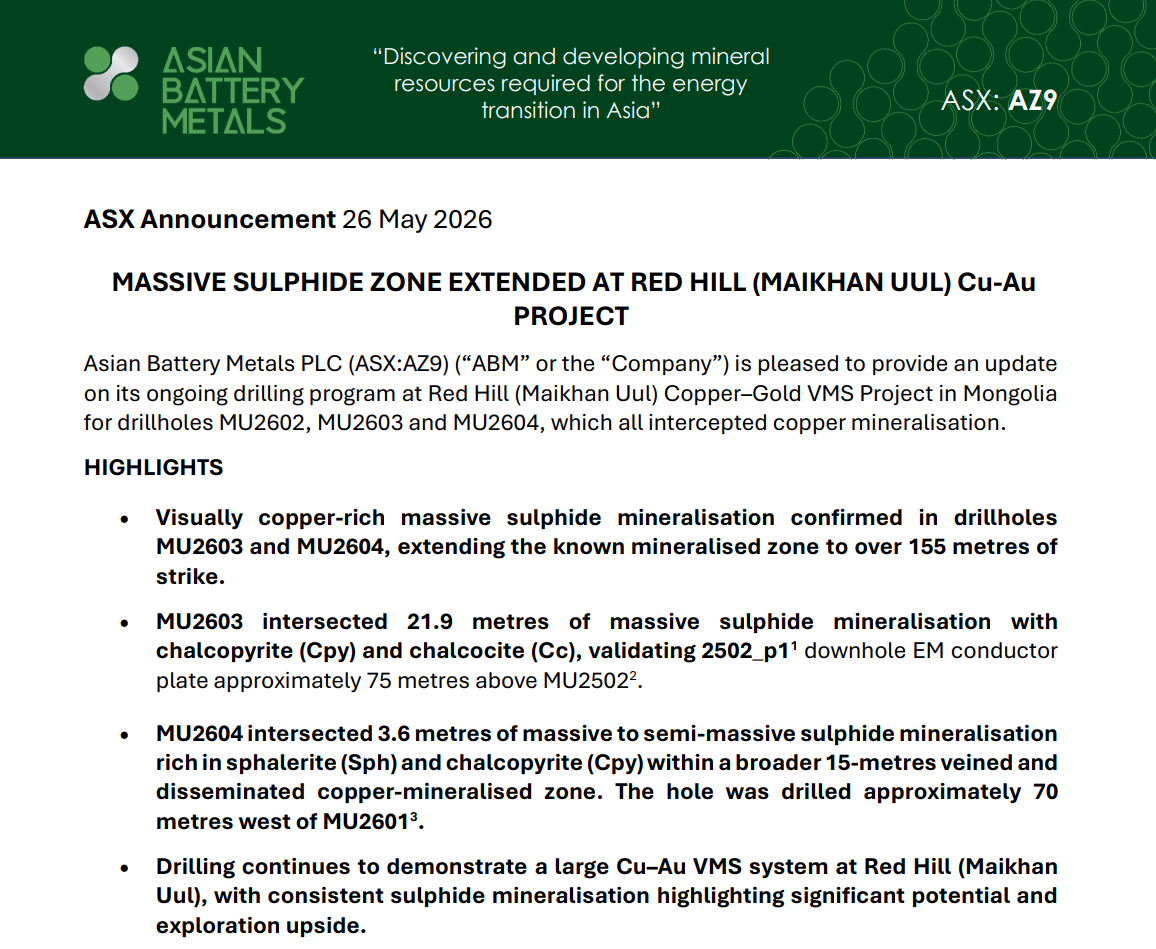
So the picture from two holes: each one thicker than the last, and the copper in the rock getting richer as the drill goes. The mineralised strike across Red Hill now runs more than 155 metres.
All of this against a copper price up 27% over the past six months, and the worst run of supply disruptions the industry has seen in years.
AZ9 still trades at 2c on a market value of around $15 million, with $5.2 million in the bank. Assays from these drill hits land in the coming weeks. If they come in where the visuals are pointing, the stock likely won't stay this quiet for long.
Who's Running AZ9 and What They’ve Got
Gan-Ochir Zunduisuren spent years inside the boardroom of Oyu Tolgoi, the Rio Tinto-operated mine in southern Mongolia that ranks among the largest copper-gold deposits on the planet.
He sat there as the Mongolian government’s representative, the person whose job it was to understand how the rock came out of the ground and where the money went when it did.
He runs AZ9 now.
The company is built around its Yambat ground in southwestern Mongolia, where it made the Oval discovery in late 2024. Oval is a copper-nickel-PGE deposit with a five-million-tonne resource and first-pass metallurgy that came in above 90% recovery, which is what put AZ9 on the map.
Red Hill sits eight kilometres from Oval, on the same belt.
So when the rig hit massive sulphide on the first attempt at Red Hill, it was confirming what AZ9 already had reason to suspect from the rocks at Oval. The belt works.
The Hole the System Has Been Waiting For
Red Hill is what geologists call a volcanogenic massive sulphide system (VMS). In plain English: thick layers of sulphide minerals that were deposited by hot fluids venting onto the seafloor 100s of millions of years ago, then buried under younger rock and preserved.
The highest grades in a system like this sit closest to where the hot fluids came up through the seafloor. That spot is called the feeder zone.
Find the feeder, and you find the part of the system worth building a mine around. That is the prize AZ9 is hunting at Red Hill.
So far there’s been two holes drilled, for two hits.
The first hole, drilled in May, pulled 18.8 metres of sulphide.
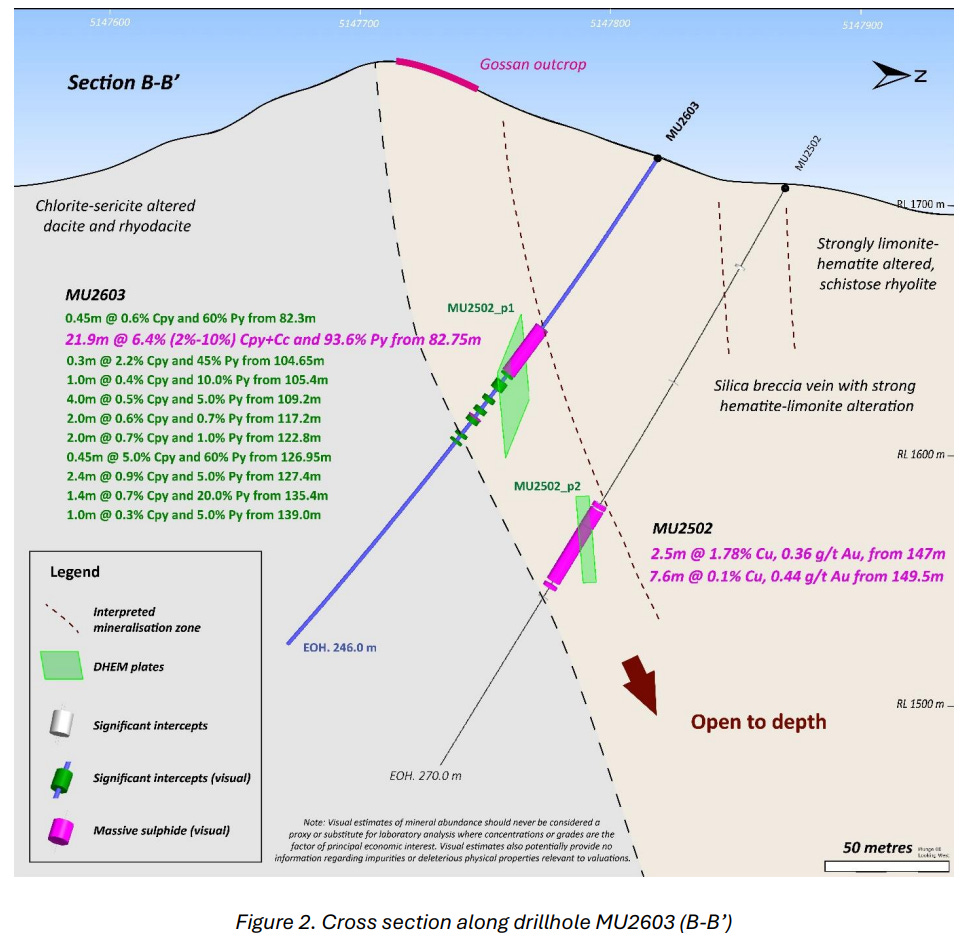
MU2603, announced today, has topped it. 21.9 metres of massive sulphide.

Massive sulphide is rock that is essentially solid metal-bearing mineral, packed tight all the way through. Think of the difference between a thin layer of icing on a cake and a 21.9-metre slab of pure icing.
The thicker the slab, the bigger the deposit can grow once the drilling fans out from it.
The new hole was drilled 50 metres south of an older drill hole, MU2502, and intercepted the same sulphide lens about 75 metres up-dip.
In plainer English: the system is bigger than the old hole suggested, and sits closer to surface than previously thought. Shallower copper is cheaper copper to pull out of the ground.
Visible chalcopyrite and chalcocite are running through the core. Chalcocite is the high-grade copper mineral that we flagged earlier in the article, showing up in the drill core for the first time.
Globally in 2026, only 18 companies have reported a copper drill hit grading better than 2% over more than 20 metres of length.
Most of those companies are valued in the 100s of millions of dollars. If the assays from MU2603 land where the visuals are pointing, AZ9 joins that list at a very cheap $15 million market value.
AZ9 picked up Red Hill in April on a mining licence valid until 2045, so there is no tenure clock running on any of this.
The rigs keep turning, and assays will soon tell us what the rock actually grades.
The System Keeps Growing
Two more holes pushed out from MU2603. One went west and one went east. Both came back with something to look at.
MU2604 was drilled to the west. The hole hit a 3.6-metre band of copper and zinc-rich sulphide inside a wider 15-metre mineralised zone. That intercept extended the known copper system at Red Hill out to more than 155 metres long.
Two months of drilling with 155 metres of system traced. The drill keeps finding rock that nobody had ever turned the ground over for.
The eastern hole, MU2602, drilled into a 44.5-metre thick zone of weathered, rusty rock with chalcopyrite veins running through it at depth.
Rusty rock above a sulphide system is what geologists call a gossan. It is what happens when sulphide minerals close to surface have been weathered by water and air over millions of years, leaving behind iron oxides that stain the rock red and brown.
Gossans are smoke trails. They sit on top of bigger sulphide systems underneath. Finding one means there is probably more to drill below it. Drilling east at Red Hill is now firmly on the to-do list.
So in two months, AZ9 has drilled four holes at Red Hill. The first two went into the main lens and hit massive sulphide on both attempts. The third extended the system west. The fourth turned up a gossan to the east, pointing the drill at the next target.
The system is bigger than the first hole suggested, and the drill hasn't found the edge of it yet in either direction.
The chalcocite in MU2603 also points the drill where it wants to go next. AZ9 has flagged that grades may zone higher toward the west-northwest, and MU2604 is already drilling in that direction.
The 2% Question
We’re speculating that MU2603 could come back at copper grades around 2%. The assays will settle that one way or the other, and they are four to five weeks away.
Historic hole MU2501, drilled during the due diligence phase before AZ9 bought the project, returned 14.5 metres at 2.23% copper and 0.73g/t gold from 132.5 metres. Red Hill has already produced a 2%+ copper hit, in the same mineralised lens that MU2603 has just drilled through.
Visuals are visuals, and grades are grades, and the only thing that closes the gap between the two is the assay lab.
The 2%+ grade in this system is a hole in the ground that AZ9 already has on the books.
If the assays come back anywhere near 2% over a 21.9-metre interval, AZ9 will be sitting on one of the rarer copper drill results of the year, at a market cap below most of its peer group.
The Copper Backdrop Is Doing Some Heavy Lifting
Behind the price move is a supply squeeze that has gone from chronic to acute. Codelco, the biggest copper producer on earth, just fired an executive after audits showed a 27-year production low. Anglo American and Glencore have hit fresh permit delays at Collahuasi, the world's sixth largest copper mine.
Cochilco, the Chilean copper commission, named Mongolia as one of the producing regions expected to help fill the supply gap, alongside the DRC, Zambia, Canada and the US.
Copper futures are trading around US$6.47 a pound on COMEX, the highest level the metal has held all year.
AZ9 is drilling in the exact bracket Cochilco is pointing at.
Where AZ9 is at
The assays for the first hole come back in around two weeks, and the bigger batch covering the headline 21.9-metre intercept and the two flanking holes follows four to five weeks behind that.
A gravity survey is already running across the ground, and the rig is moving onto the shallow gold target at MU2501, where a historic hole in the same lens once returned 2.23% copper over 14.5 metres.
The company is sitting on $5.2 million in cash, so the rigs keep turning whether the market is paying attention or not.
If the assays come back anywhere near what the visuals are pointing at, AZ9 is holding a result that very few junior explorers have produced this year, in a market that is already short of the metal.
If they come back softer, the system is still bigger and richer than it was a month ago, and there is plenty of ground left to drill.
Either way, the rig keeps turning, and the next month is the one to be watching.