Elk Range Mining (ASX: ELK) has hit 290 metres of gold at 2.8 grams a tonne in its first drill hole at the Friday Gold Mine in Idaho, with 89.6 metres at 5.5 grams inside it.
Eleven weeks ago we wrote that a drill hole at Friday ended in 133 grams a tonne more than a decade ago, and ELK had just gone back for it.
It found 11 metres at 21 grams sitting straight underneath, and the gold kept going for another 170 metres.
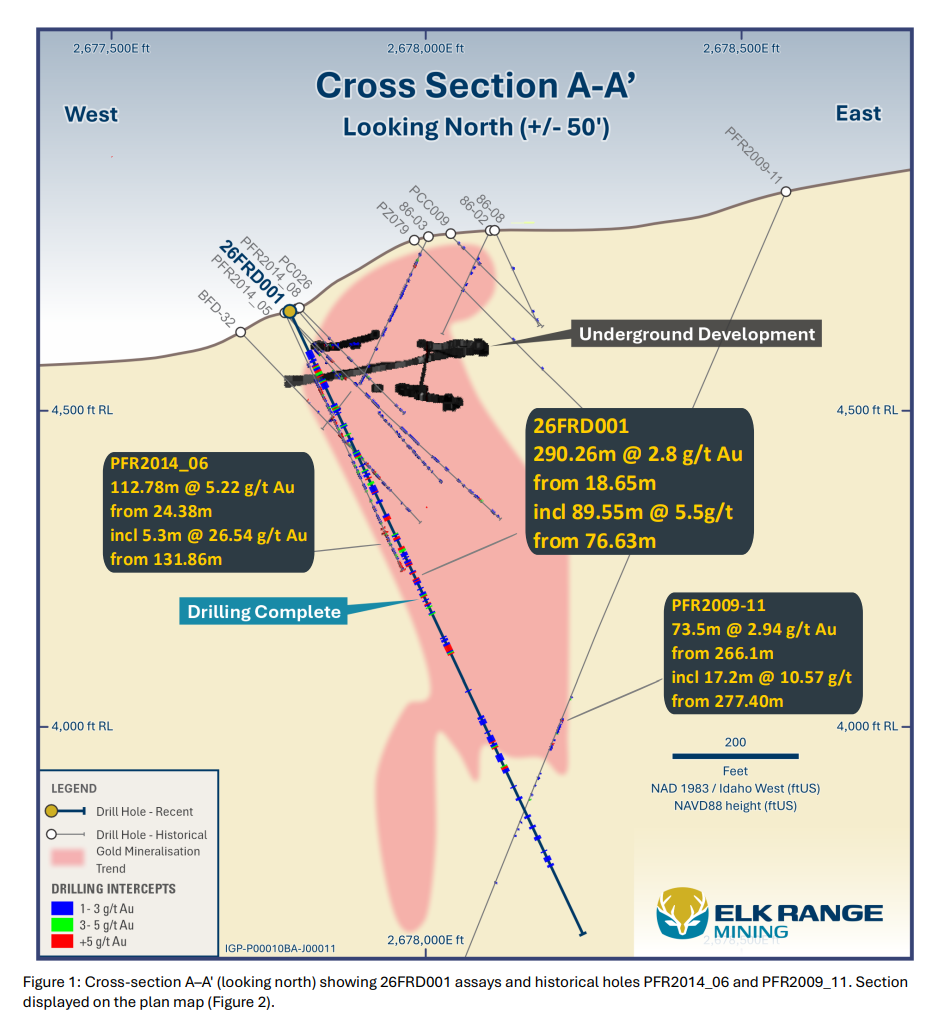
The 2014 hole averaged 5.22 grams over 112 metres, and the 133 was the last three-quarters of a metre before the rods stopped at 137 metres.
Nobody drilled under it for 12 years.
Elk drilled its hole eight metres away, ran it through the same ground and kept going.
“Every investor looking at an old mine asks the same question: did the gold stop where the drilling stopped?” CEO Edward Keys said. “This hole answers it.”
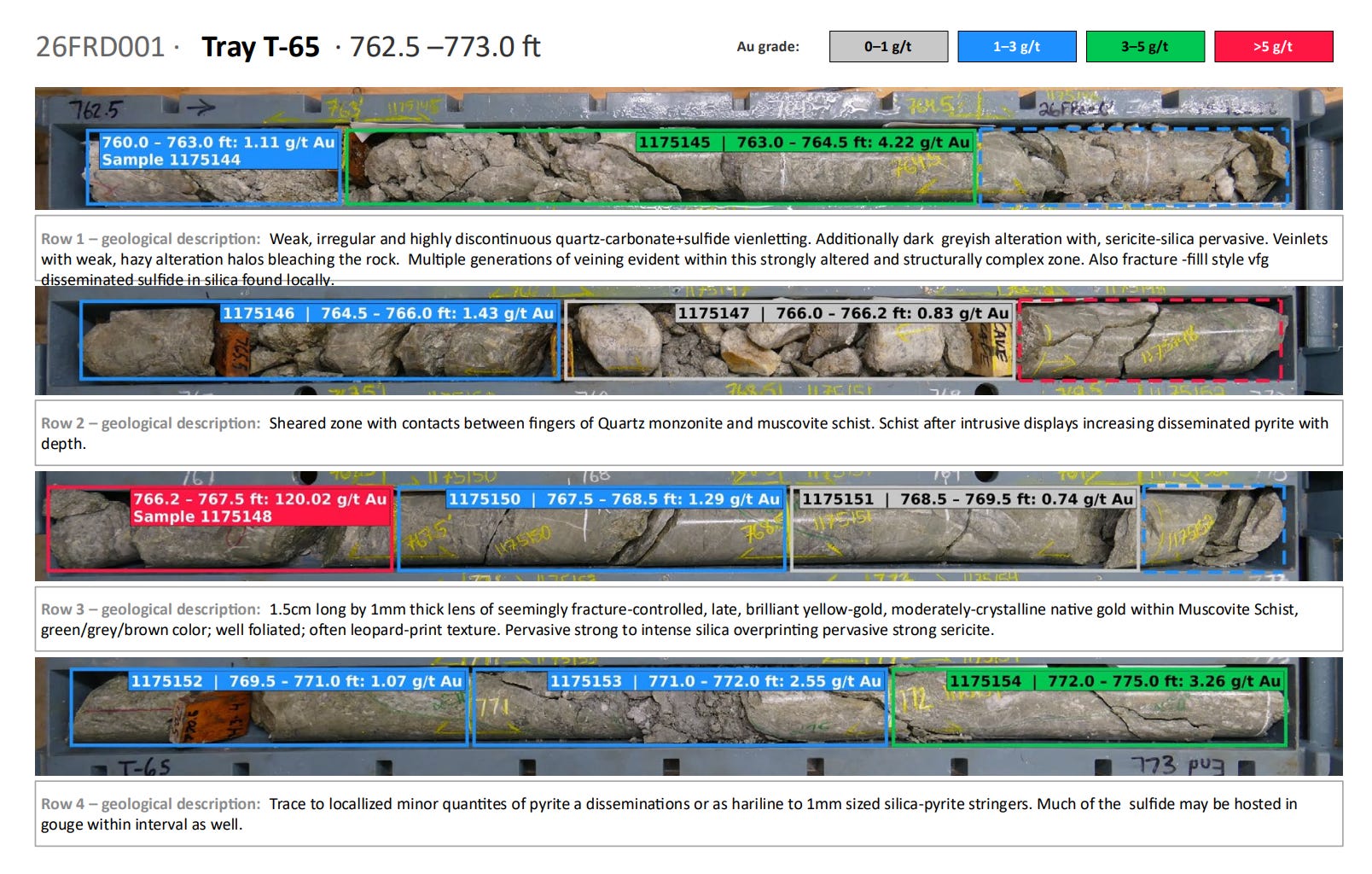
Keys told us the first thing he looked for when the assays landed was the gold the crew had photographed in the core at five depths back in September and October. Three of the five stayed on Elk’s side when the saw went through, so those trays are off to conferences as show pieces.
The lab’s half from 122 metres ran 268 grams a tonne over 30 centimetres.
“We’re talking bonanza grades,” he told us.
For anyone new to gold grades, plenty of mines make good money on a couple of grams a tonne. This hole averaged 2.8 across 290 metres, and the best stretch of it ran more than seven times that.
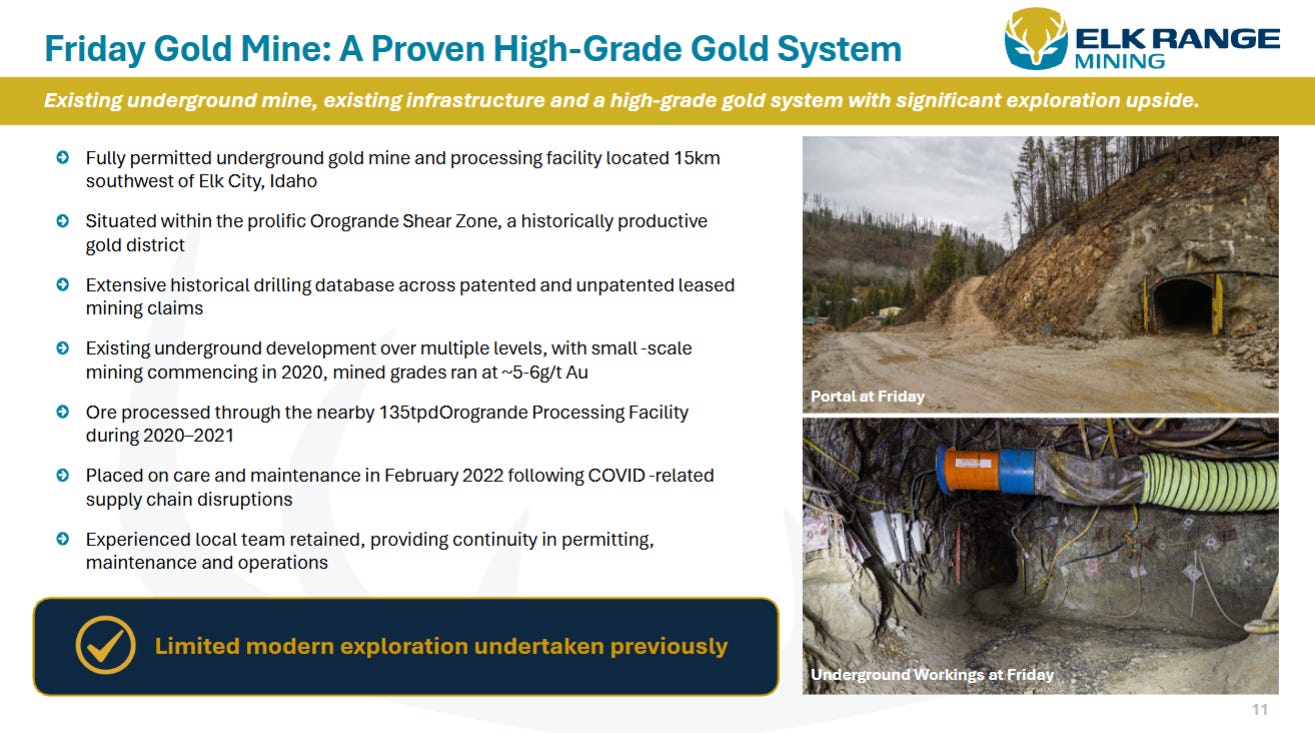
Friday is the permitted underground mine the last owner spent more than US$40 million building, then parked during Covid with gold at US$1,887. Gold’s above US$4,000 now, and Elk is drilling the same ground with the decline and the mill already paid for.
ELK went into its trading halt at 13.5c. At that price it’s a $17 million company with $6.7 million in the bank at the end of September, so the market was paying about $10 million for the mine the day before this hole came back.
A $17 million explorer carrying this hole and the money to drill seven more looks cheap to us. The rig is already on the second pad with two holes underway, and their assays land in late November.
The First Hole, Zone by Zone
The hole hit gold 19 metres below the surface and stayed in it, with a few lean patches, all the way to 309 metres. Elk counts the lot as one stretch of 290 metres at 2.8 grams a tonne.
The top 53 metres are serviceable at 1.9 grams, with 20 metres at 2.6 grams and a seven-metre run at 4.5 grams inside them. Plenty of mines globally operate at those grades.
From 77 metres the hole gets serious.
It runs 89.6 metres at 5.5 grams, and inside it sit 13.9 metres at 9.7 grams from 112 metres and 37.1 metres at 8.3 grams from 129 metres.
The richest stretch of the hole begins at 137 metres, the depth where the old crew pulled their rods out, and runs 11.3 metres at 21.4 grams. Nobody had drilled a metre of it before.
Below it the gold keeps coming. From 177 metres the hole ran 12.7 metres at 4.5 grams, with three metres at 13.4 grams in the middle of it. From 216 metres it ran 51.8 metres at 2.6 grams, and 22.4 metres of those averaged 5.1.
The last 36 metres of gold thin out to 0.8 grams, the gold stops at 309 metres and the hole finishes at 337.
Geologists multiply length by grade to rank holes, and this one comes to about 820 gram-metres from the first gold to the last.
Keys called it “an incredible way to start Elk Range”.
The lab also put a number on each of the five places the crew saw gold in the core. Beyond the 268 grams at 122 metres, the veinlet at 234 metres, the one longer than a centimetre in the Tray 65 photo, ran 120 grams over 39 centimetres, and the three sightings in between came in at 5.4, 2.6 and 6.1 grams.
The core also came up with a line marked down its side the whole way, so the geologists know which way every vein in it runs. It’s the first oriented core anyone has pulled at Friday.
“For the first time at Friday we have oriented core, and it’s showing us how the high-grade gold is aligned. That makes every hole from here smarter than the last.”
- Elk Range Mining CEO Edward Keys
Elk Drills Down the Guts
Elk pointed its first hole along the shear zone (the crack in the hill the gold lives in) and drilled right down the guts of it.
Drill down the length of a vein and you get a long number. Drill across it and you get its thickness, which is the number a mine gets built on.
Elk’s 290 metres is the long way, so the gold is thinner than the lengths above say.
Keys told us the first hole was always going to go in this way, because this slice of the hill had few old holes in it and Elk wanted a look down the whole structure before cutting across it. The next seven holes come across the zone to measure how thick it is.
Elk’s hole went through the same zone the 2014 hole did and came out the other side with 89.6 metres at 5.5 grams.
What the Result Does for ELK
Around 386 holes have been drilled at Friday over the past century, all of them reported under an overseas code, so on the ASX they count for nothing until Elk’s own core backs them up.
The best of the lot now has Elk’s hole eight metres from it, through the same zone and 170 metres further down.
ELK drifted from 20c to 13.5c while the core sat at the lab. We held every share, because the stock was always going to be judged on this hole.
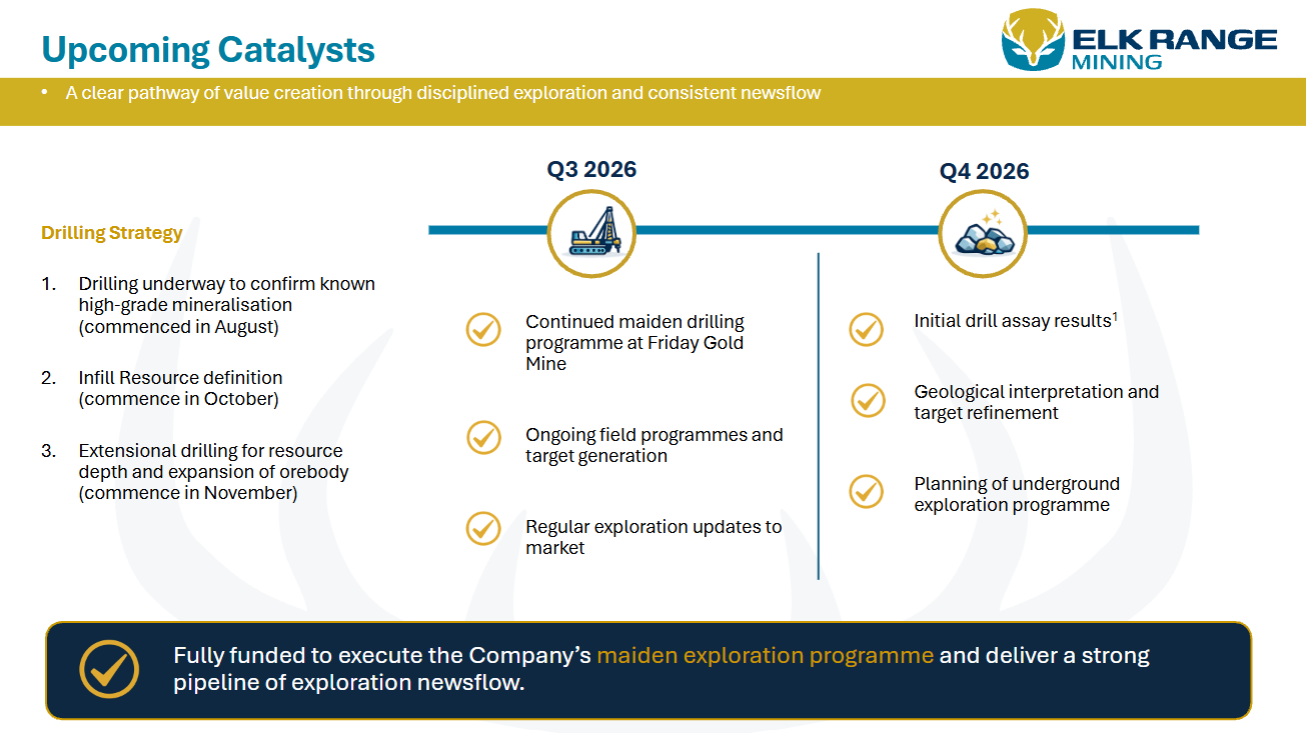
Keys has done what he told us he’d do in August, putting the first hole straight under the old one and running the rig day and night to get the core to the lab.
He spent last night in a hotel room in Boise, Idaho, with a presentation at the Idaho minerals conference two days away and a week of Melbourne investor rooms behind him.
As we’ve written before, Keys keeps a sleeping bag on the mill floor at Friday, so a hotel room counts as a rare night off.
“We’re not sitting on our hands at Elk Range,” he said. “Morale is good out there. We’re kind of having fun doing it, seeing all this gold.”
The gold at Friday is nuggety, and one hole tests one slice of a system 430 metres long, so the size of Friday rests on the next seven holes.
Leanne Kite bought 250,000 shares on market in the first week at 19c, and three more directors bought after her. We like a board with its own money in at the price we paid.
Next Steps for Elk Range Mining
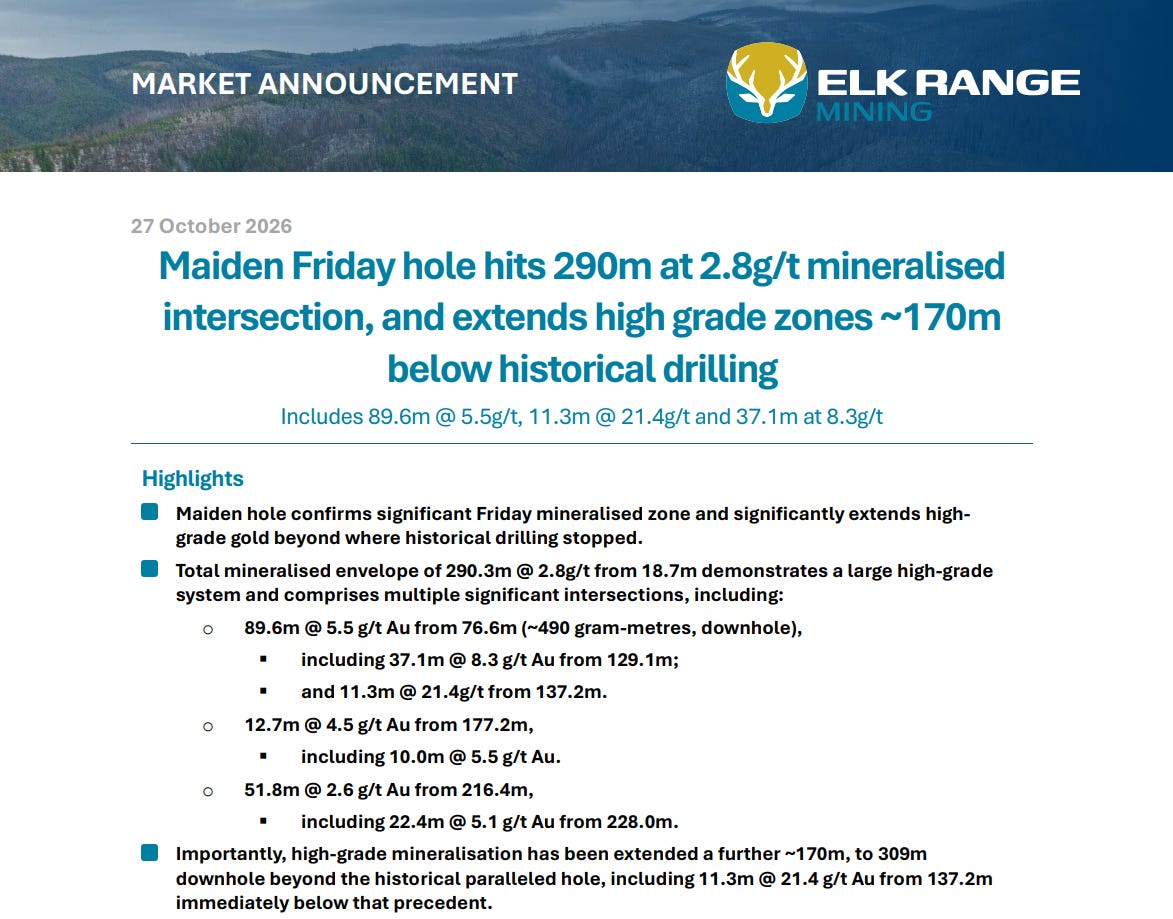
The rig has moved to the second pad, where the second hole stopped at 151 metres for a mechanical fix and the crew turned the rig to start the third, which is 125 metres down with 396 planned.
Core from both goes to the lab in the coming days, and Elk expects assays in late November.
Elk also sent the old 2014 core back for a photon assay, the bigger test we wrote about in September, and the lab still has it.
Elk’s eight-hole program is aimed at a maiden JORC resource for Friday, the first time anyone has counted the gold in this hill to the Australian standard.
We wrote in August that a century of Americans proved the gold is there, and a team of Australians would find out how much. The first Australian hole went 170 metres past where the Americans stopped, and the rig is already in the next one.