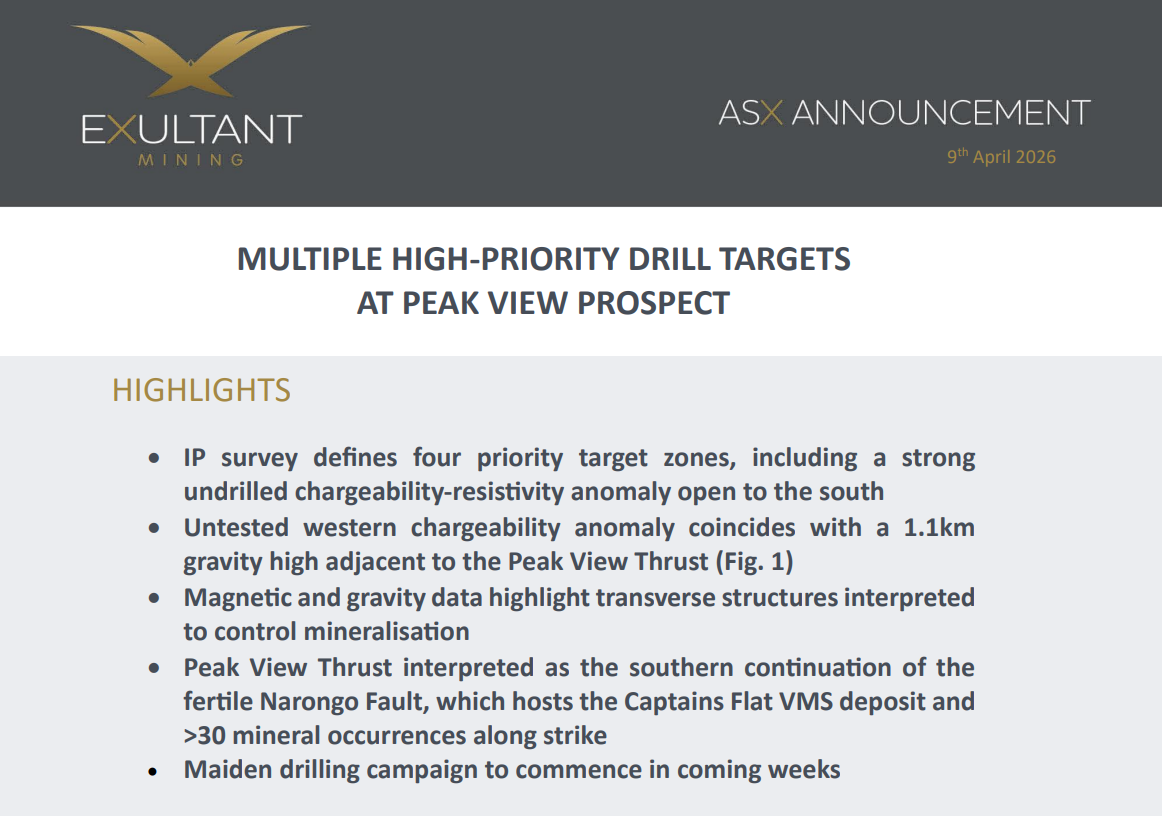
The strongest geophysical targets at Peak View have never been drilled. That’s about to change.
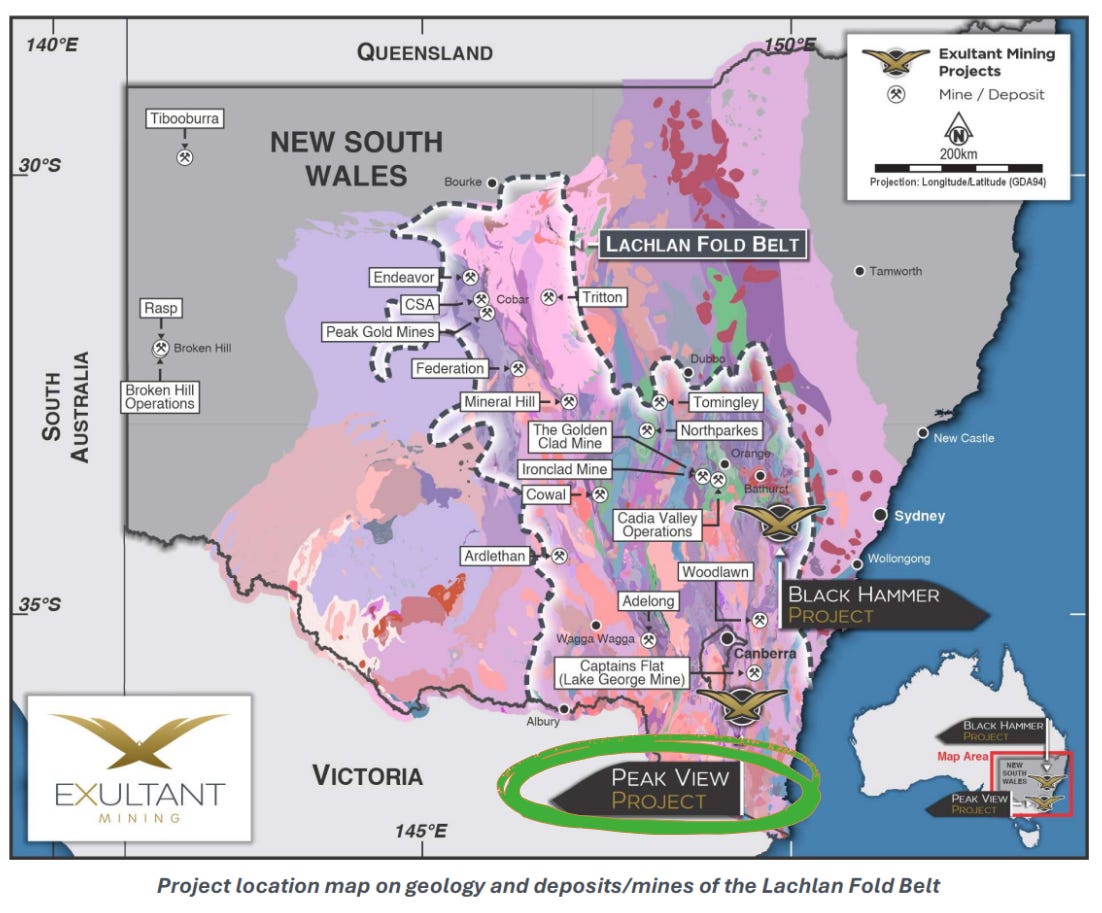
Exultant Mining’s (ASX:10X) Peak View prospect sits in the Lachlan Fold Belt in New South Wales, a mineral belt that's produced some of Australia's biggest base metal deposits.
50 g/t gold at Undoo Creek and 339 g/t silver at Big Badja grabbed the headlines over the past month for 10X, but Peak View's base metal target is the drill program they’ve been building towards since listing in December.
Historical drilling at Peak View hit zinc, lead, copper and silver, but only tested a small part of the system. 10X’s soil sampling has since defined a 900-metre mineralised corridor, and new IP and gravity surveys have now defined several large targets along the same trend that have never been tested.
10X is trading at around 19 cents a share with roughly $4 million in cash. Strip out the cash and you’re paying about $3 million for everything else. Drilling starts in late April.
At that price, the market is paying almost nothing for a funded drill program on a structure that hosts Captains Flat, one of NSW's biggest historic base metal mines, and more than 30 mineral occurrences along strike.
Why Peak View matters
The Lachlan Fold Belt has produced base metal deposits worth billions.
Captains Flat was one of NSW's largest, producing lead, zinc, copper, silver and gold from the 1880s through to 1962.
Woodlawn, owned by Develop Global (~$1.7B market cap), is now being brought back into production after Trafigura backed it with a US$65 million offtake deal.
Both sit along the same broader structural trend as Peak View.
The region has produced multiple base metal systems and those two deposits alone show what scale looks like when you find something real in this belt.
At $7 million, 10X is the cheapest way into this belt. The historical drilling proved the system carries grade.
The new geophysics says the best parts were never touched. Late April will tell us whether that gap between the geology and the valuation closes.
What the Surveys Found
The IP survey tested the soil anomaly we mentioned above and identified four priority target zones. Two of them stand out.
A soil anomaly is exactly what it sounds like. Elevated metal values show up at surface, usually because mineralisation sitting deeper underground has weathered and left traces in the dirt above it.
It tells you something is down there. It doesn’t tell you how much.
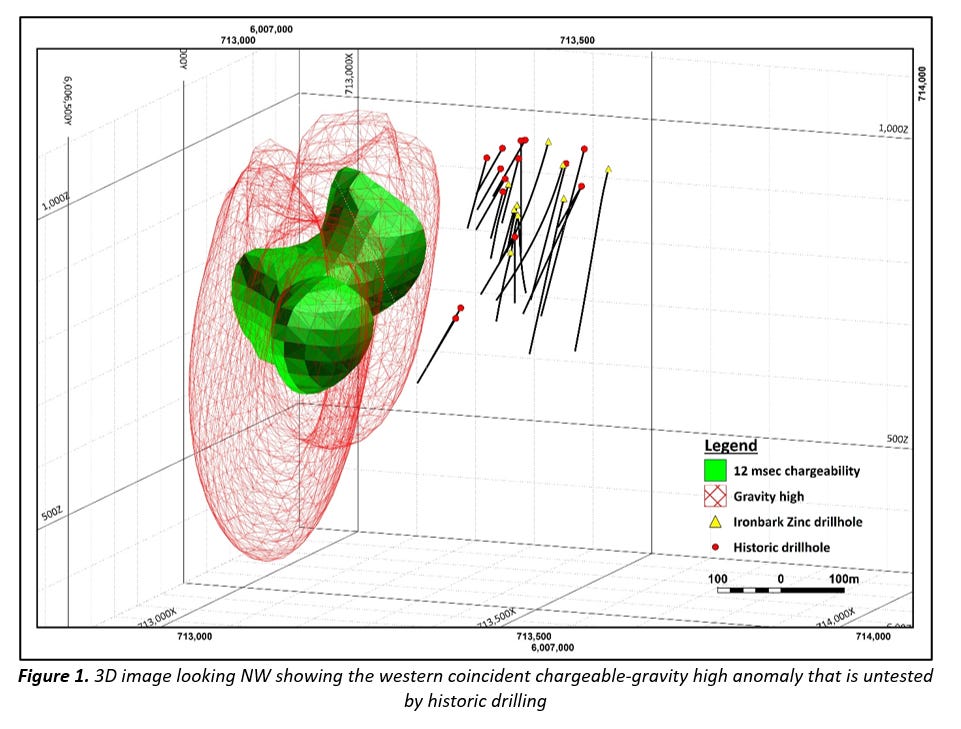
The first is a 700-metre chargeability anomaly sitting west of all the historical drilling.
Chargeability is a geophysics term that measures how strongly rocks hold an electrical charge after a current passes through them.
Sulphide minerals hold charge well, and sulphide minerals are what host metals like copper, lead and zinc.
So a strong chargeability response is the geophysicist’s way of saying “there’s probably sulphides down there.”
Historical drilling hit mineralisation beside a chargeability response of around eight milliseconds. The newly identified western anomaly exceeds 12 milliseconds, and nobody has ever put a drill hole into it.
The weaker signal had metal. The stronger signal is untested.
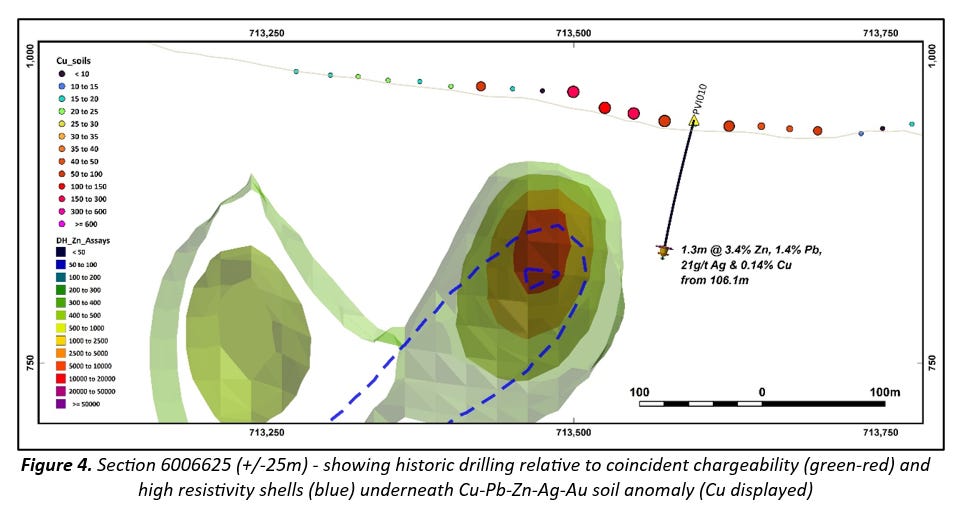
The second sits directly beneath the widest part of the surface anomaly and shows both high chargeability and high resistivity.
Resistivity measures how easily electricity moves through rock. When chargeability and resistivity both increase in the same spot, it often means sulphides are concentrated within a structured rock unit rather than scattered through surrounding material.
For the non-geos, that means the metals are likely sitting in one place rather than smeared across the landscape, and gives the drillers something to aim at.
Historic hole PVI010, drilled within 40 metres of this anomaly, returned 1.3m at 3.4% zinc, 1.4% lead, 21 g/t silver and 0.14% copper from 106 metres downhole.
That's real metal, right next door to a stronger anomaly that has never been tested.
A third target sits down-dip of massive sulphides hit by earlier drilling, where PVI006 returned 4.4m at 342.7 g/t silver, 4% lead, 1.1% copper, 0.74 g/t gold and 0.84% zinc from 48.7 metres. A resistivity anomaly beneath it suggests the system continues at depth and has never been followed up.
Gravity Anomaly Lines Up With a Major Fault
The ground gravity survey defined a 1.1 kilometre long gravity high that lines up with the western chargeability anomaly.
Gravity surveys pick up changes in rock density underground.
Dense rocks pull harder on the gravity meter. Sulphide accumulations are dense compared to surrounding rocks, so a gravity high can point to sulphides at depth.
When the gravity high and the chargeability anomaly land on the same spot, it strengthens the case that there’s sulphide accumulation sitting below.
This anomaly sits beside the Peak View Thrust, interpreted as the southern continuation of the Narongo Fault.
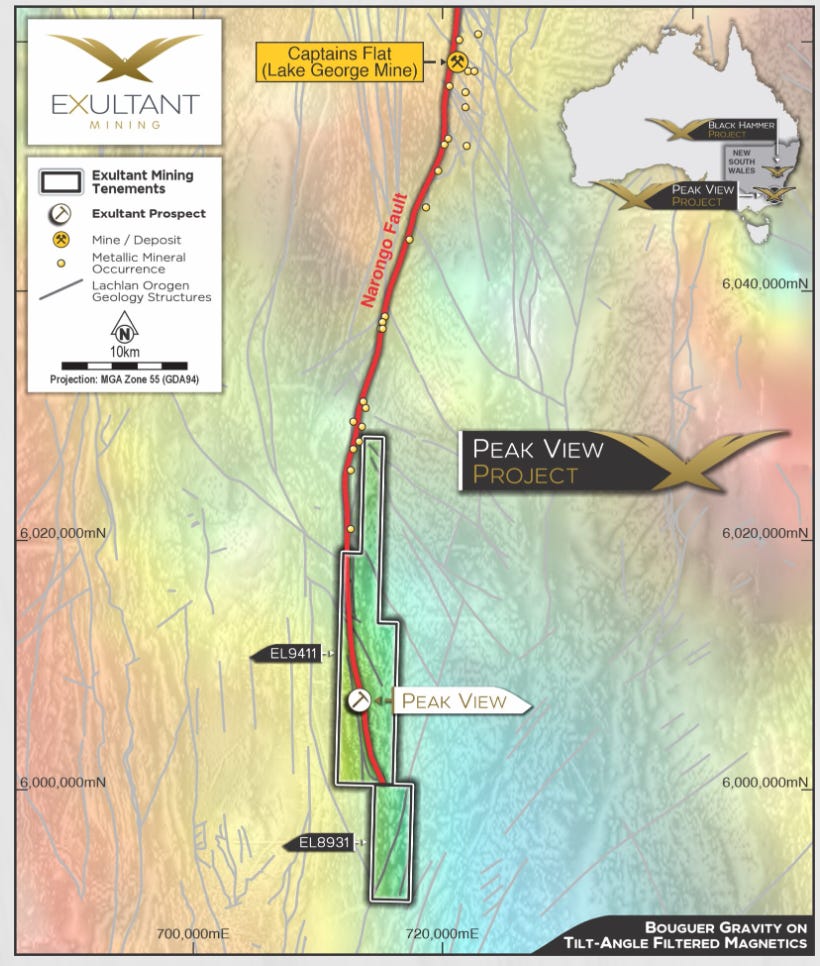
That structure hosts the Captains Flat deposit and more than 30 mineral occurrences along strike.
When you’re exploring near a fault system with that kind of track record, the odds improve. It tells you the plumbing was there to move mineralised fluids through the rock.
Most of the historical drilling targeted a gravity low. The gravity high corridor, where the strongest chargeability and gravity responses overlap, was missed entirely.
Where the Structures Cross
Magnetic data has identified several cross-cutting structures intersecting the prospect.
In base metal systems like this, the interesting spots are where big regional faults meet smaller cross structures.
Think of the big fault as the highway and the cross structures as the off-ramps. Where those pathways hit favourable rock units, metals can concentrate into defined zones instead of spreading thin.
At Peak View, the widest part of the surface metal anomaly sits where one of these cross structures intersects the main trend.
The strongest geophysical anomaly sits in the same spot.
Every dataset is pointing at the same piece of ground. Soils, IP, gravity and now the structural interpretation all converge on one area.
That suggests one connected system running through the prospect.
What Comes Next
10X has already lodged drilling applications covering 15 holes and is finishing final targeting work before mobilisation. Late April is the current timeline.
Peak View is only one component of the broader project area. Big Badja and Undoo Creek remain separate exploration opportunities within the same district-scale footprint.
At 19 cents with $4 million in cash, the enterprise value is sitting around $3 million. That's for a funded drill program across multiple targets on a proven mineralised structure, with two other prospects already putting out high-grade surface results.
Fifteen holes will tell us a lot. We think the ground will do the talking.