


It’s drilling time.
Elk Range Mining (ASX: ELK) has wasted no time since listing on the ASX, starting drilling at the Friday Gold Mine in Idaho.
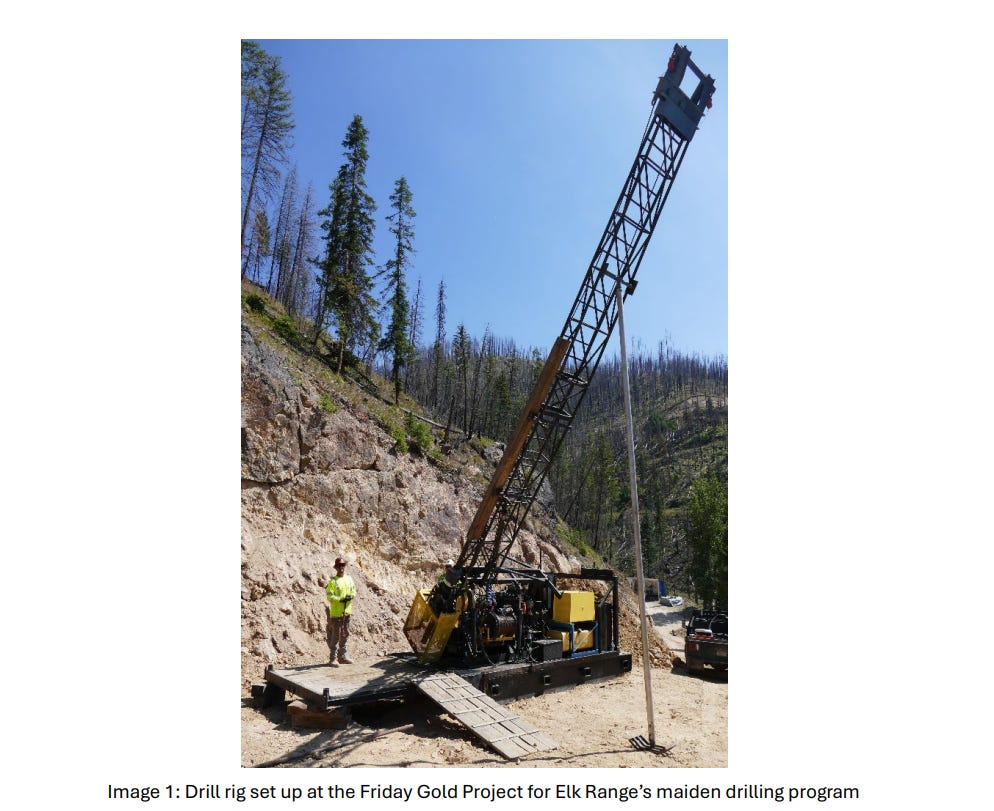
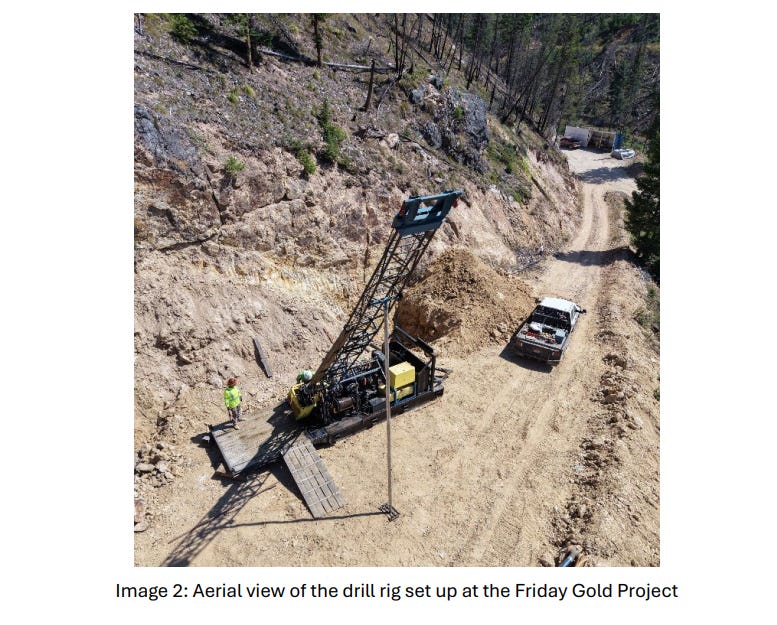
The first hole is already in progress, chasing gold the old drilling already found and pushing deeper to find out how far down the system runs.
Top of the list is the standout hole from the old campaigns, 110m at 5.34g/t gold. The final two-and-a-half feet of that hole graded 133g/t, and the drillers ran out of steel with the grade still climbing.
What’s sitting below that hole is the reason we backed ELK at 20 cents. This program is the first time anyone has gone looking for it.
The rig started there, twinning the old hole to confirm what it hit before pushing well past the old depths to see how far down the gold keeps running.
It’s good timing as gold jumped more than 3% overnight to its highest level in around two-and-a-half months, after the US Treasury moved to pump extra cash into the financial system.
Gold has now ripped above US$4,500 an ounce, and the market is pricing all of this at 18c a share, a $15 million company valuation with $10 million of cash in the tin.
Management told investors the float money would go straight into drilling, and it only took them days after listing to make good on it. CEO Edward Keys flew to Idaho before the stock listed, came home just long enough to ring the bell, then flew straight back. He’s there now, sleeping on the floor of the mill while the rig turns up the hill.
As he put it from site: "We are excited to have rods spinning at Friday and to get down to the work we set out to do."
Why We’re Backing ELK Range Mining
You can find our full write-up on why we’re backing ELK here
What the Drilling is Chasing
The gold system at Friday has sat largely untested for more than a decade, but the drilling crew knows this hillside better than anyone alive. Many of them worked at Friday when it last ran, and a few of them mined it.
Five years after pulling ore out of this ground, they’re back drilling underneath their own workings to find out how much they left behind.
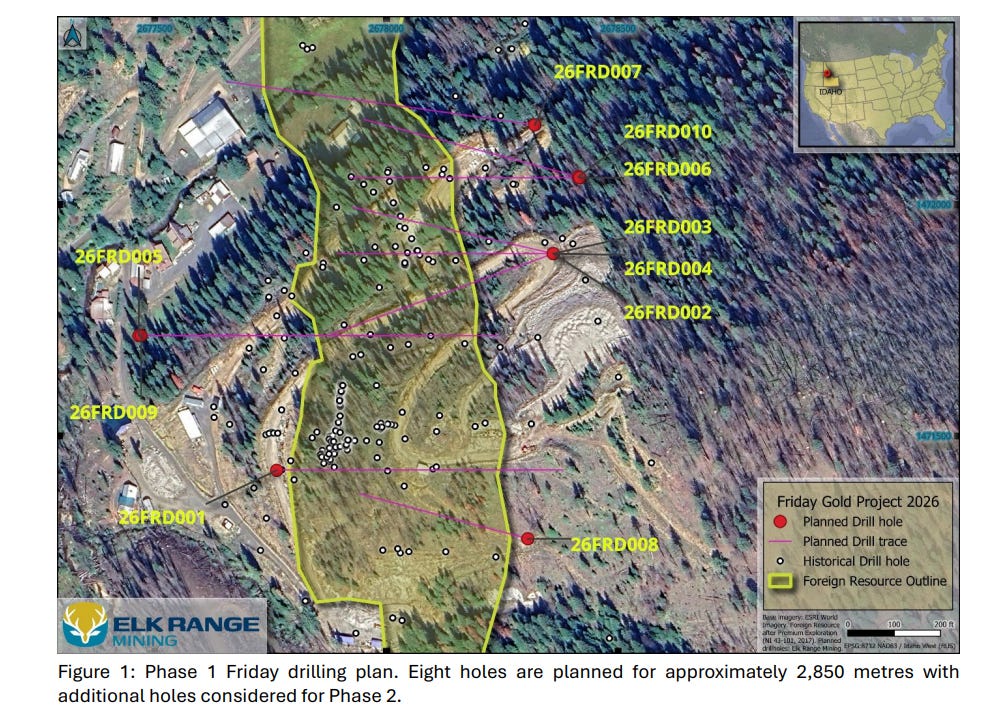
Phase 1 runs to roughly 2,850 metres across eight holes, with two more on standby if the early results look promising.
All of it is diamond drilling, which pulls a solid cylinder of core from the ground. That core shows the veins up close and the angle everything runs at. It comes up with its orientation marked too, so ELK learns which way the gold-bearing structures are heading.
By the end of the eight holes, they’ll have the first proper picture of this system anyone’s had in 100 years of mining it.
That will decide where Phase 2 drills later this year, when the rig moves inside the mine and works from the tunnels the last owner cut.
The old database holds more than 380 holes, and there’s plenty to aim at in it. Historical drilling returned 151m at 2.69g/t gold, including 54.1m at 5.62g/t, and a short interval running 57.6g/t.
Those are down-hole lengths, so the true widths are smaller, but the grades still put Friday in rare company. “Monster grades that were not followed up” is how Keys describes them. He’s a geologist, so we’ll take his word on the monster part.
An intersection as good as that would be the best hole most gold explorers ever drill. ELK is starting with a database full of them and a mine already sitting on top.
However, those old ounces won't count on the ASX until ELK's drilling confirms them and moves Friday towards its first JORC resource, the modern Australian standard for reporting what's in the ground.
Drilling Under a Mine Already Paid for
Friday is a permitted underground gold mine that was pulling ore as recently as five years ago, before the previous owner parked it and moved on.
That owner sank more than US$40 million into the site along the way, covering the underground development, a processing plant, roads and a camp. The market currently prices the company that owns all of it at $15 million.
So nearly every dollar of the $10 million ELK raised goes into drilling on private, patented ground with every permit already in place.
Buffalo Gulch and Deadwood sit further along the structure that fed Friday, giving ELK district-scale ground to work through once the first resource is banked.
In Short
Friday was last mined with gold near US$1,887 an ounce. Gold has surged above US$4,500, so the same ground is worth more than twice what it was the day the last truck left, and high-grade drill hits get rewarded quickly in this market.
ELK shares sit at 18c, under the 20c float price, while the drilling that float paid for is underway at a historically producing, high-grade gold system with district-scale ground around it.
Executive director Leanne Kite put her own money into 250,000 shares on market within days of listing.
The market rarely lets you in below an IPO price with the rig already turning.
Somewhere on that Idaho hillside, a crew that mined this ground five years ago is now drilling to find out what they walked away from. The first answers will start landing in October.