


The uranium explorer in our portfolio has spent three months waiting on a piece of paper from a provincial government in Argentina (and so have we).
It arrived this morning.
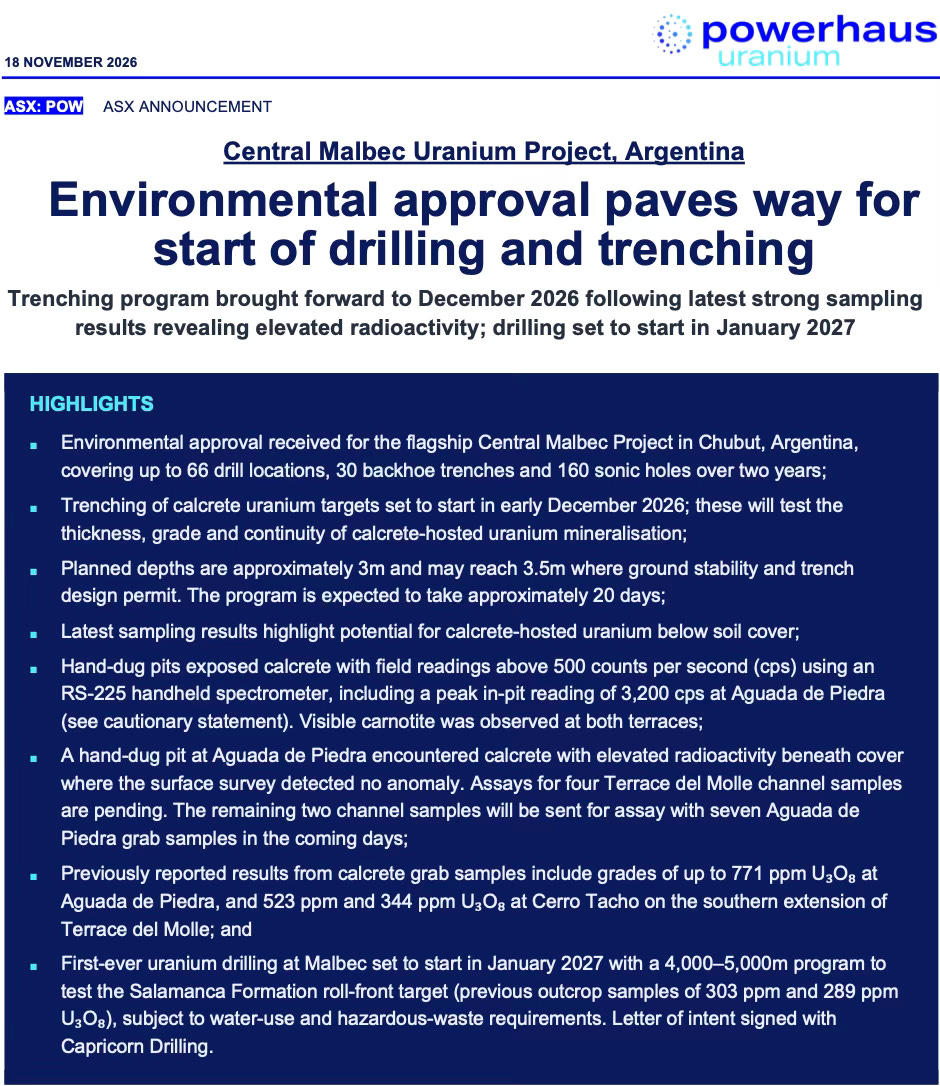
Powerhaus Uranium (ASX: POW) has its environmental approval to drill at Malbec, its uranium project in southern Argentina.
It came a little later than POW planned. It also came back more than twice the size.
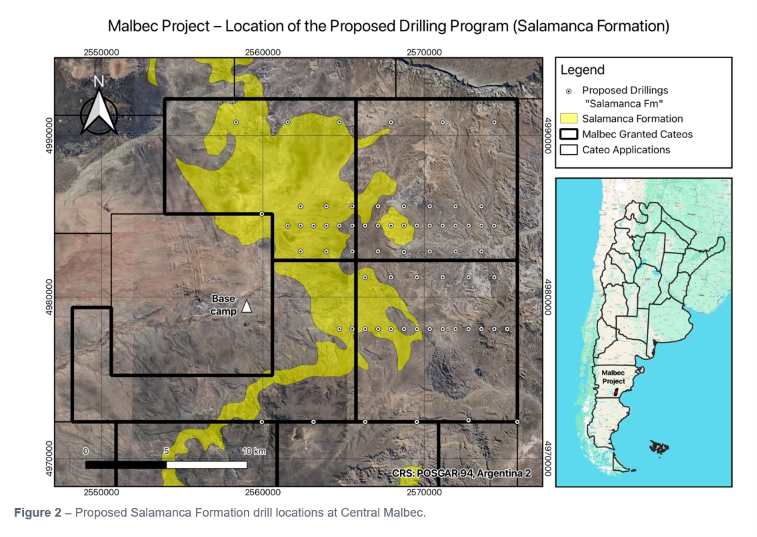
When POW listed in August the plan was 20 to 30 drill holes. The new approval allows up to 66 drill sites over two years.
If an early hole hits uranium, POW can step out and drill the next one under the same approval. We know this management team has a knack of early drilling success from previous companies, so we like the extra room.
A backhoe goes in first in early December, to cut trenches through the uranium near surface. The drill rig follows in January for the first uranium hole ever drilled at Malbec.
When we added POW to our portfolio, we told you it’d be October for the rig, but we’ll take January and more than twice the drill sites.
POW is 16c against the 20c it listed at. About $8 million of its $13.6 million value is cash.
It’s about to get busy at Malbec. Let’s dig in.
What Powerhaus Has Found at Malbec So Far
Managing director Siobhan Lancaster told us in August that you can dig a small hole at Malbec and see the uranium in your hand. “It seems to be sort of everywhere,” was her line.
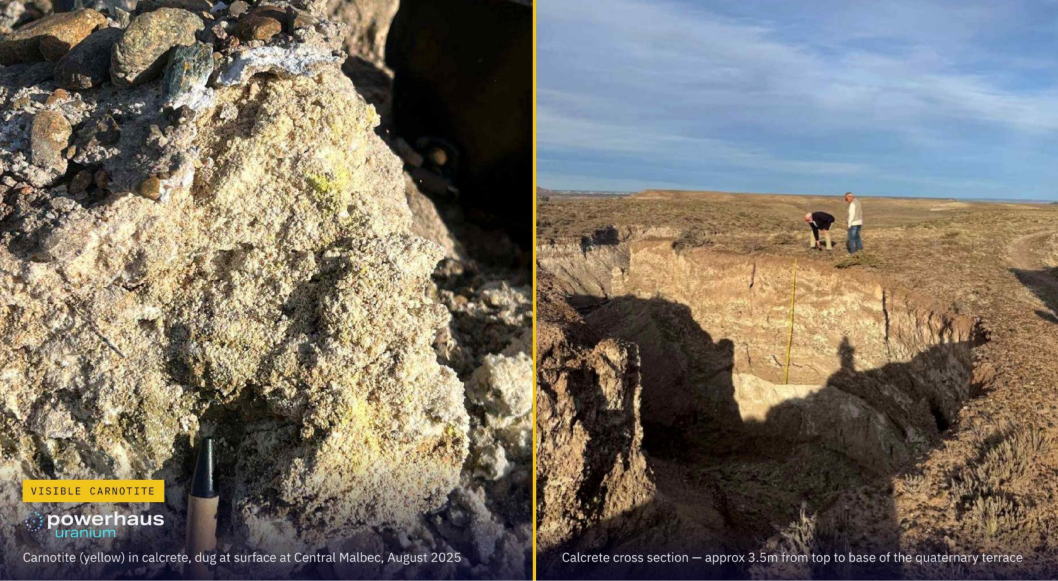
The POW crew has spent the weeks since October backing her up with shovels. They dug pits by hand on two separate terraces and saw yellow uranium mineral in the dirt at both.
The uranium sits in a hard white crust called calcrete (you’ll have seen it across WA’s Goldfields). The yellow mineral is carnotite, which POW’s geologists could pick out by eye.
For us the best line in the announcement is POW saying its surface surveys may have undersold how far the uranium runs.
A radiation detector can’t read uranium through even a thin layer of soil. The crew walked nine square kilometres of the biggest terrace with one and it stayed quiet, then they dug through a metre or less of soil and four of the five pits that reached the crust came back with elevated readings.
If the uranium runs under the soil the way the pits suggest, POW has far more of the 17 square kilometre terrace to chase than its survey map showed.
POW hasn’t touched the terrace’s southern end yet, where earlier samples ran 523 and 344 parts per million and the licence is still being granted.
The other terrace (Aguada de Piedra) is where a sample ran 771 parts per million uranium oxide before POW listed, which is a pretty good grade for this style of uranium. All seven pits the crew sampled around it read above the level POW calls elevated, and so did a pit next door on ground where the detector had read nothing.
The strongest reading was 3,200 counts a second from half a metre down, more than six times what POW calls elevated. (Counts measure radioactivity. The grade comes from the lab, and the pit samples are there now.)
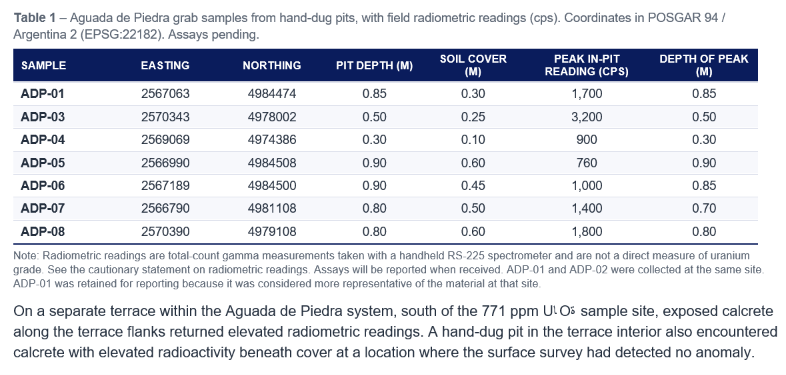
By hand the crew only saw the top of the uranium layer, and the best reading on the biggest terrace came 1.7 metres down in the deepest pit they dug.
The trenches go about three metres down to measure how thick the uranium runs and how rich it is. POW plans about 10 of them to start and wants the job done before Christmas (the approval allows 30).
If the trenches deliver, a second rig follows from the middle of next year with up to 160 shallow holes to drill the terraces out.
Explorers can’t talk about grade until the lab results are in, so we go through their announcements looking for clues.
POW pulled its trenching forward from next year to December and made a point of saying how easy the yellow mineral was to see.
It feels to us like management is hinting the shallow uranium could be much bigger and higher grade than we first thought.
When we backed POW we saw the shallow uranium as a good sign for the drilling. After these pits we think it could be a discovery on its own.
What the Drill Rig is Hunting in January
The January rig is why we backed POW. It’s hunting a Kazakh-style uranium deposit.
Kazakhstan mines about 40% of all uranium at the lowest cost in the world.
POW’s technical director Philippe Portella spent 35 years hunting uranium for the French and worked on the Kazakh deposits. When Lancaster asked him where the next giant one was hiding, he said Argentina.
Lancaster said she’d have to have a think about Argentina. She had her think and listed a company to drill it.
Her last company hit uranium on its fourth drill hole and was taken over inside three years.
In a Kazakh-style deposit, groundwater has left the uranium in a long band inside buried sandstone. The miners leave the rock where it is, pump a solution down one well to dissolve the uranium and draw it back up another.
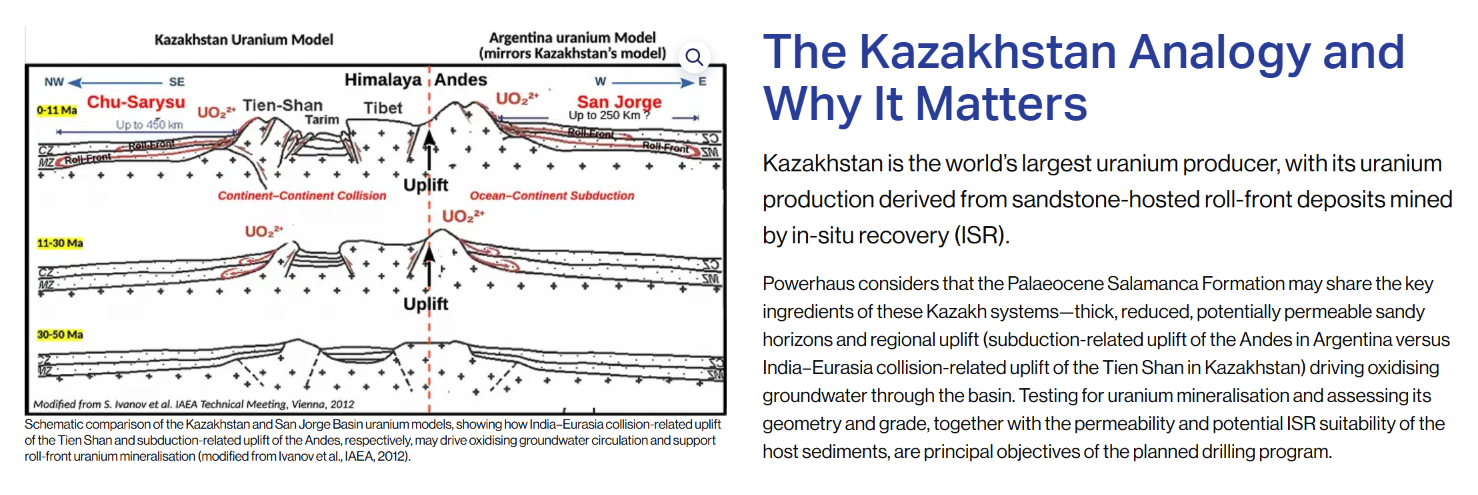
A conventional mine has to dig the rock out and truck it to a mill. Skipping all of it is what makes Kazakh uranium so cheap.
POW’s target is a layer of sandstone about 100 metres thick. Samples from where it reaches the surface carried uranium, and POW reads it as a possible sign of a bigger system underneath.
The first program is 4,000 to 5,000 metres of drilling. POW is buying the oil industry’s old survey data over Malbec to work out where the sandstone channels run before it picks its holes.
The rig still needs water and waste permits before it starts. POW has to find the uranium first, then show it can be pumped out the way Kazakhstan does it.
Why We Backed POW and the Board
Lancaster calls Powerhaus “a world-class team”. Most managing directors say the same about their own board (we’ve heard it at a lot of lunches).
So in October we went to POW’s investor lunch to see who turned up and if we’d be impressed. Nearly the whole board was in the room.
Lancaster worked on the sale of Extract Resources, which owned the Husab uranium deposit in Namibia and went for $2.2 billion. The deal got done with the Fukushima disaster unfolding in the middle of it.
Andrew Penkethman drilled out Husab. Sashi Davies ran Extract’s marketing to the power companies and traders who buy uranium.
Steve Blower, who we sat next to at lunch, sat on the discovery teams for three uranium finds in Canada, and Chairman Richard Pearce co-founded Lancaster’s last company with her and chaired it until it was taken over.
We wrote in October that they could sit on nearly any uranium board in the world. They’ve picked a $13.6 million explorer. We left the lunch more confident in POW than we walked in.
What We’re Watching as Uranium Nears US$100
Power companies were paying US$97 a pound for uranium on long-term contracts when POW listed.
Power companies are now signing at about US$99 (one dollar to go). It’s the highest price since records began in 1996.
The world will need twice as much uranium by 2040 as it uses today, and explorers spent the past 10 years barely looking for it.
Fund managers put $525 million into Paladin Energy (ASX: PDN) last week for a Canadian uranium mine due in 2031. We think they’re right to pay up for supply so far out.
POW has gone the other way so far. It listed at 20c with the long-term price at US$97. It’s 16c with the price at US$99.
We think the shares catch up once the results start landing. Three lots of results are on the way.

The pit samples are first, and the lab is due to report over the next couple of months. The results will be the first grades from the shallow uranium since POW listed.
The trenches follow before Christmas, and with thickness and grade in hand we can start sizing the shallow uranium.
The rig starts in January on the first uranium hole ever drilled at Malbec. If it hits, POW has up to 66 approved sites to chase it.
Take out the cash it had at the end of September and investors are paying about $6 million for Malbec and the team. Today they have no grade and no drill hole to value it on. Over the next three months they could get both.
We’ve waited three months for a piece of paper. We think the next three will be a lot more fun.