


Mount Ridley Mines (ASX: MRD) appointed Chris Larder as chief technology officer less than a month ago. He came with a processing method he'd spent more than 10 years building on his own, and the personal IP that goes with it.
It’s called Selectro, and it could soon change the profit line of projects well beyond MRD’s.
Selectro recovers rare earths and critical minerals at a higher percentage than can currently be done. Higher recoveries mean more metal from every tonne you process, and more metal to sell.
Larder thought it could be rolled out on MRD’s Grass Patch project in Western Australia, replacing hydrochloric acid leaching the industry has always used.
Grass Patch holds heavy rare earths, the metals inside the magnets in EVs and defence systems, alongside the light rare earths that do the volume in that same magnet trade. It also holds gallium (which China refines almost all of), and one of the largest scandium resources in the world.
This morning MRD released the first results of Larder’s process on Grass Patch.
Across all the commodities, rare earths, gallium and scandium, the Selectro method hit the traditional method for six.
Selectro more than doubled the traditional method’s recoveries, and on gallium, where the acid returned nothing, it recovered more than half the metal.
At a time when the West is spending billions trying to build rare earth processing that runs through anywhere but China, MRD could be clipping the ticket on every project that uses it.
“The Selectro Process is the culmination of over a decade of development and refinement, so it is very encouraging to see the technology deliver strong results on Mount Ridley material”
CTO Chris Larder
What is Selectro
The basic problem in mining is that the metal you want is locked inside the ore. To free it you need to soak the crushed rock in a chemical that leaches it out. For the type of deposit MRD has, everyone uses hydrochloric acid.
Selectro does the same job, but has tested better on a few fronts:
More metal out. Double the acid’s result on the same sample. Up to 83% recovery on heavy rare earths, and 77% on lights.
Cheaper. The reagent itself costs less per unit, and it’s closed loop, which is a smart way of saying the reagent gets recovered and reused each cycle.
Unlocks gallium. Acid recovered 0% of it. Selectro got 56%, for a metal that's under Chinese export controls.
Cheaper and more effective is a rare place for a new processing technology to land. Plenty of clever recovery methods die as science experiments because the circuit gets too complex to build. Larder kept his simple.
The Scoreboard: Selectro vs Acid
Recovery is the share of metal you get out of the rock and into something you can sell. The higher the recovery, the more money from every tonne you dig up and process.
It’s a hurdle plenty of projects never clear. Finding a deposit is one thing, being able to economically dig it up and process it for sale is another.
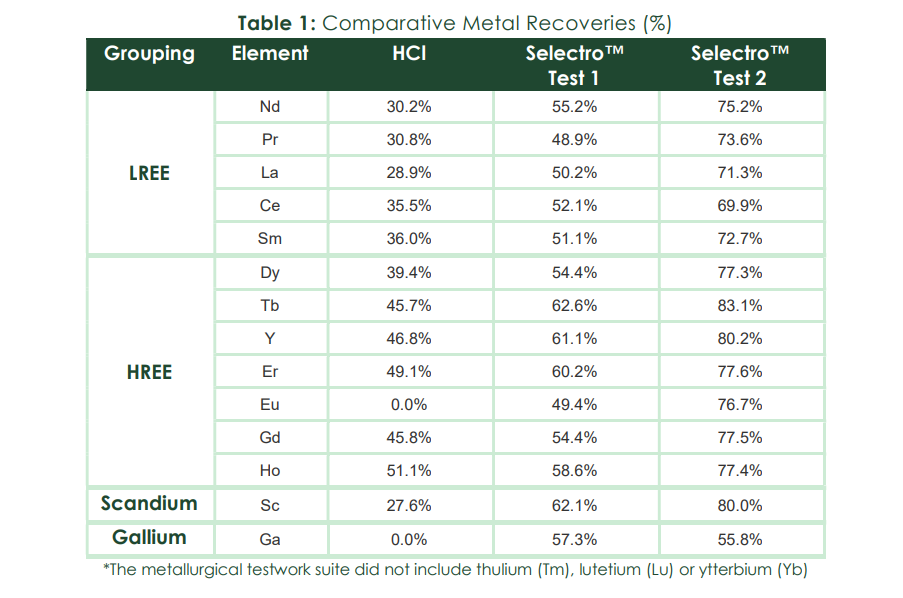
We’ve gone through what MRD’s Grass Patch contains below and compared the processing recoveries of each metal, and Larder’s decade incubating the Selectro process is delivering recoveries beyond what we expected.
The tests ran on a composite of five diamond core samples from MRD’s drilling, and the second test beat the first.
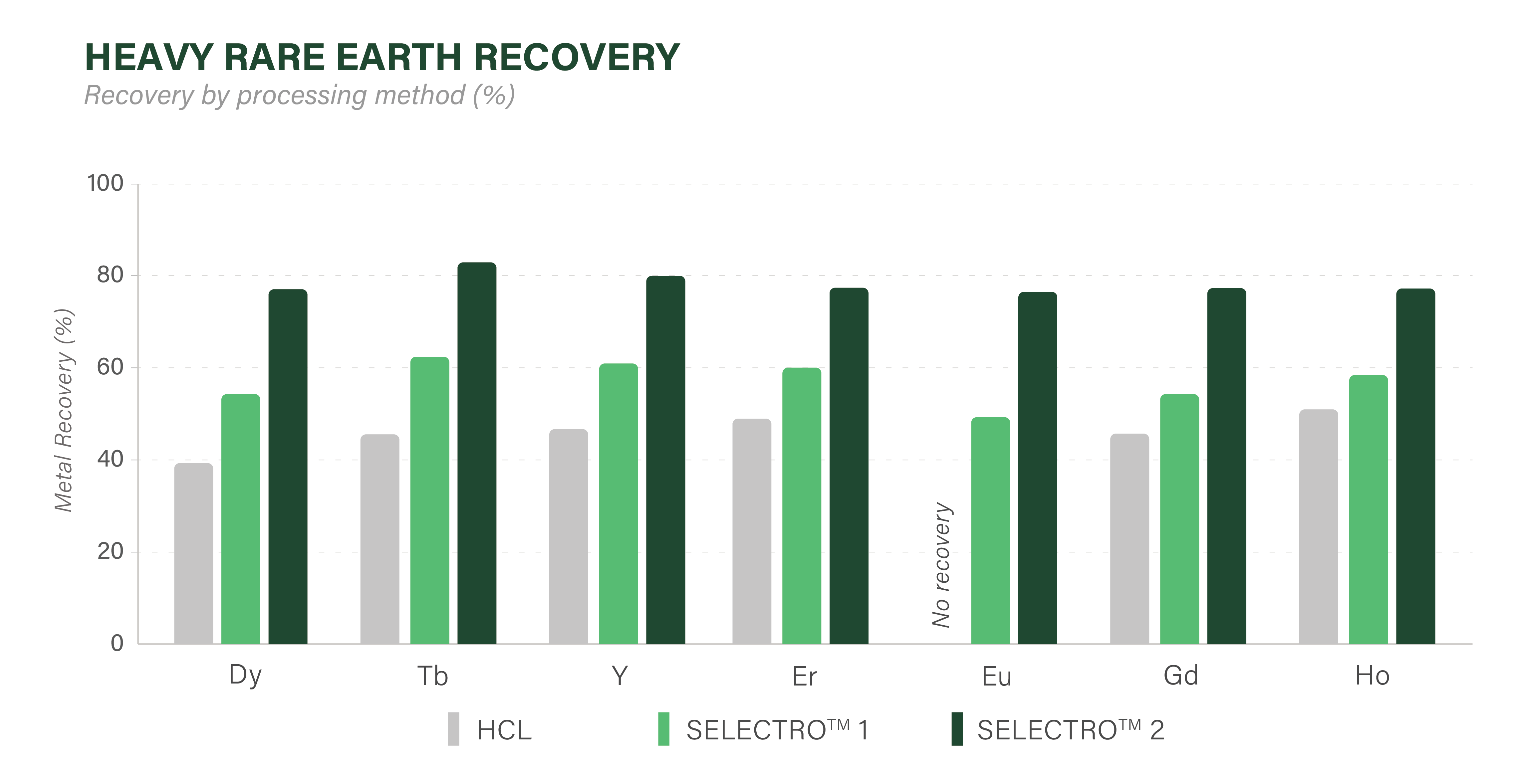
Heavy rare earths
The traditional acid leach managed between 0% and 51% on the heavy rare earths in this sample, averaging 38% on the two that count most, dysprosium and terbium.
Dysprosium and terbium, the two most valuable heavy rare earths thanks to their role in the magnets inside EVs and defence systems, averaged above 80% using Selectro.
To give some context to Selectro's 80% recovery at Grass Patch, which is above Australia's next rare earth mine, Arafura's Nolans, which has raised near $2 billion and will start construction next month.
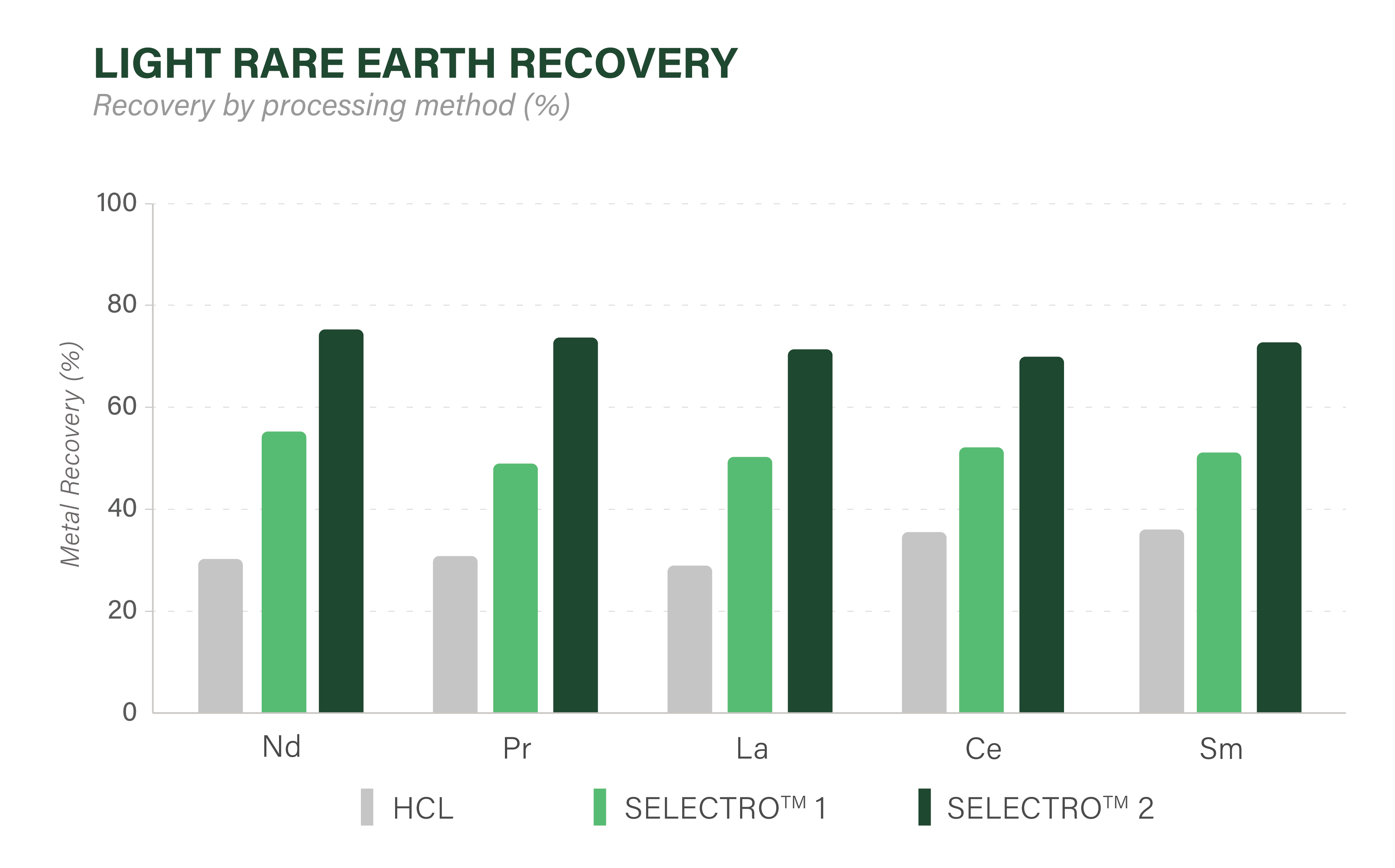
Light rare earths
Selectro pulled 70% to 77% across the full suite of light rare earths, and the acid managed 28% to 36% on the same rock.
The two light rare earths that count here are neodymium and praseodymium (NdPr). NdPr is the backbone of the permanent magnet market, they do big volume while the heavy rare earths do the lifting on price. Using Selectro, both cleared 70%.
Gallium
Gallium goes into semiconductors and defence systems. China produces nearly all of the world’s refined supply and has it under export controls.
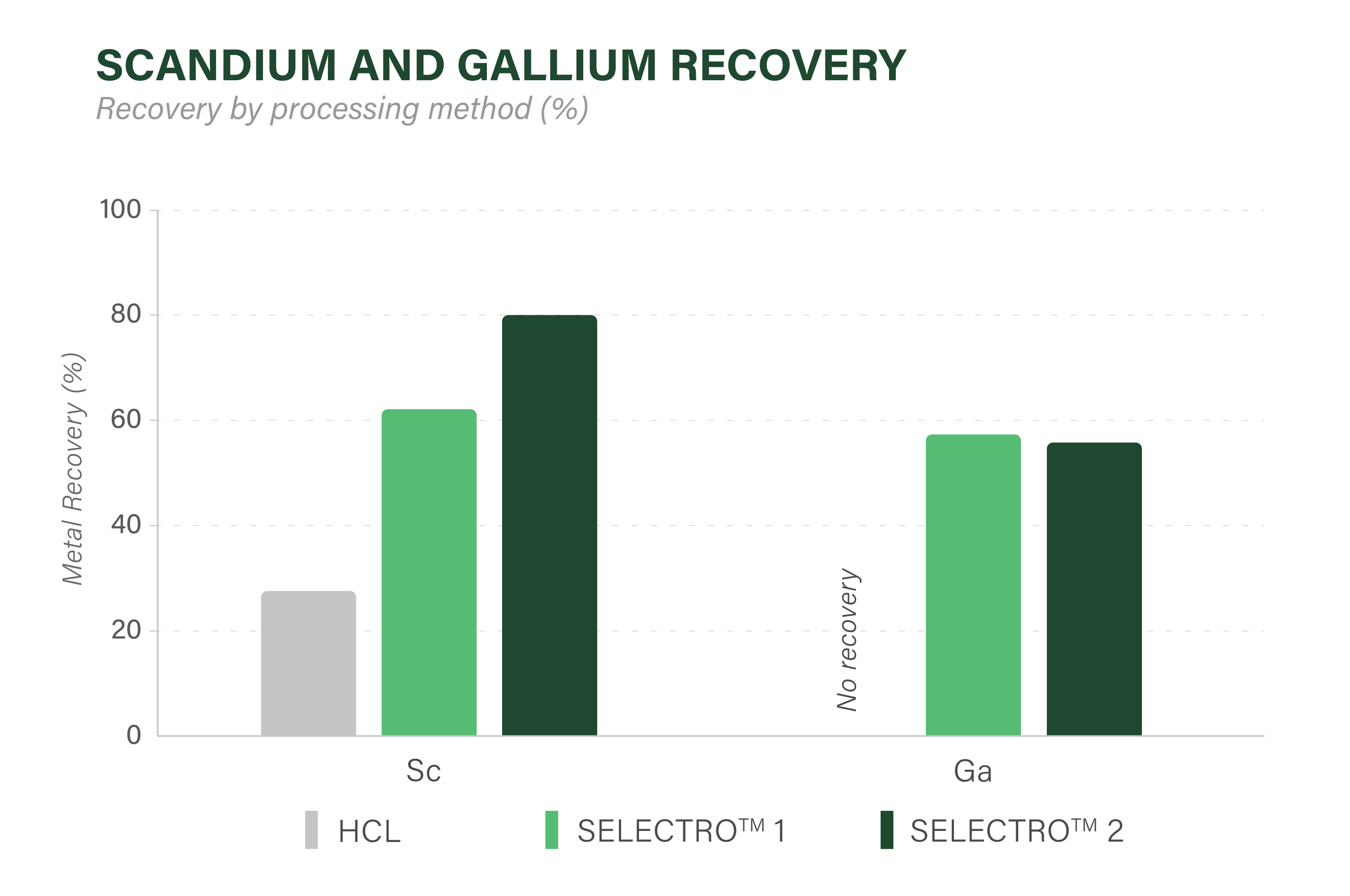
Grass Patch holds an 838.7 million tonne gallium resource. Run it through the industry’s standard acid leaching and you get zero. The acid recovers nothing.
Selectro cleared 55% in both its tests.
Caird’s been talking to people inside US defence, and he told us they have no gallium supply for military applications. The Department of War is pouring a lot of effort into fixing that.
Recovering over 50% with first-pass results that haven’t been optimised, for a metal the West has no secure supply of, makes both Selectro and Grass Patch a lot more attractive.
Scandium
A metal used in aerospace and defence to help strengthen alloys, and only produced as a by-product of other metals, returned 25% recoveries using the traditional method.
Grass Patch holds one of the largest scandium resources anywhere, 368 million tonnes at 57.3ppm. But the caveat on it has always been recovery, because a resource you can't process economically is worth nothing.
Selectro returned 80% of the scandium out of the test sample. If that holds at scale, MRD is sitting on scandium it can sell.
The Scandium Problem
Every tonne of scandium produced today comes out as a by-product of something else. No one currently produces it as a stand-alone metal.
Global production runs between 15 and 40 tonnes a year at the moment and forecasters have demand north of 100 tonnes through the decade.
It’s been such a topic of conversation that the US government is already writing cheques, lending US$400 million to a scandium operation in NSW just last week. We covered it in the most recent weekly wrap.
MRD’s processing method returning up to 80% scandium changes the unit economics for its own project. And it can license the method out while the US government is handing out hundreds of millions for the metal.
Commercialising Selectro
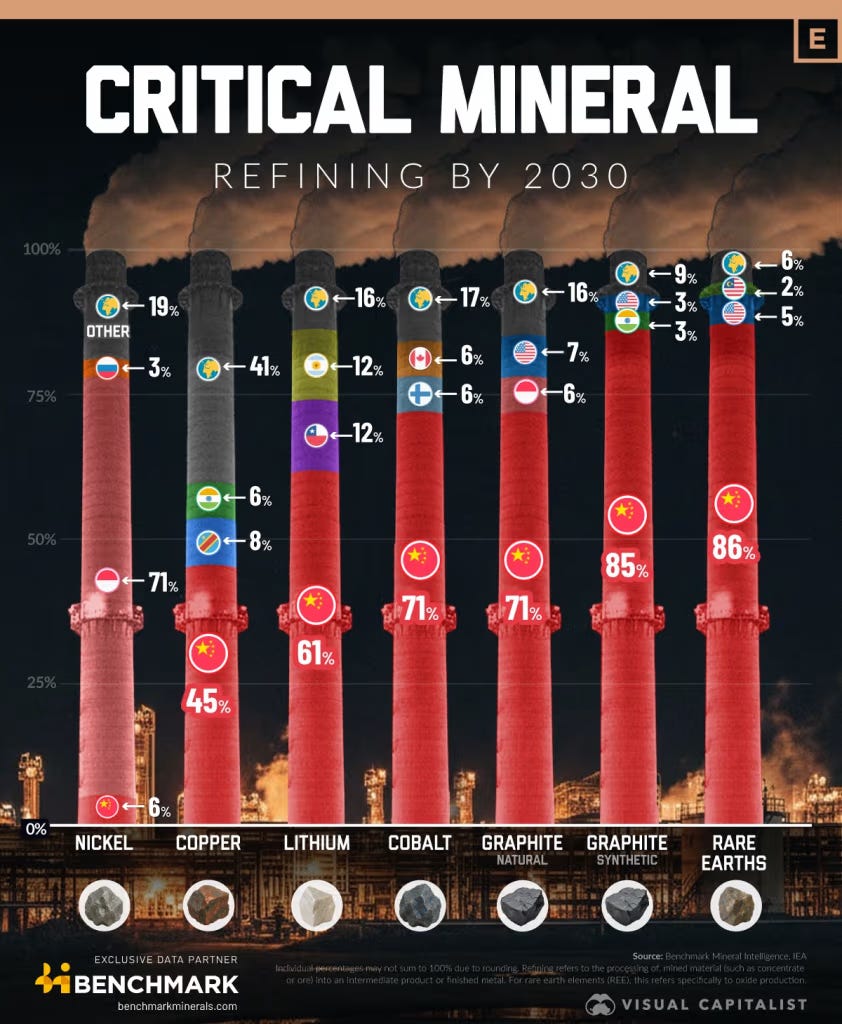
Processing is where critical minerals projects go to die. As Donald Trump put it earlier this year, rare earths are not rare, what’s rare is the processing, and China controls around 90% of the world’s capacity.
Getting the metals out of the rock at a cost that works is what Western governments are spending billions on.
MRD now owns a process aimed straight at that problem, proven on its own rock first.
Larder brought it to them in December last year, after the gallium resource announcement, wanting to test it on MRD's rock. He and Caird spent the best part of eight months talking before the IP came across through his employment deal.
Selectro is already mobilising other metals of commercial interest beyond heavy rare earths, scandium, and gallium, and MRD believes it may be suitable for a range of deposit styles well past Grass Patch.
If MRD is able to prove that Selectro works at scale, the licence for the processing method suddenly goes to the highest bidder.
With projects costing billions of dollars in capital, the ability to reduce the operational cost makes Selectro hard for the majors to ignore.
What Comes Next
Selectro has been tested on small samples so far, the next step is a bulk sample to prove the method runs at scale.
Part of it will be floated first, following the phosphate result we covered last week, so the coming tests run on concentrated feed for the first time.
“The Selectro Process results validate what we believed to be true about Grass Patch, that we have a genuinely polymetallic system where all three critical minerals can be recovered from a single leach process,”
CEO Allister Caird
The market spent the past year valuing MRD on what sits under Grass Patch.
It may very well turn out that Selectro, developed in a lab over the past 10 years by CTO Chris Larder, becomes more valuable to MRD than what it has in the ground.