


Thirteen days ago we added Evion Group (ASX: EVG) to the Equities Club portfolio as our only US-based critical minerals play.
This week the rock came back signed off.
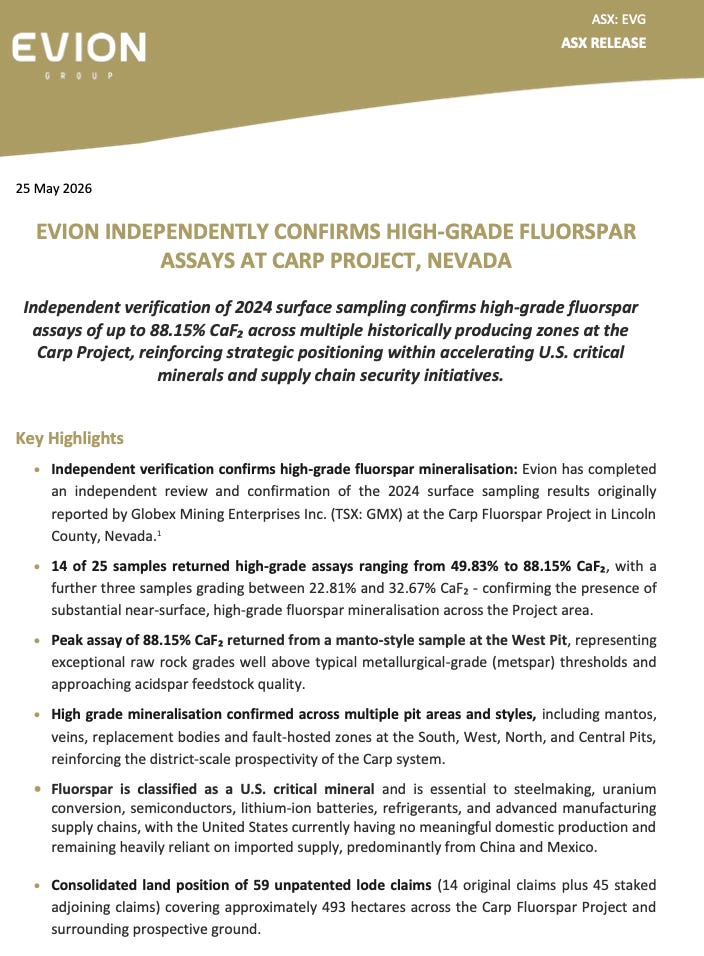
Surface samples from EVG’s Carp project in Nevada have come back grading up to 88.15% calcium fluoride. And three of the historic pits on the property cleared 80%.
The mineral they’re chasing is called fluorspar. It’s the unglamorous backbone of the lithium-ion battery, the semiconductor chip, the uranium fuel cycle and most modern refrigerants.
China produces 59% of the world’s supply. The United States produces none, and hasn’t since 1990 (which it recently realised is a big issue).
In January, the Pentagon wrote a US$169 million cheque to a single mine in Utah to restart American supply.
That’s the room EVG is now walking into with verified, ultra-high-grade rock on US soil.
Carp now puts EVG ahead of the only other ASX-listed company chasing US fluorspar - but more on that below.
At 5.5c, EVG trades on around $40 million with over $7 million in the bank. That’s enough cash to fund the next stage of work at Carp, push their Maniry graphite project in Madagascar toward a long-awaited mining permit, and keep the company’s Indian graphite joint venture filling out its order book.
Mal Randall also joined as chair last week, bringing 45 years in resources and 25 of those inside Rio Tinto, with current chair seats at Argosy Minerals (ASX: AGY) and Hastings Technology Metals (ASX: HAS). He doesn’t take chair roles at this point in his career on a whim.
Today’s verification is the first of several catalysts EVG has flagged for the months ahead.
What Fluorspar is and Why the US Wants it
Open the back of any modern phone and you’re looking at fluorine. Not in any obvious way, but in the lithium salt that lets the battery hold a charge, and in the way the chips were etched.
Open the air-con unit on the office wall. Fluorine.
Open the cooling system of a data centre. Fluorine.
The fuel rods inside a nuclear plant. We don’t recommend opening those. But fluorine again.
You get the idea.
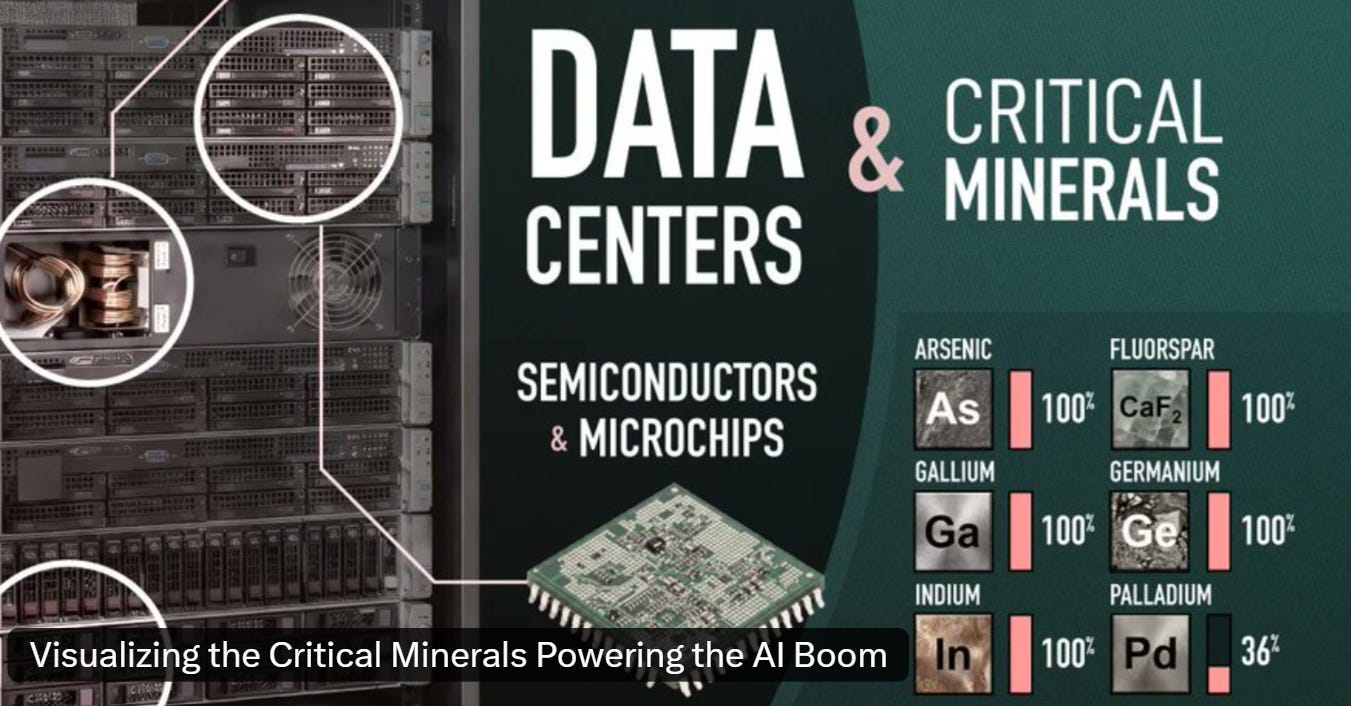
All of it traces back to one rock. Crush fluorspar, refine the high-grade material, add water, and you have hydrofluoric acid, which is the upstream feedstock for almost every fluorine chemical the modern economy depends on.
The US consumes around 380,000 tonnes of fluorspar a year to feed that demand. None of it has come out of the ground in America since the early 90s.
For most of those 35 years, it didn’t matter. The supply came cheap from somewhere else, and the somewhere else was usually China.
Given the goings-on in geopolitics these past few years, it matters a lot now.
The Cheque That Changed The Conversation
In January, the Pentagon awarded a US$168.9 million supply contract to Ares Strategic Mining for its Lost Sheep mine in Utah. The deal can scale to US$250 million over five years.
Ares is the only fully permitted fluorspar mine on US soil. The contract is Washington’s first serious move to rebuild domestic supply, and the cheque is sized appropriate to how much the Department of Defense wants fluorspar.
Lost Sheep historically produced fluorspar at grades around 60% to 70%. It’s the only US-based comparable the Pentagon has put real money behind, which makes what Carp returned this week worth measuring against it.
The Carp samples came back grading up to 88.15%, with three of the four historic pits clearing 80% on rock straight out of surface. That’s well above the grade Washington is currently paying to restart.
And EVG isn't the only ASX-listed company that's noticed the opportunity.
Carp vs The Peer Next Door
The Carp mine shut when cheap imports walked the economics of small US producers off a cliff in the early 70s. The rocks stayed in the ground. The price of fluorspar, and the politics around who supplies it, moved on.
OD6 Metals (ASX: OD6) is working the Quinn Project around 220km north of Las Vegas. EVG and OD6 trade at similar market caps and are chasing the same opportunity.
Two ASX juniors, same commodity, same country. The difference is in the detail.
OD6’s best surface work to date is a 12-metre channel sample at 68.9% from its Horseshoe prospect, with a peak grade of 79.7%. That’s commercial-grade fluorspar from real work on the ground, and it’s why the market’s paying attention.
The company also points to 1957 Union Carbide flotation testwork on a sample from its Mammoth prospect, which returned a 97.83% concentrate. OD6 has been upfront that the result is nearly 70 years old, never JORC verified, and yet to be repeated under modern conditions.
Carp’s headline 88.15% came out of the rock at surface this week, signed off by an independent geologist working to the JORC Code. The peak in OD6’s modern work is 79.7%.
Both stocks have plenty of work ahead. EVG starts with higher-grade rock on a fresher dataset, a producing-mine history on the property, a binding option over 100% of the ground at Carp, and more cash in the bank to put it to work.
What 88% Actually Means
Fluorspar gets sold in two grades:
Metspar (above 60% CaF₂) goes to steel mills as a flux.
Acidspar (above 97%) goes to chemical plants making hydrofluoric acid, which is the upstream feedstock for AI chip etching, EV batteries, nuclear fuel, refrigerants and a long list of industrial chemistry.
The higher the grade, the more the buyer pays.
Most fluorspar mines pull rock out of the ground at somewhere between 30% and 60%. They then put it through a processing plant to clean it up to the grade their customer wants. That processing step costs money, time and chemicals, and the higher the grade coming out of the ground, the less of it you have to do.
The peak grade at Carp came in at 88.15% from the West Pit, with an adjacent five-metre body at 78.29%. The North Pit and Central Pit also cleared 80%. South Pit topped out at 75.62%.
14 of 25 samples landed between 49.83% and 88.15%.
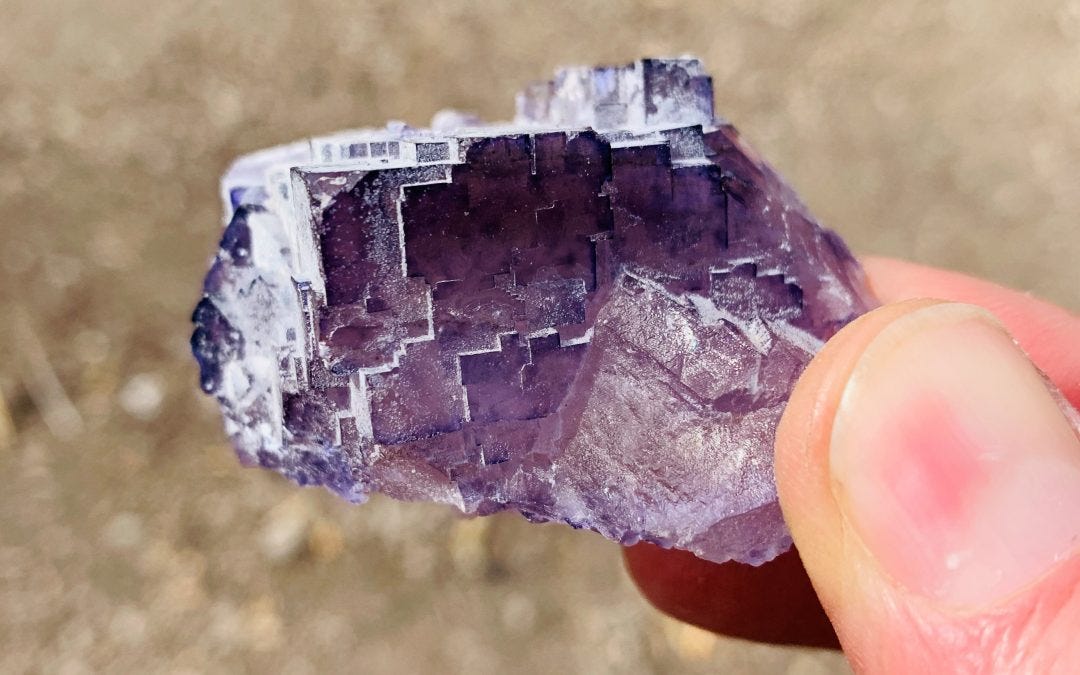
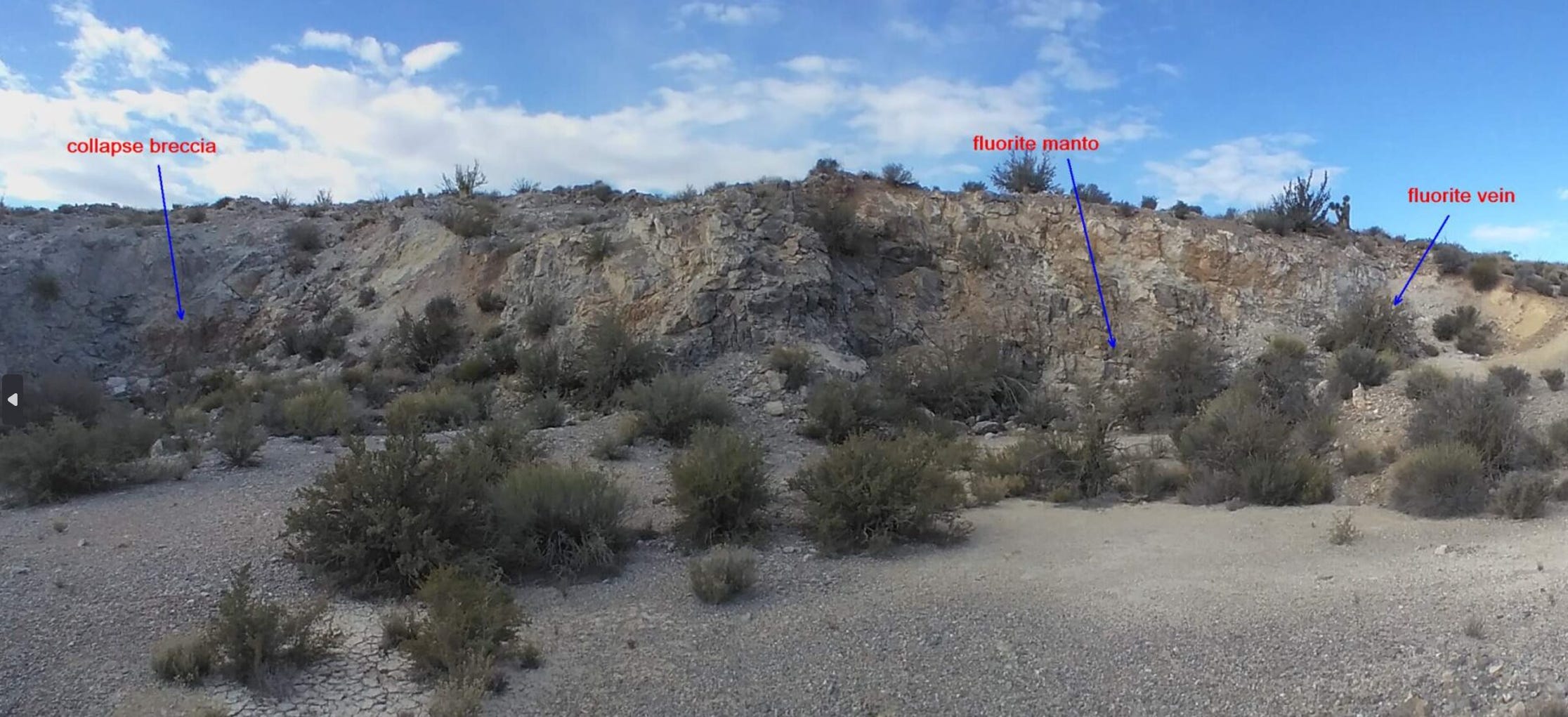
The high grades also came back from four different rock types: flat sheets of mineralisation, steep veins, replacement bodies, and rock running along old fault lines.
Four styles, spread across four pit areas. That points to a whole mineralised system across Carp.
The original mine ran on 69% rock between 1958 and 1971. The new sampling has come in well above that grade across multiple pits. The bits the old miners didn’t get to are sitting at higher grades than the bits they did.
The samples also threw up a touch of gold, and one separate rock type came back with strong grades of silver, copper, lead and zinc.
None of that is the main game at Carp. But it’s free upside sitting on top of the fluorspar.
Rock chips are selective hand-picked samples and don’t represent bulk grade. Carp still has to be drilled out, met-tested and worked up the development curve.
The Rest of EVG
There’s more to EVG than the fluorspar story.
The company started life as a graphite developer and only expanded into fluorspar earlier this year.
The Maniry graphite project in Madagascar is weeks away from its mining permit. The country’s Mines Ministry has directed the Mining Cadastre to process it.
The 2022 feasibility study put Maniry’s pre-tax net present value at US$263 million over a 21-year mine life, and a €3 million EU grant unlocks with the permit.
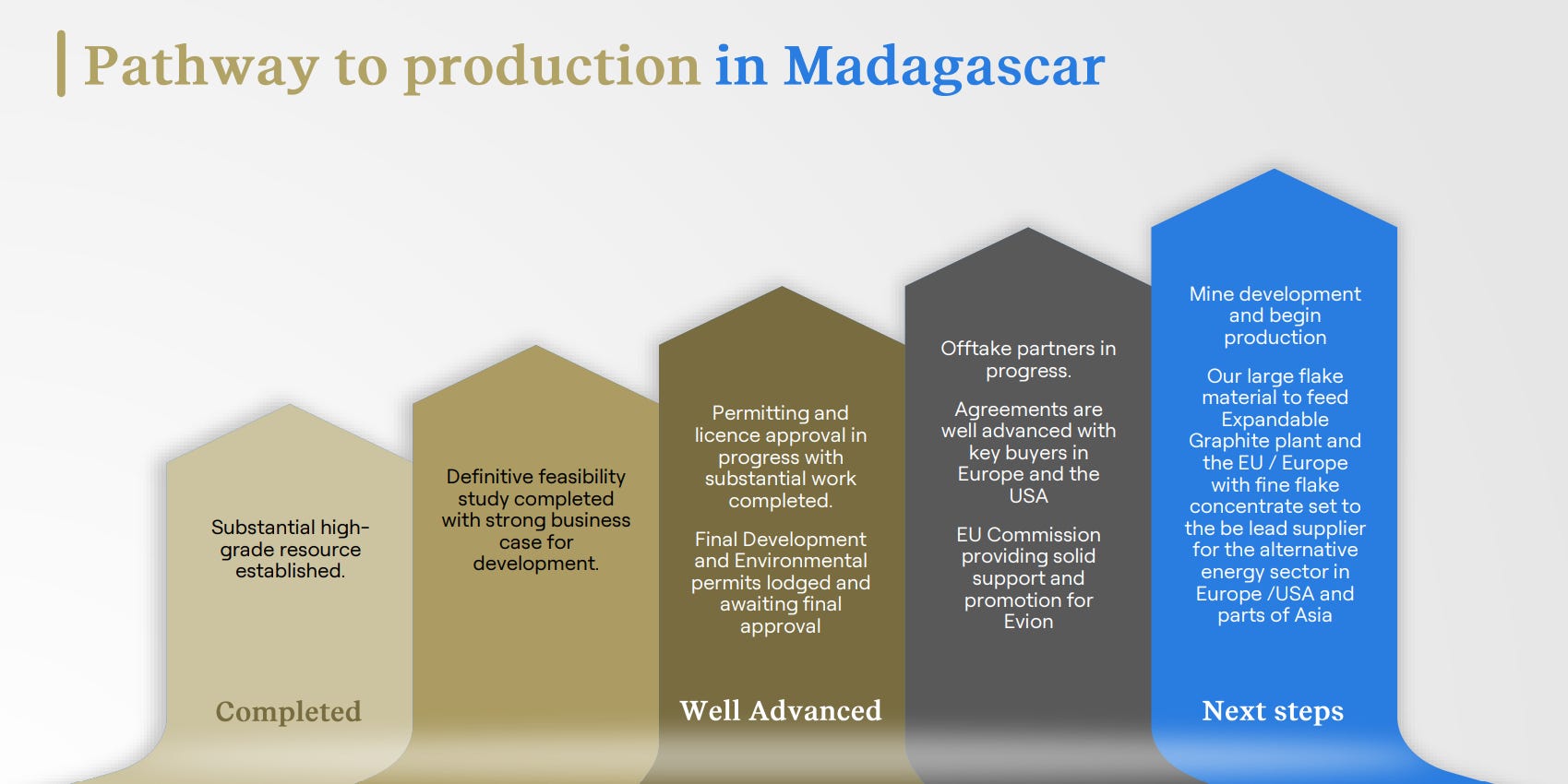
EVG also runs a 50/50 graphite joint venture in India that’s been shipping expandable graphite into international markets since March, including a A$1.5 million order to a US buyer in December.
Fluorspar in Nevada, graphite in Madagascar, processing in India, with no Chinese partners anywhere in the chain.
Half of Washington has spent the past two years trying to assemble what EVG already has.
What Happens Next at Carp
EVG has more than quadrupled the project footprint in the lead-up to this week’s results.
The original Carp ground covered 14 mining claims over 117 hectares. EVG has now staked another 45 claims alongside it, running in the same direction the high-grade rock runs underground.
The full holding now covers around 493 hectares.
The work program from here:
Systematic surface sampling across the new ground to test whether the high grades extend along strike.
Detailed geological mapping to refine drill targets.
Permitting with the US Bureau of Land Management, the federal agency that approves drilling on public land in Nevada.
First drill holes once permits land.
Two targets sit ahead of the drill rig. The depth extensions of the steeply dipping veins already returning high grades at surface. And new manto-style targets across the expanded ground, the flat-lying sheets of mineralisation that built the historic Carp mine.
EVG has flagged a detailed update on the field program shortly.
We’re at surface samples now, but drill holes are what could turn Carp from a high-grade sampling story into a project Washington and its allies can actually buy from.
That’s the moment we’re waiting for.
Where to From Here for EVG
Carp has put rock at surface that most fluorspar juniors would kill for.
At 5.5c on around $40 million with over $7 million in the bank, the work from here is execution.
Three things can move this stock. A drill rig in Nevada. A piece of paper in Madagascar. And a growing list of American buyers placing orders with a graphite plant in India, for the simple reason that they would prefer not to buy from China.
Any one of them can reprice a $40 million stock.
For a country that spent 35 years not caring where its fluorspar came from, EVG is starting to look like a useful little ASX-listed reminder.