


The world wants nuclear power.
China’s building reactors by the dozen, and the US has set itself the job of quadrupling its nuclear fleet by 2050.
Microsoft is paying to switch Three Mile Island back on so its data centres never lose power, and Amazon, Meta and Google have all signed reactor deals of their own.
And all of it comes back to one fuel the world suddenly wants a lot more of than it’s digging out of the ground.
Uranium.
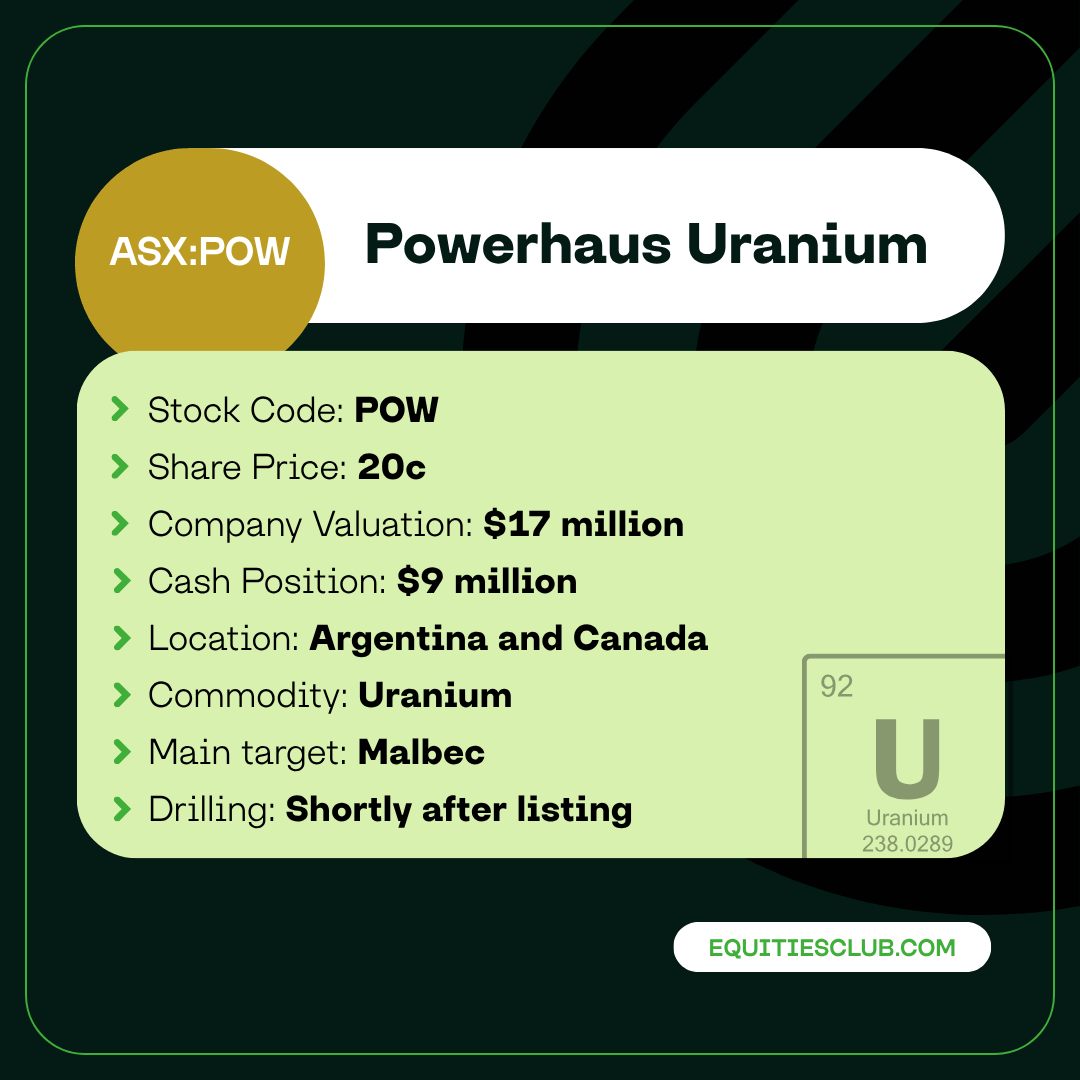
Meet our latest portfolio addition: Powerhaus Uranium (ASX: POW). It starts trading at 10am AWST today.
POW has ground in Argentina and Canada, with Argentina the main prize.
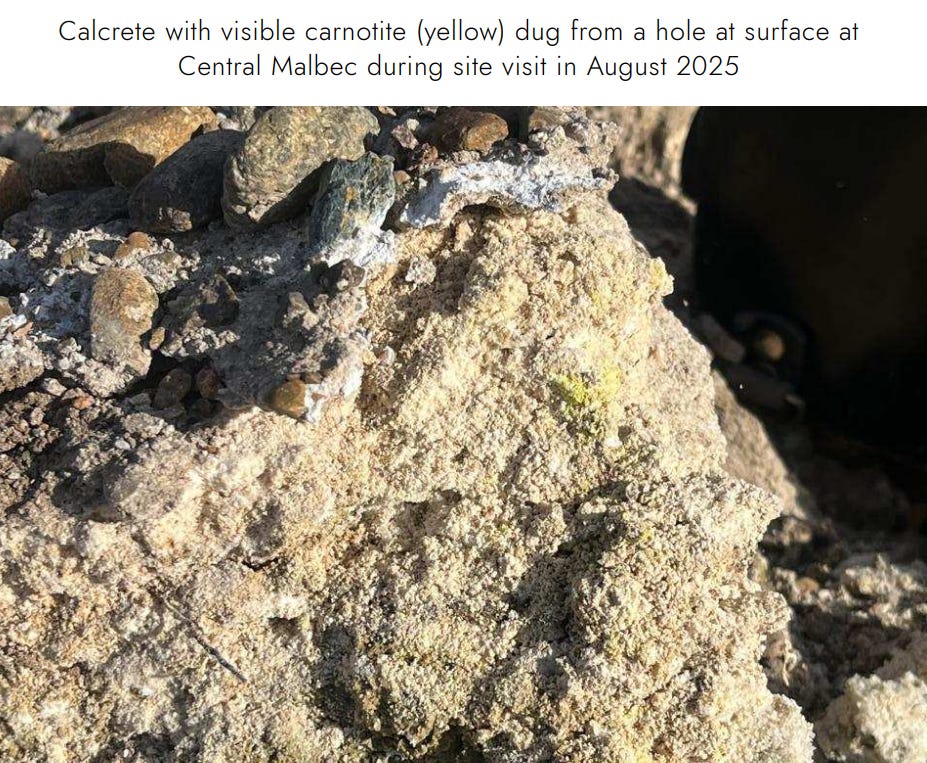
Managing Director Siobhan Lancaster told us you can dig a small hole there, reach in, and pull out uranium that's yellow against the dirt.
Lancaster was part of the Extract Resources team that found the Husab deposit in Namibia and sold the company for $2.2 billion, then ran 92 Energy, which made a uranium discovery in Canada on its fourth drill hole and was taken over inside three years of listing.
Now she’s holding yellow rock at a project that gets its first drill hole within weeks.
Alongside her sits a deep bench of all-stars who have been on discovery teams for some of the standout uranium finds of the past decade. They've found it (and sold it) before and now get to start again from the ground floor.
Listing today at 20 cents, POW has a market cap of $17 million, with $9 million raised in the IPO and most of it headed straight into the ground. Strip out the cash and the market is valuing the whole company at single-digit millions.
While Australia's government will need to be dragged kicking and screaming into accepting nuclear is the fuel of the future, the rest of the world has already made up its mind.
So have we.
Uranium is at its highest price since 2008 and POW has picked up ground where it sits at surface. It’s hard to top that.
Let’s dig in.
The Reactors are Getting Built This Time
Germany spent 20 years phasing nuclear out and switched off its last three reactors in 2023. Within a year it was buying French nuclear power across the border to keep the lights on.
China waved through eight new reactors worth about US$25 billion at the end of July.
Donald Trump signed executive orders last year targeting a quadrupling of nuclear capacity to 400 gigawatts by 2050, with US$80 billion behind 10 new reactors and more money to rebuild domestic enrichment.
Reports of nuclear’s death, it turns out, were greatly exaggerated.
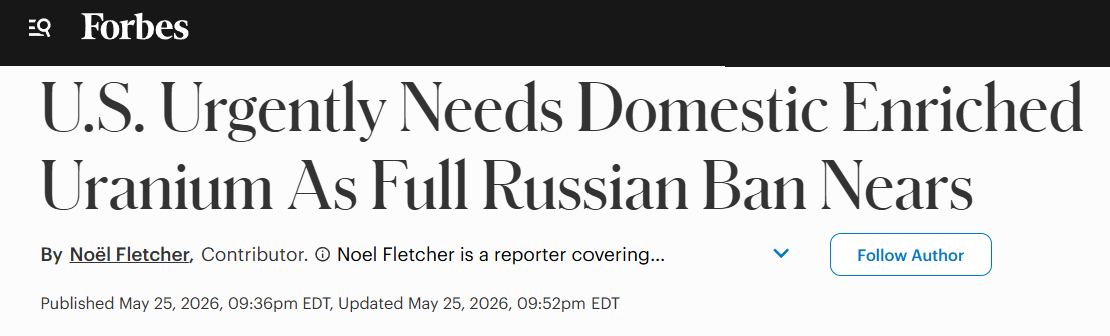
And from 2028, Russian uranium is banned from the US, pulling a slab of supply out of the Western market.
Over in Europe, France is pouring concrete on six of its reactors, with an option on eight more. Britain is about to sign off the money on its next plant, Poland's building its first reactors, and the EU has lifted its long-term nuclear target for the first time in years.
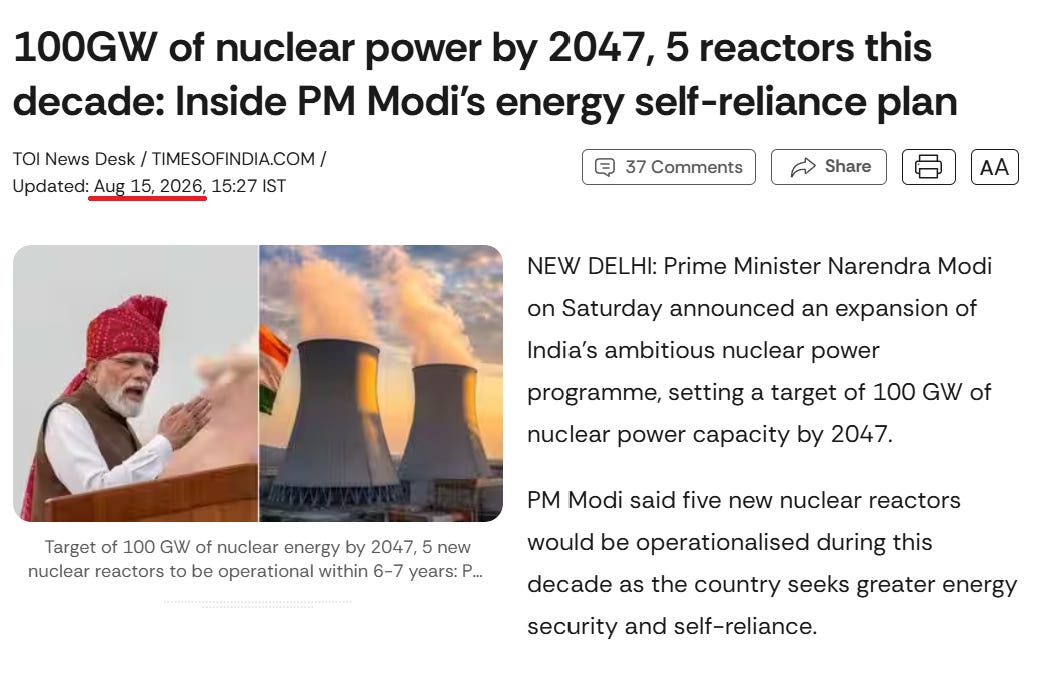
India runs less than 9 gigawatts of nuclear today and has set itself a target of 100 by 2047.
That means building close to 100 reactors' worth of capacity in two decades. It even passed a law opening the sector to private money for the first time and ending the government's monopoly on building reactors.
A reactor runs for decades once it's switched on, and it needs fresh uranium every year of its life. The utilities behind this list will be signing fuel contracts long before the concrete is set.
Big Tech Starts Buying Reactors
In 1979 a reactor at Three Mile Island in Pennsylvania partially melted down. It’s still the worst nuclear accident in American history, and for a long time was used as the counter-argument to the benefits of nuclear.
Microsoft just signed a deal to restart it, and is contracted to buy everything it produces for the next 20 years. First power is expected next year.

The technology has moved a long way in 50 years. Nuclear now sits alongside wind and solar as one of the safest ways to generate power (measured by the grim-sounding stat of deaths per unit of electricity produced).
That’s part of why AI companies are comfortable going all-in. The other part is that a data centre runs flat out 24 hours a day, and tech bros like Google’s head of energy have admitted a carbon-free grid will take “more than just wind, solar, and lithium-ion storage”.
To underline the nuclear stampede, consider what’s happened in just the past two years:
Amazon locked in 1.9 gigawatts of reactor output in Pennsylvania through to 2042, and tipped US$700 million into a developer of small modular reactors
Meta signed 20 years of output from a reactor in Illinois, with commitments of up to 6.6 gigawatts across four suppliers
Google ordered seven small reactors of its own, with the first due to switch on by 2030
OpenAI signed a 20-year lease last Monday on an Ohio data centre that will scale to 8 gigawatts, the largest AI facility planned anywhere in the world.
All up, Microsoft, Amazon, Meta and Google have signed 13 nuclear deals for close to 10 gigawatts of power, all of it since 2024.
Every one of those reactors needs a whole lot of uranium.
Why the Price Keeps Climbing
When Siobhan Lancaster listed 92 Energy five years ago, uranium was selling for roughly US$32 a pound.
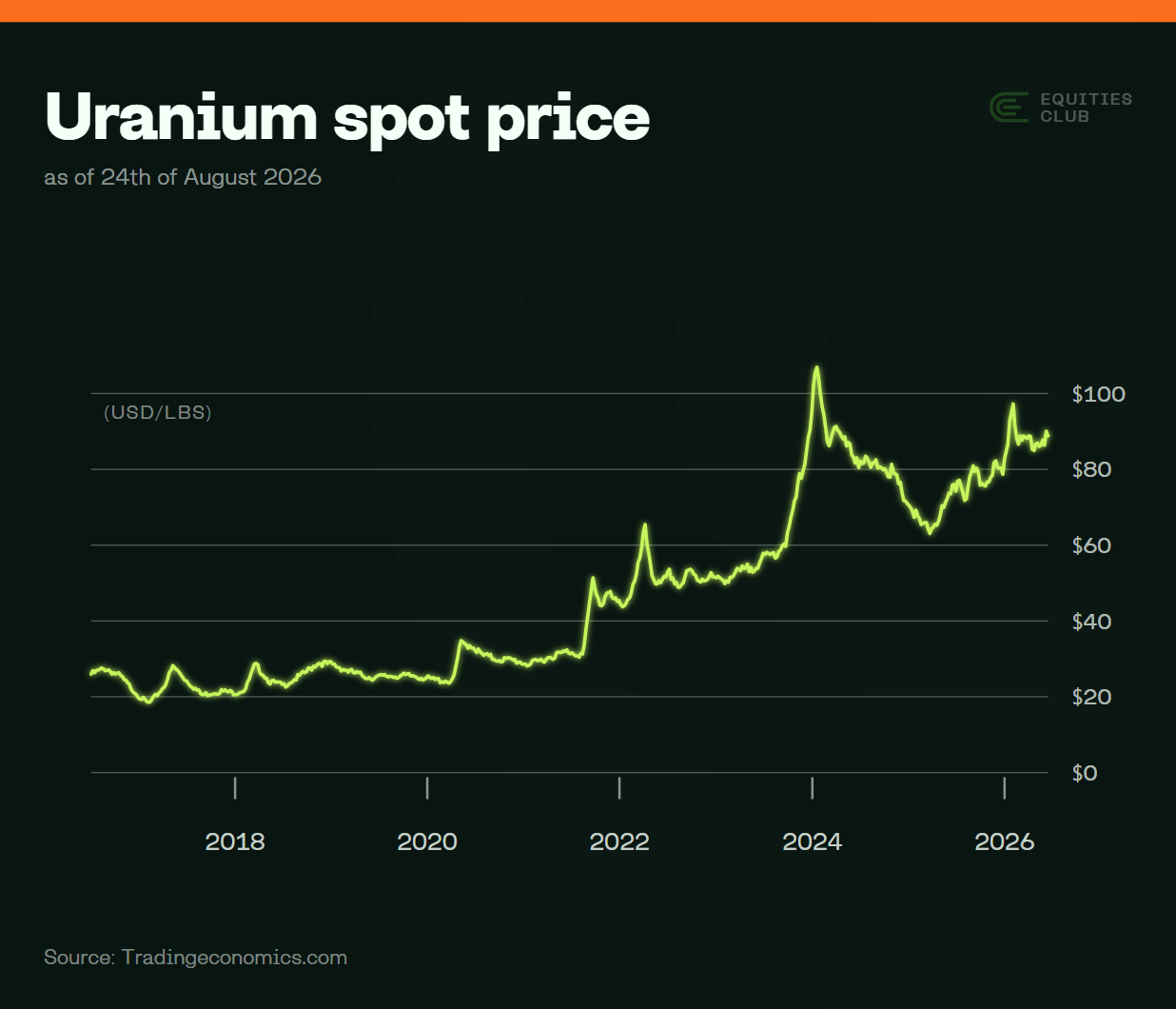
Today the term price sits at US$97, its highest since 2008, and she puts the difference down to a decade where the industry barely explored and barely discovered.
So while the reactors have kept multiplying, the mines have stayed still.
Uranium gets bought differently to oil or gold so those numbers need a quick explanation. Power utilities sign their fuel deals years in advance, locking in five to 10 years of supply at a time at the term price. The spot price covers one-off parcels, and it’s sitting lower, near US$88.
The term price is the one that counts, because that’s where the reactors buy their fuel.
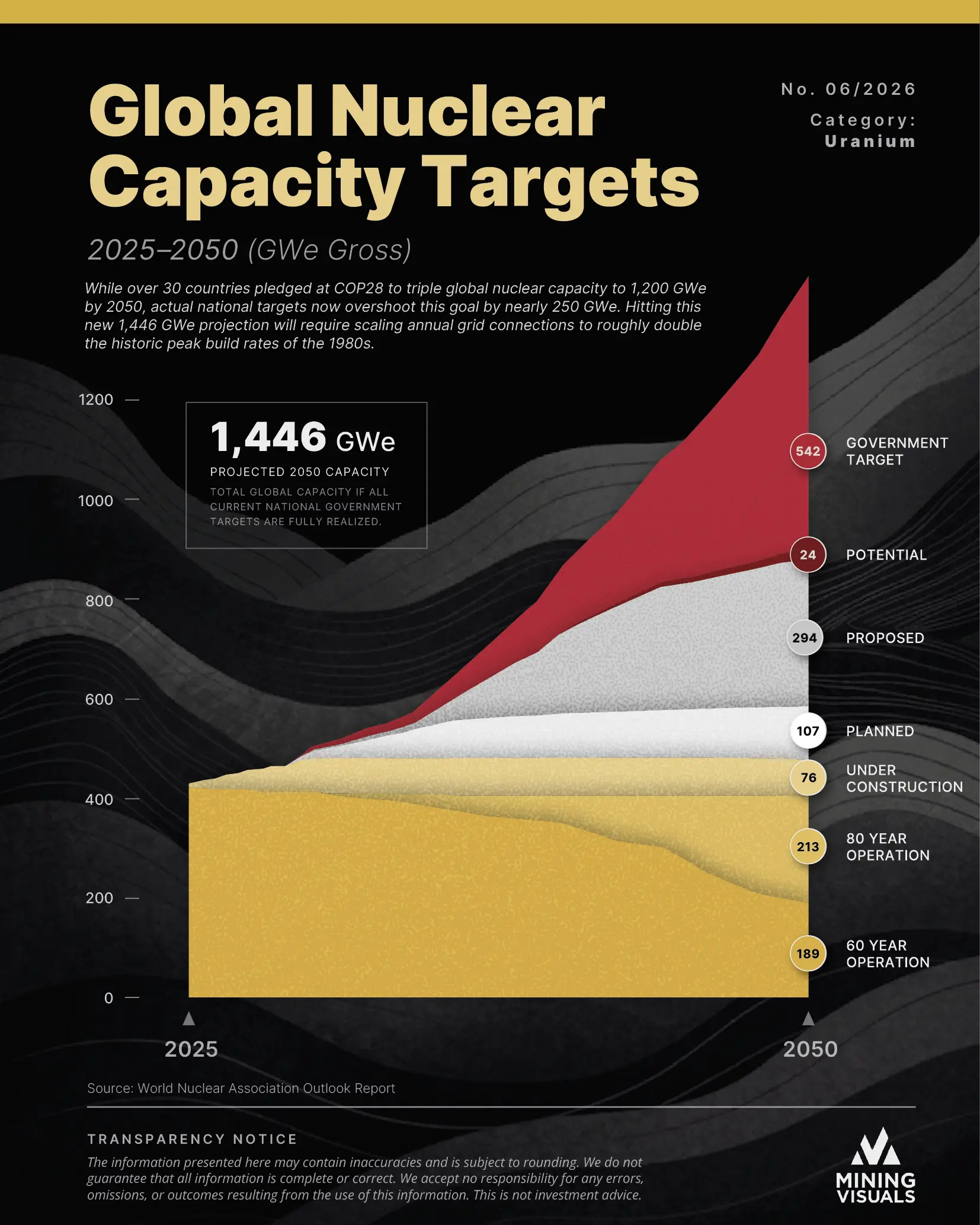
The World Nuclear Association has uranium demand hitting around 390 million pounds a year by 2040 as its base case, and 520 million if things run hot. Mines dug up roughly 132 million pounds in 2024.
The world will need three to four times the current uranium supply in just over a decade, and mines can take 10 years or more to permit and build, so the gap can't close quickly no matter what the price does.
It's about the most lopsided supply and demand setup we can find on the ASX, and it's why we went looking for a uranium company to back.
During the cheap years the utilities got slack and stopped locking in supply, and by 2025 they'd only secured 48% of their future needs, down from 56% the year before. Now they're all scrambling back at once, into a market that can't fill them fast.
The banks that trade uranium for a living have put out their forecasts. We don't make price calls at Equities Club, so here's what the pros are saying:
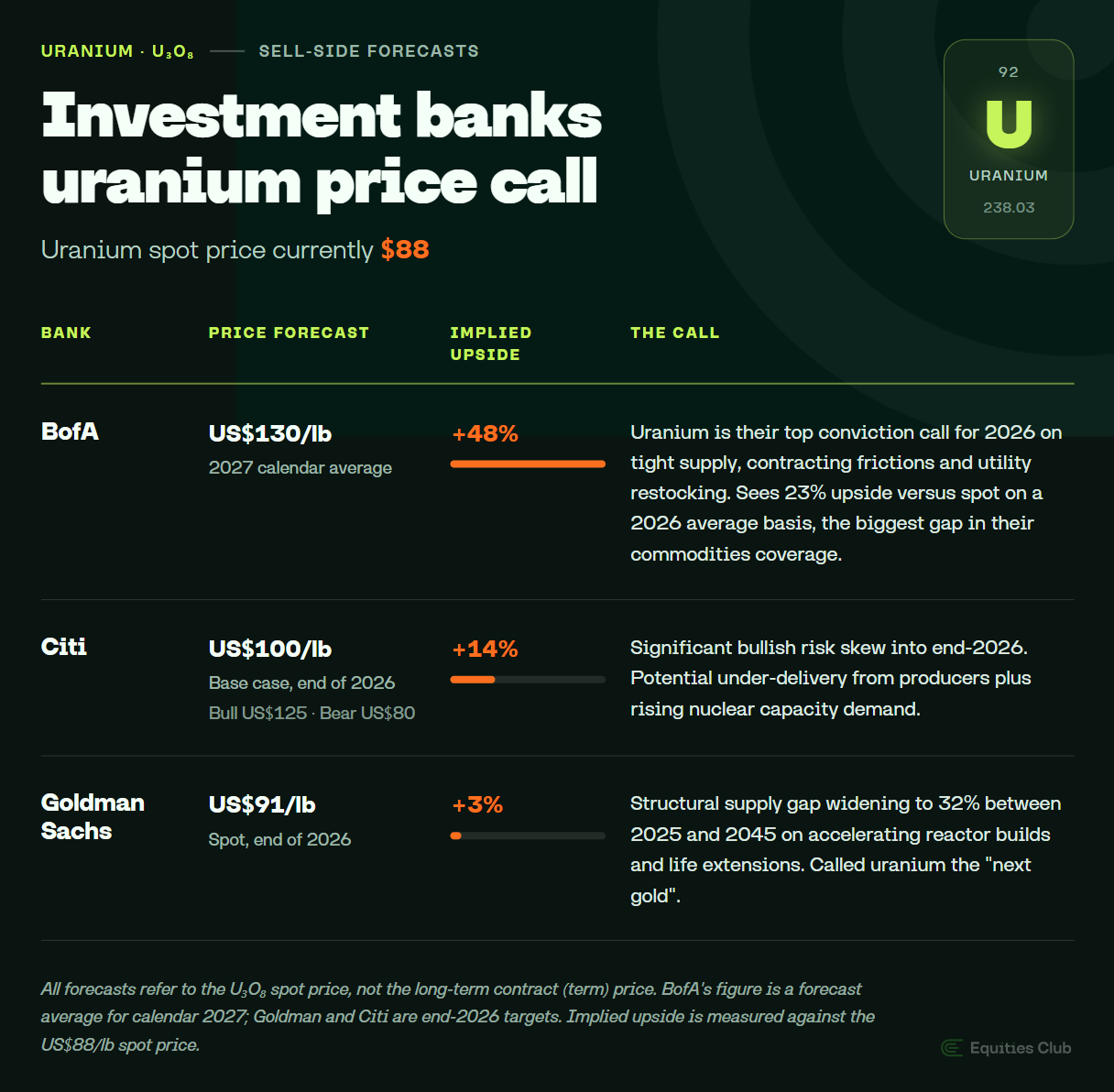
Macquarie, Morgan Stanley, RBC and Canaccord are bullish too, though they mostly show it by backing uranium producers like Cameco instead of publishing a price forecast.
Two Countries Feed the World’s Reactors
The world’s supply of uranium is controlled by only a few.
Kazakhstan digs up close to 40% of the world’s supply (and it barely digs at all). The method they use is called in-situ recovery. They drill wells into porous sandstone, pump a mild solution down, let it dissolve the uranium out of the sand, and pump the loaded liquid back to surface.
Barely any rock gets moved, which is why it’s the cheapest way to produce uranium anywhere in the world. Kazakhstan’s state producer mined it for US$18 a pound last year.
It's also the method POW is chasing in Argentina, in the same style of sandstone (more on that later).
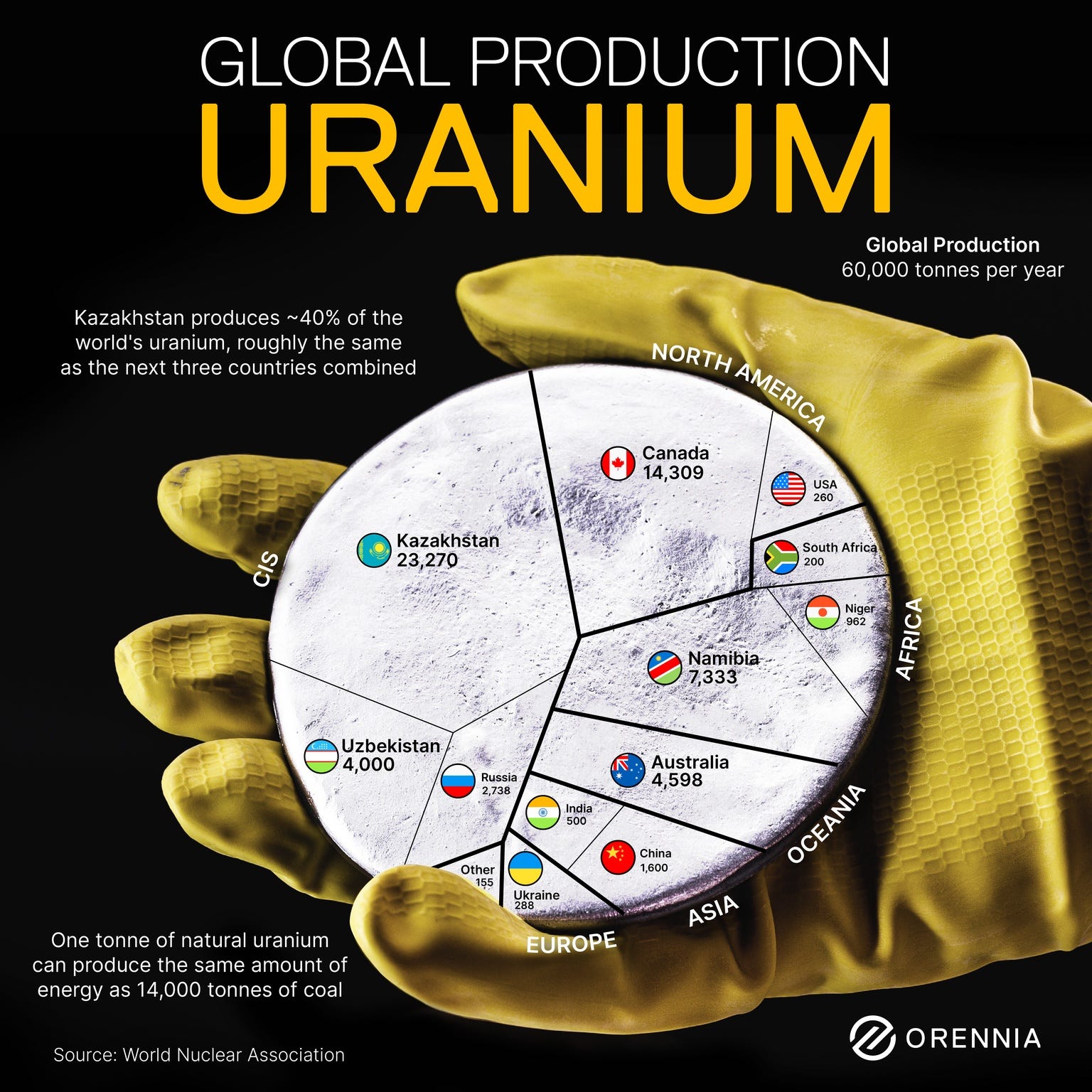
Canada’s Athabasca Basin supplies the high-grade end, home to Cameco’s McArthur River and Cigar Lake, the richest uranium mines going. Namibia holds Husab and Rössing, the two big open pits in the desert.
Past that short list, the world has leaned on stockpiles built up over the years that are running down.
With supply that concentrated, one bad week can spook the whole market, which we saw in July.
Cameco shut mining at Cigar Lake, the highest-grade uranium mine on earth, for two weeks after the mill it feeds ran out of sulphuric acid. The shortage traced all the way back to the closure of the Strait of Hormuz, which is where a huge chunk of the world's sulphur ships through.

We covered Hormuz when it shut (like everyone else with a publish button), and we’ll admit uranium wasn’t on our list of casualties.
The acid problem reached Kazakhstan too where Kazatomprom is the world's biggest uranium producer and runs its wells on sulphuric acid. Its cost of production jumped 37% in six months mostly due to the acid shortage, and the plant it's building to make its own acid won't be ready until late 2027 at the earliest. So it's keeping production flat until then, even with uranium at an 18-year high.
The biggest producers on earth can't lift supply. That leaves the door wide open for whoever finds the next deposit.
Argentina Just Changed the Rules
Siobhan Lancaster sat down with Philippe Portella, a geologist who’d spent 35 years hunting uranium for French nuclear group Areva, and asked him where the next giant uranium deposit was hiding.
Argentina, he said. A massive Kazakh-style roll front system that nobody had gone after.
Lancaster told us her honest reaction was “Argentina, that’s a bit interesting, I’ll have to have a think about that.”
Fair enough too. Argentina used to be radioactive to investors. Pun intended.
The country has defaulted on its debt three times this century. In 2002 the government cut the peso loose from the US dollar and froze bank accounts, and inflation skyrocketed. Building a mine there was a bet on the government as much as the ground.
But president Javier Milei has spent two years decontaminating the place, and the centrepiece is a law called RIGI. It hands large projects up to 30 years of locked-in tax and regulatory stability.
It’s a written promise that the rules won’t move under your feet, and so far it’s worked.
BHP and Lundin signed up their US$9.7 billion Vicuña copper project last month, and Rio Tinto has signed up its Rincon lithium project. All up, 16 projects worth close to US$30 billion have been approved so far, with another 25 waiting.
In December the Economy Ministry said that it wants to turn Argentina into the "Saudi Arabia of uranium".

Governments announce things all the time, but this one created a new department the same week to run its nuclear push.
Argentina has mined uranium before, from seven small historic operations, and it runs three nuclear reactors today. The ministry puts the country's known uranium at around 36,000 tonnes, and the modern exploration tools this team used to find Husab in Namibia and Gemini in Canada have never been run over any of it.
Chubut Province, where POW's Argentine projects sit, has banned open-pit mining and cyanide since 2003. In-situ recovery uses neither, which is why Powerhaus bought ISR-style ground there.
The Five Reasons We’re Backing Powerhaus
1. A Board That Has Done This Twice Before
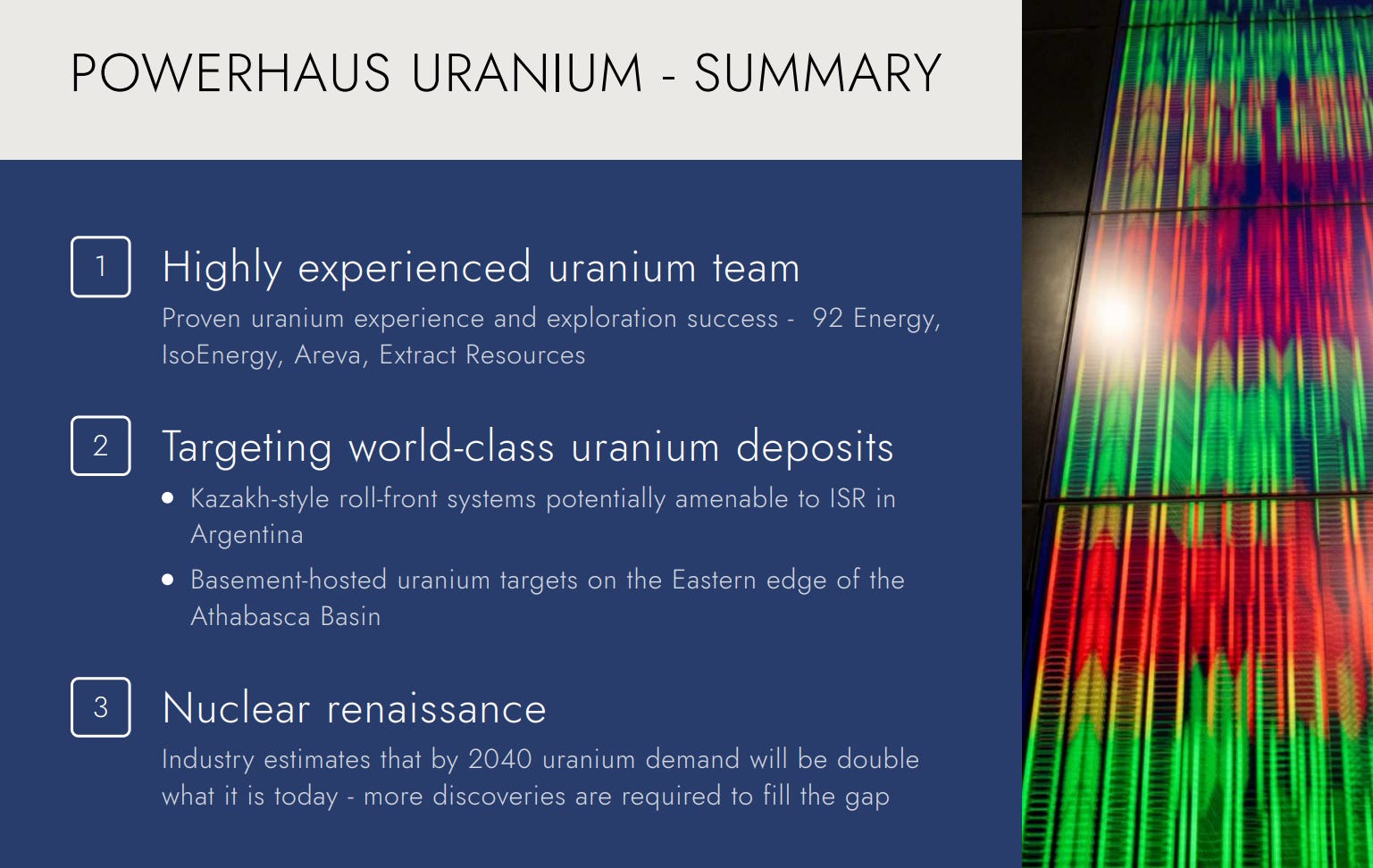
Powerhaus is the 92 Energy team and the Extract Resources team joining up for another crack, and Lancaster’s CV is the spine of it.
At Extract she worked on the $2.2 billion sale of Husab, a deal that got over the line with Fukushima unfolding in the middle of it. If you can sell a uranium company for billions while the industry’s worst accident since Chernobyl is worldwide news, you can sell one in this market.
She then founded 92 Energy with Richard Pearce, now Powerhaus’ chair. She ran it, he chaired it, they were drilling within two months of listing, made a discovery on the fourth hole, and the company was taken over inside three years.
Portella is technical director, and his career took in the Kazakh roll fronts and Argentine uranium. He’s personally worked the very deposit type Powerhaus is drilling for.
Steve Blower sat on the discovery teams for three separate Athabasca uranium finds, IsoEnergy’s Hurricane, Denison’s Gryphon and 92 Energy’s Gemini.
Andrew Penkethman ran the feasibility study at Husab and drilled out the resource, and now leads Ardea Resources.
Sashi Davies was Extract’s head of marketing and knows the utilities and traders who buy uranium, having worked with the likes of Boss Energy.
This group has taken uranium companies from first drill hole to takeover twice. Now they’re starting a third time, from 20 cents.
2. A Very Big Target, at a Very Small Price
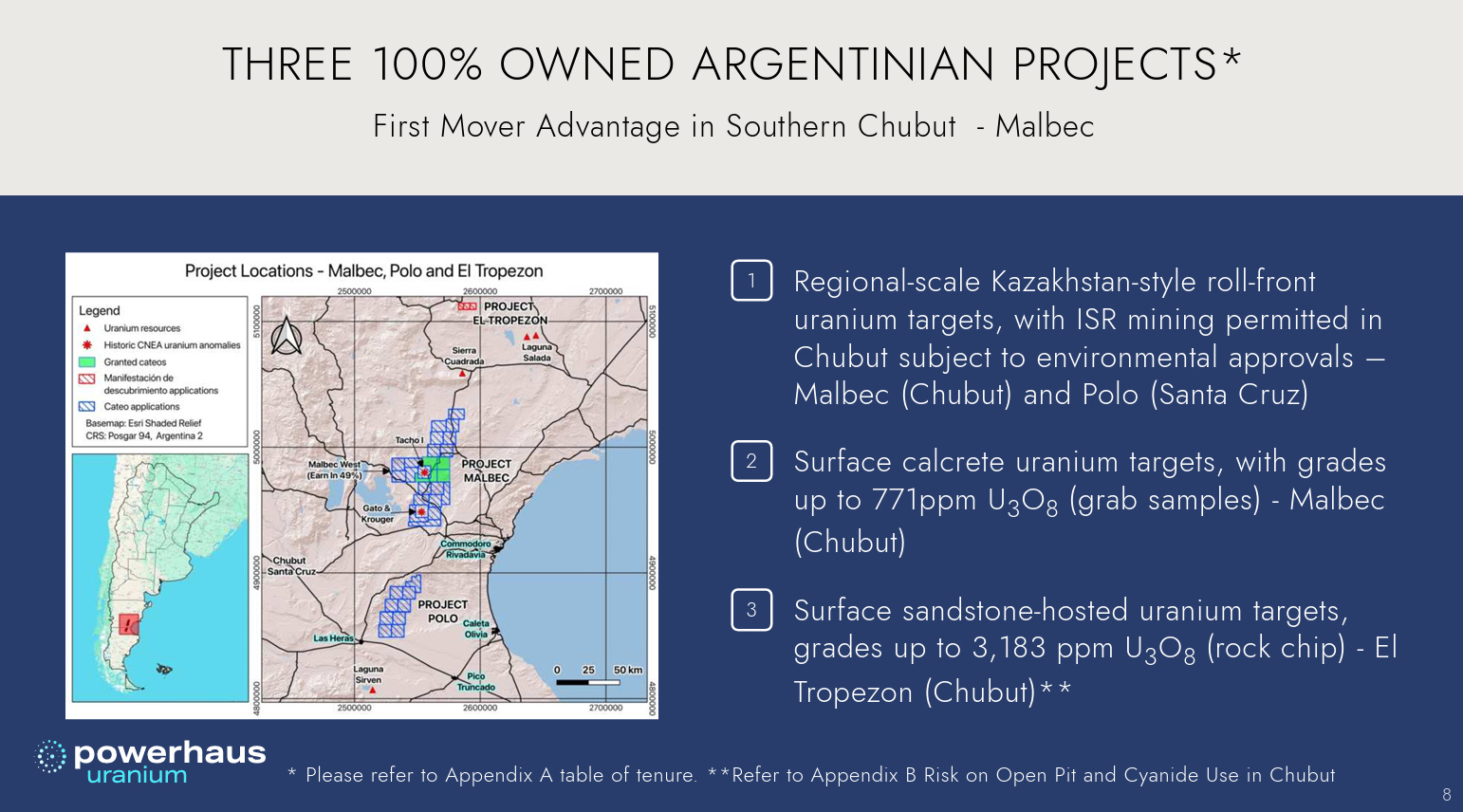
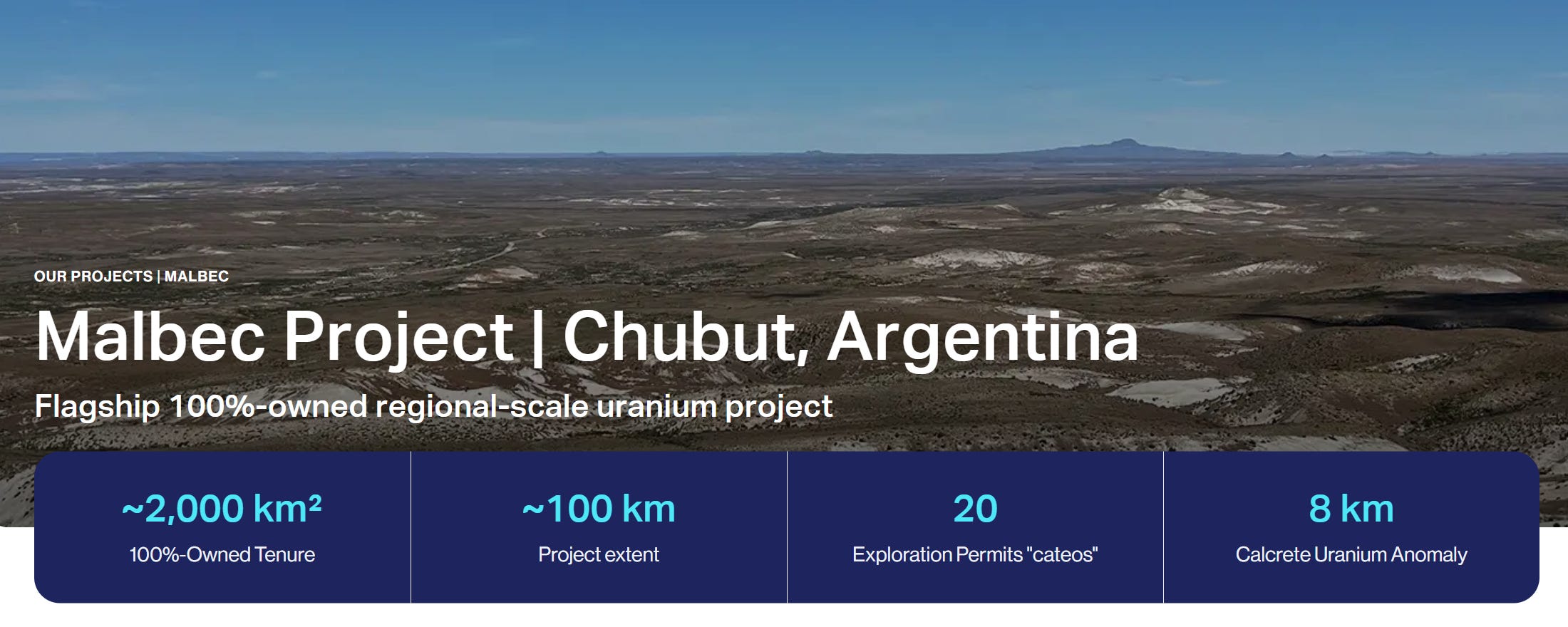
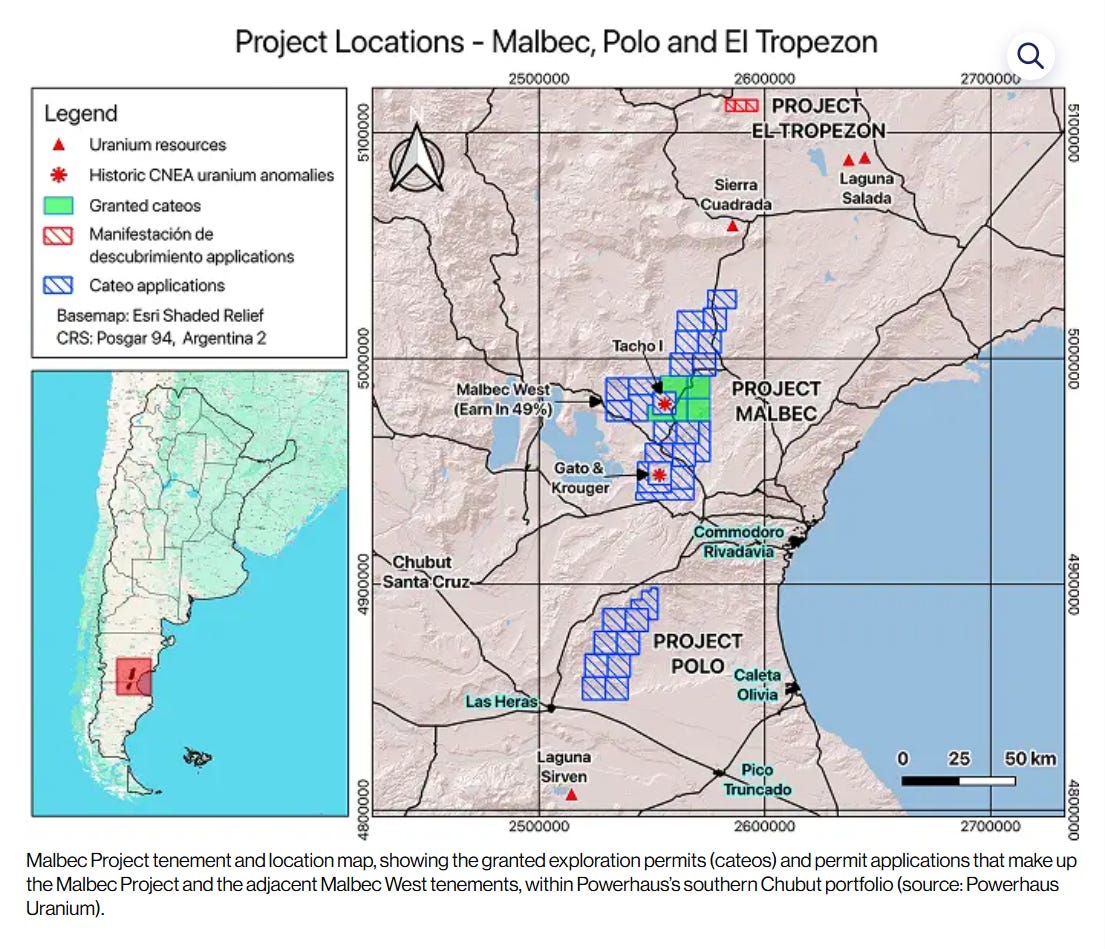
The flagship is Malbec, around 2,000 square kilometres of southern Chubut, held through four granted permits and 16 applications.
Groundwater picks up dissolved uranium as it seeps through porous sandstone, carries it along, and then hits a patch of ground where the chemistry flips.
At that boundary the uranium falls out of the water and stacks up in a long curved band. Geologists call it a roll front.
Kazakhstan is riddled with them, some running for hundreds of kilometres, and they feed 40% of the world’s uranium.
And the Kazakh comparison has independent backing. The IAEA, the UN's nuclear agency, has published a cross-section putting Chubut's geology side by side with the Kazakh basins.
The uranium sits at the boundary between two types of sandstone, and the colour of the sand tells you which type you've drilled into. So every hole tells you which side of the boundary you're standing on, and you step the next one towards it.
Powerhaus is targeting a formation about 100 metres thick, with the uranium expected to start shallow, from under 50 metres down to around 250, the depth and soft ground that ISR runs best in.
And roll-front mineralisation has already been exposed on the same trend just north of Malbec, with the host formation interpreted to run straight under Powerhaus ground.
The first holes ever drilled into it go in early October, a 5,000 metre drill campaign to be exact, and the whole thing sits inside a company priced at little more than its cash.
3. Uranium You Can Already See
There’s uranium sitting at surface on Powerhaus ground.
The team was following up an anomaly from an airborne survey flown back in the 1970s. They walked the ground on the first site visit, got to a riverbed, and there it was, yellow uranium mineral about 30 centimetres down.
The sampling since has come back as high as 771 parts per million U3O8, and shallow trenches show the mineralisation carrying down to at least two metres.
A short drive away at El Tropezon, rock chips have run up to 3,183 parts per million, and a channel sample cut 1,370 parts per million over half a metre, all sitting on a 1970s airborne anomaly that has never had a hole put through it.
A caveat on those numbers. Grab and rock-chip samples are hand-picked from the best-looking material a geologist can find at surface. They show uranium is there and where to drill. The drill program will tell us how much.
4. The Drills Start Within Weeks
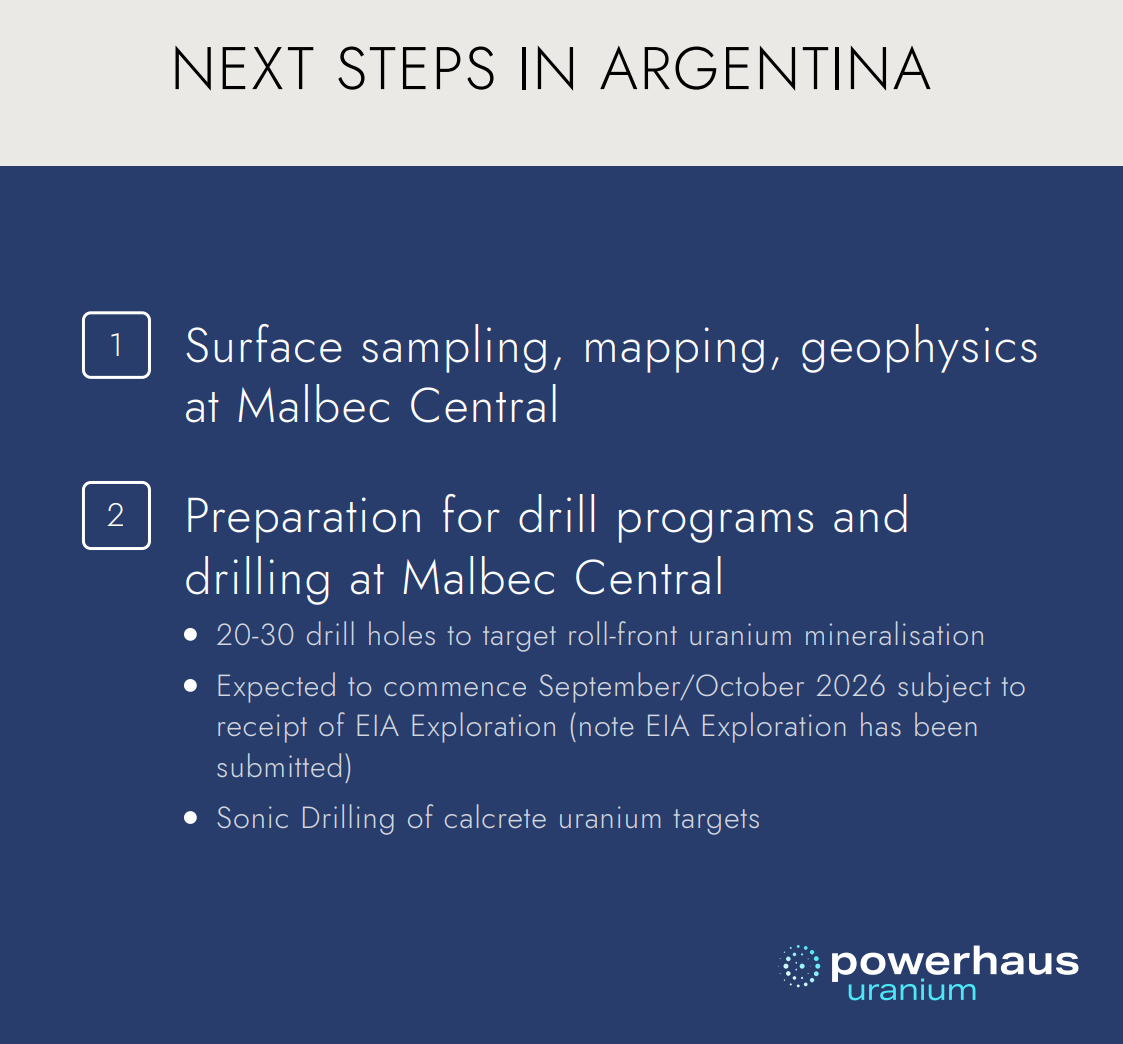
Powerhaus starts surface sampling, mapping and geophysics at Malbec Central straight after listing, then moves to a program of 20 to 30 holes into the roll-front targets, lined up for early October once the exploration permit lands.
The permit has already been submitted, and the 5,000m drill campaign will follow. Sonic drilling is set aside for the shallow calcrete targets. For a company that only started trading today, first assays are a matter of weeks to a couple of months out.
Plenty of explorers list and then ask you to sit tight for a year before anything spins. This one will know by Christmas whether the uranium at surface keeps going at depth, with the term price at an 18-year high while it finds out.
5. A Second Shot in the Athabasca
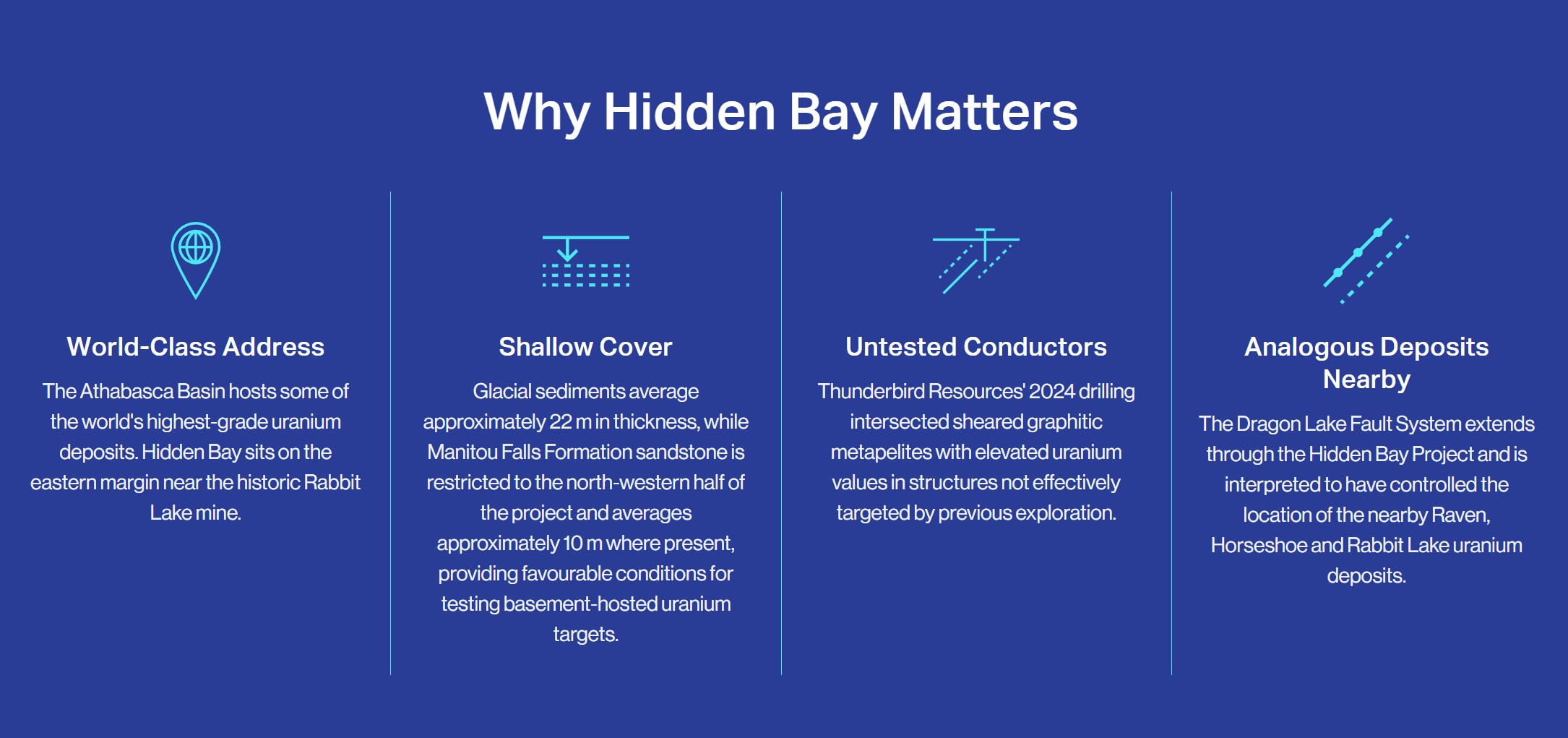
Powerhaus has bought Hidden Bay in Saskatchewan’s Athabasca Basin, the same province that hosts Cameco’s best mines.
It's home ground for this team. Steve Blower's three Athabasca discoveries include Gemini, the one that got 92 Energy taken over.
It sits about 20 kilometres from the Rabbit Lake deposit and on the Dragon Lake fault, the structure that controls the Rabbit Lake, Horseshoe and Raven deposits.
A hole drilled by the previous owner in 2024 cut anomalous uranium of 0.38 metres at 227.6 parts per million inside a graphitic-pyrite shear zone. That’s the style of ground that hosts the basin’s biggest deposits, NexGen’s Arrow among them.
Powerhaus completed the purchase earlier this month, and at today's price you're paying for Argentina with Canada thrown in.
What Could Go Wrong
It's important we're straight about the risks too.
Every grade in this article comes from grab samples, rock chips, shallow trenching or old surveys, and Powerhaus has no resource to stand behind any of it yet. The first holes at Malbec decide whether the surface uranium goes anywhere.
The whole portfolio is built around ISR because Chubut bans open pits and cyanide, so a discovery that only worked as an open pit would stay in the ground. Provincial mining law also moves with the politics, and Chubut politics have a history.
Milei’s settings are friendly to capital today, but you’ve read the history above, and RIGI has never been through a change of government.
And like every small-cap explorer alive, Powerhaus will be back for more money down the track to turn targets into a resource and, one day, a mine.
We weighed all of that against uranium sitting at surface and a team that has sold two uranium companies. We’re comfortable being early.
What We’re Watching
The team lands in Argentina within a fortnight of listing, weather permitting, so the news should start early. Here’s the checklist we’ll be tracking:
Boots on ground at Malbec, with surface sampling, mapping and geophysics kicking off straight away
The drilling permit for Malbec Central, already submitted and expected in the coming months
The rig turning on the first roll-front holes, slated for around October
First assays after that, the numbers that decide whether the surface uranium keeps going at depth
Geophysics at Hidden Bay, working up drill targets on the Canadian ground
We’ll cover every step of it here.
The Bottom Line
Sometime in the next few weeks a rig will pull up on a patch of southern Argentina where a handheld detector already goes off at your feet, and start drilling to find out how deep it goes.
The roll fronts it’s chasing are the kind Kazakhstan has mined for decades at the lowest cost on earth, and when they work, they run for kilometres through the sandstone.
If the drills hit uranium and keep hitting it along the channel, POW stops being a $17 million company in a hurry.
We’re in at 20 cents, with the cash covering more than half the market cap, while the term price sits at an 18-year high and the reactors keep multiplying faster than the mines.
Argentina has spent two years rolling out the red carpet for mining money, and it would love nothing more than a uranium story it can point to.
The last time Siobhan Lancaster stood on ground like this early, it ended in a takeover. The time before that, it ended in a $2.2 billion sale.
Now she’s standing on it again, holding yellow rock, with the drills weeks away.