


Elon Musk already has a plural for his humanoid robot. He calls them “Optimi”, and he has said Optimus could become “the biggest product ever”.
They all need titanium in their joints, and the cleanest way to make it starts with a heavy, dark mineral called rutile.
We’ve spent a year writing about a company hunting rutile under the farmland of central Malawi with hand augers, which are giant corkscrews a crew twists into the ground by hand. The augers give up at about eight metres, where the ground gets wet and the sample turns to mush.
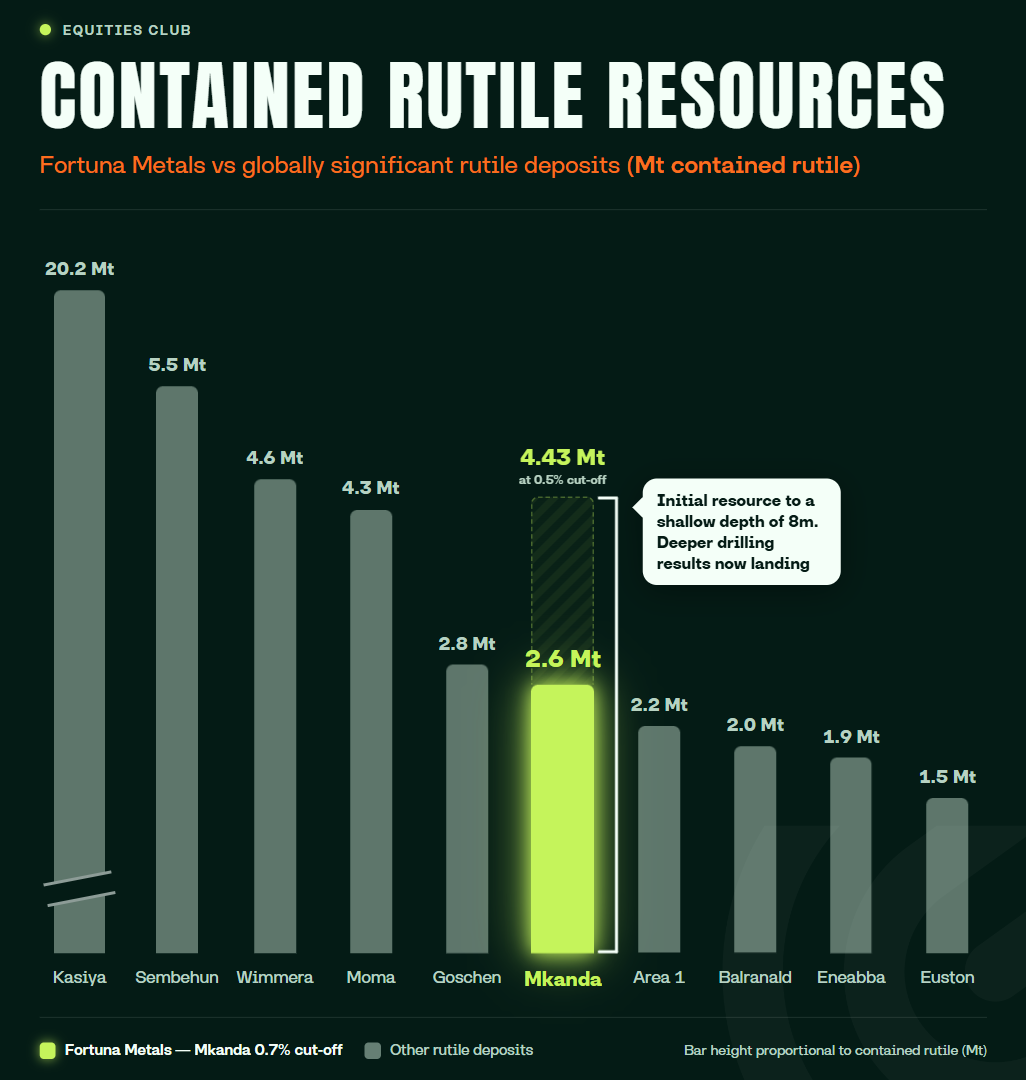
In July, Fortuna Metals (ASX: FUN) added up the top eight metres at its Mkanda project and landed on 298 million tonnes at 0.87% rutile, one of the six biggest rutile deposits in the world.
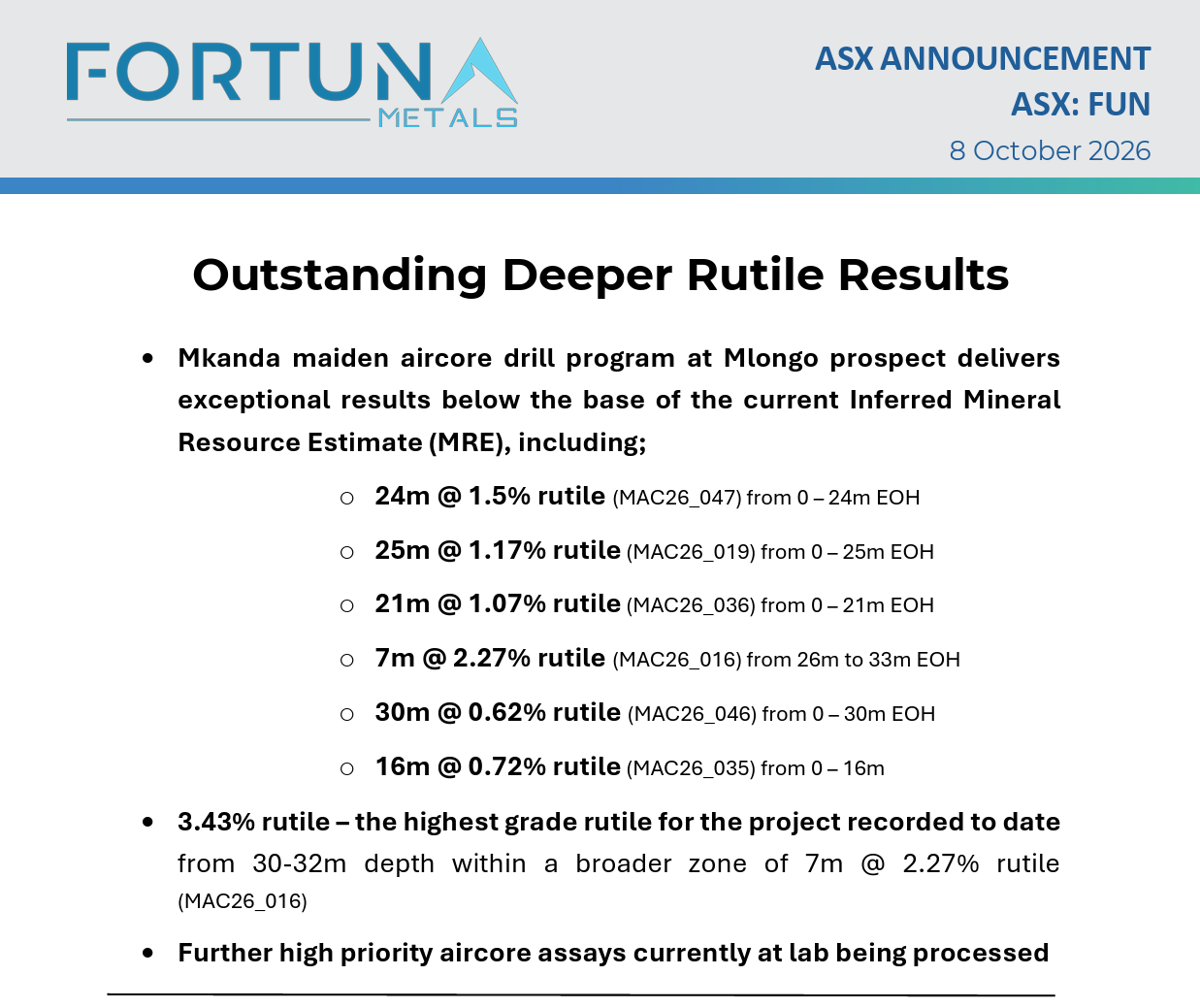
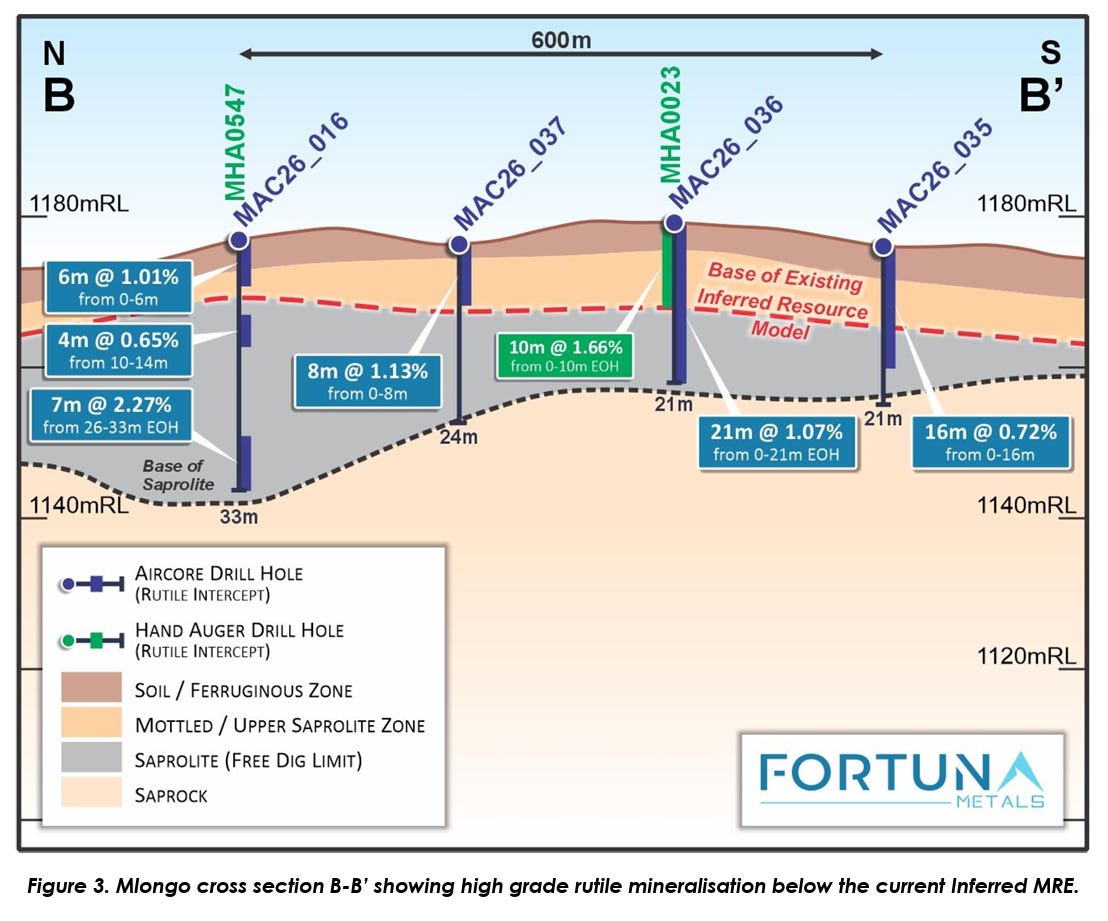
This morning FUN reported its first holes ever drilled below eight metres. The best of them ran 24 metres at 1.5% rutile from surface and was still in rutile when the rig stopped.
The hole went three times deeper than the eight metres in the resource, and its grade was about 70% higher than the resource average.
We’ve held FUN since September 2025, when it was a 4c stock. It last traded at 7.6c, which values the company at about $33 million, and roughly $12 million of it is cash in the bank.
From 4c to a Top-Six Deposit
Most rutile today goes into paint pigment, welding rods, jet engines and defence hardware, with robot makers the new blue-sky buyer on top.
FUN holds 658 square kilometres 20km south of Kasiya, the largest rutile deposit in the world. Kasiya’s owner Sovereign Metals (ASX: SVM) is worth about ten times FUN at $325 million and has Rio Tinto on its register.
Since buying the ground in September 2025, FUN has sunk 1,323 hand auger holes and turned a 5.4 tonne bulk sample into rutile grading 96.66% titanium dioxide.
In June SpaceX investor WndrCo paid $8.6 million at 11c a share for what is now 18.57% of the company. The maiden resource followed in July at 298 million tonnes grading 0.87% rutile.
What the Deeper Drilling Found
Mlongo is the first Mkanda prospect to get assays back from the 7,618 metre aircore program Fortuna finished in September.
An aircore rig uses compressed air to keep cutting through wet ground until it hits hard rock.
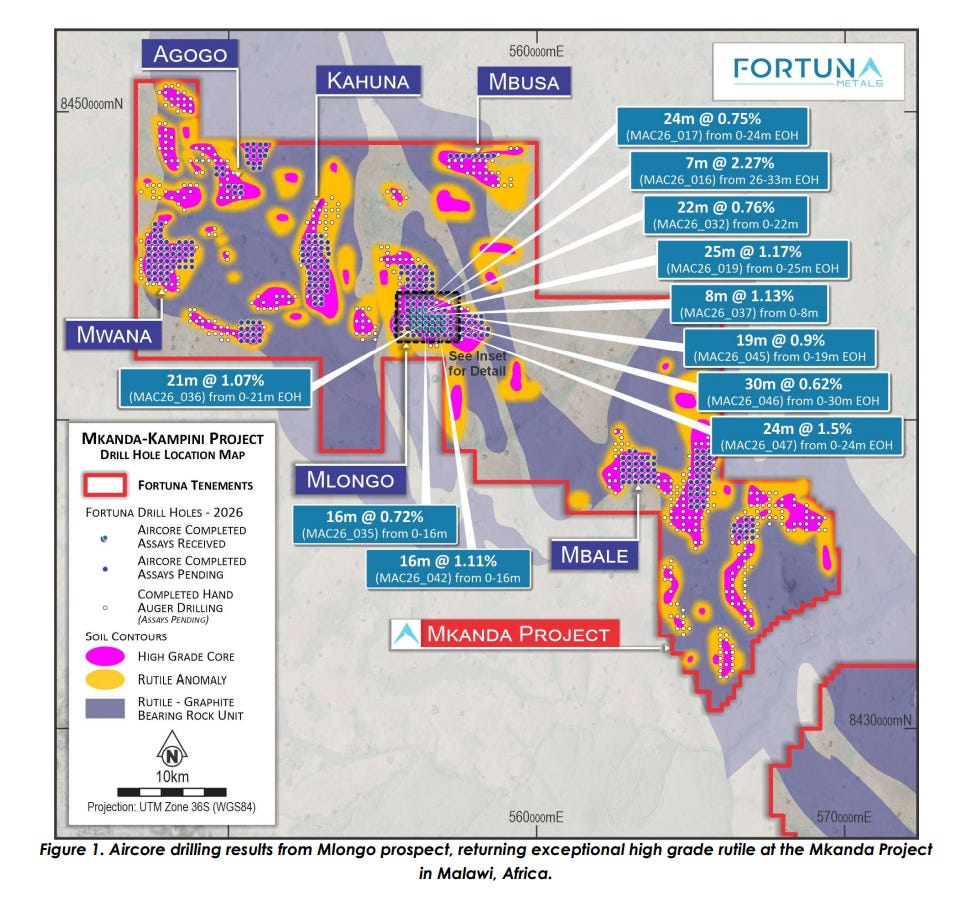
Fortuna drilled the maiden resource with holes 400 metres apart and has halved the gap to 200 metres.
Holes this close let the geologist upgrade the next resource from inferred to indicated, which a mining study needs.
Four holes carried rutile from surface to the last metre drilled:
24m at 1.5% rutile
25m at 1.17% rutile
21m at 1.07% rutile
30m at 0.62% rutile
A fifth hole ran 7m at 2.27% from 26 metres down to its last metre. Two metres inside the run graded 3.43%, the highest rutile grade Fortuna has recorded at Mkanda.
A few holes held their grade only in the top eight to 16 metres. Kasiya shows the same pattern of thick rutile cores inside thinner blankets at surface.
“These aircore results demonstrate a truly world class high grade rutile mineral system that is only getting bigger”
- Fortuna CEO Tom Langley
We’ve been writing since last November that the ground below the augers was where Mkanda could grow. Sovereign’s resource nearly tripled at Kasiya after aircore rigs drilled it to 20 metres.
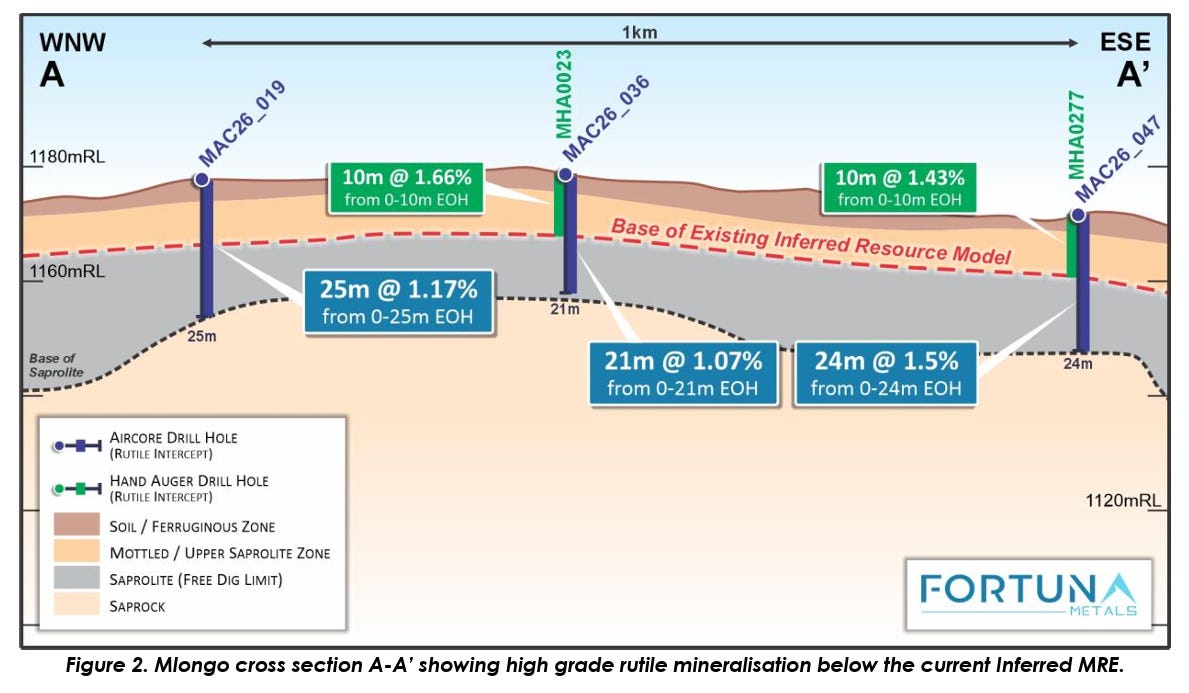
A few million years of tropical rain turned the rock at Mkanda into a soft, clay-like material called saprolite, which the rutile sits in.
At Mkanda an excavator tips the clay straight into a truck, compared to the arduous steps of drilling, blasting and crushing that most hard-rock miners have to go through.
The lab separated Fortuna’s bulk sample with gravity, magnets and static electricity.
This is possible as rutile is heavier than the dirt around it, and mineral sands miners have done it this way for decades.
Fortuna had $12.8 million in the bank at the end of July, and hand augers and aircore rigs are some of the cheapest drilling going.
What Comes Next for Fortuna
Fortuna expects results in the next four to six months from its other aircore prospects and 648 hand auger holes, which are at a lab in Cape Town.
Crews started drilling this month at Fortuna’s second project Kampini, which sits 40km south of Mkanda and has about 50km of the same host rock with little drilling into it.
The company’s September presentation has core drilling starting in October and a pre-feasibility study starting in December.
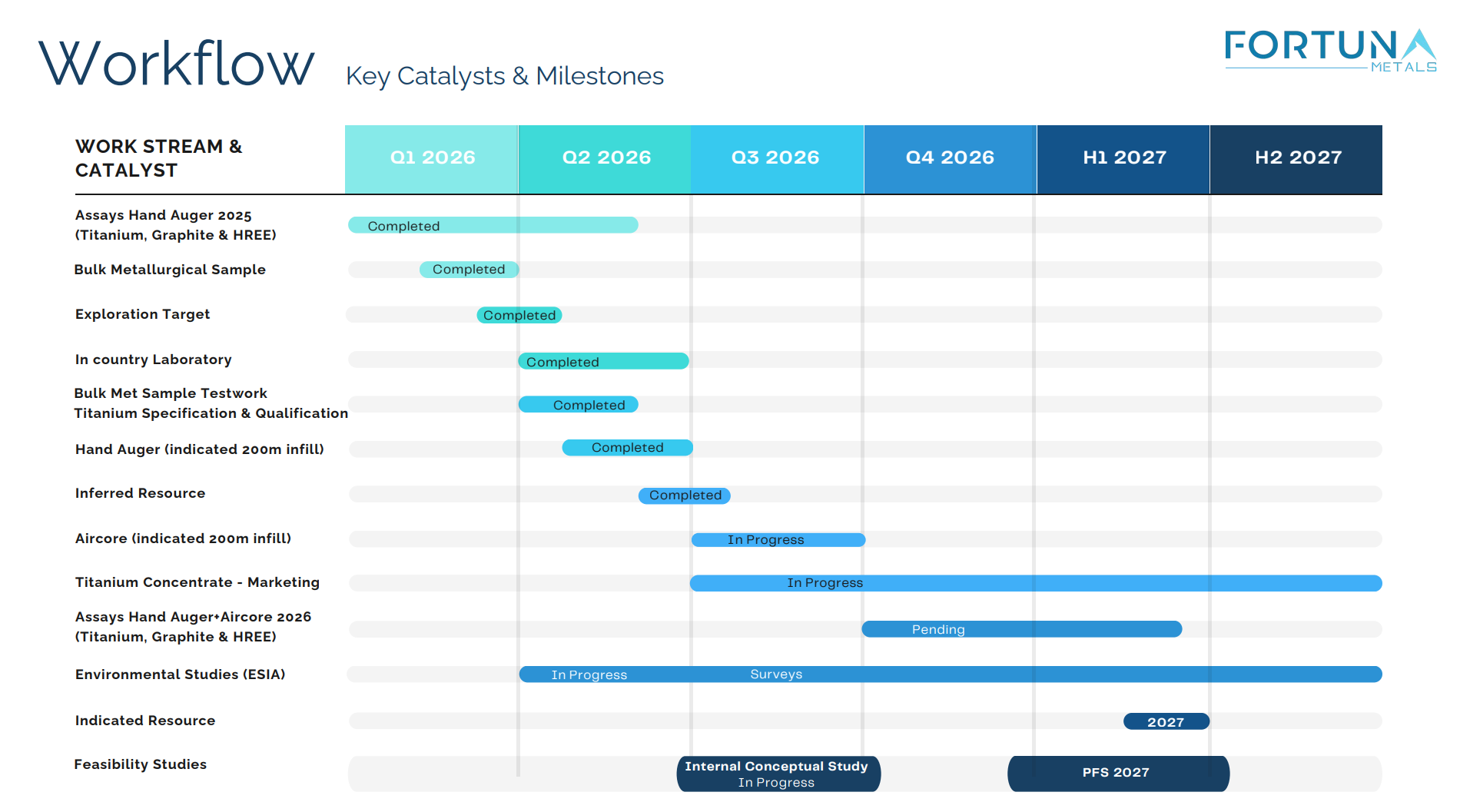
Rare earths are next on CEO Tom Langley's list after that, with the analysis running in parallel with the rutile assays.
Sovereign’s September study showed recovering them as a by-product could add US$722 million to Kasiya’s pre-tax value for about US$29 million of extra capital.
The Robots Are Shipping
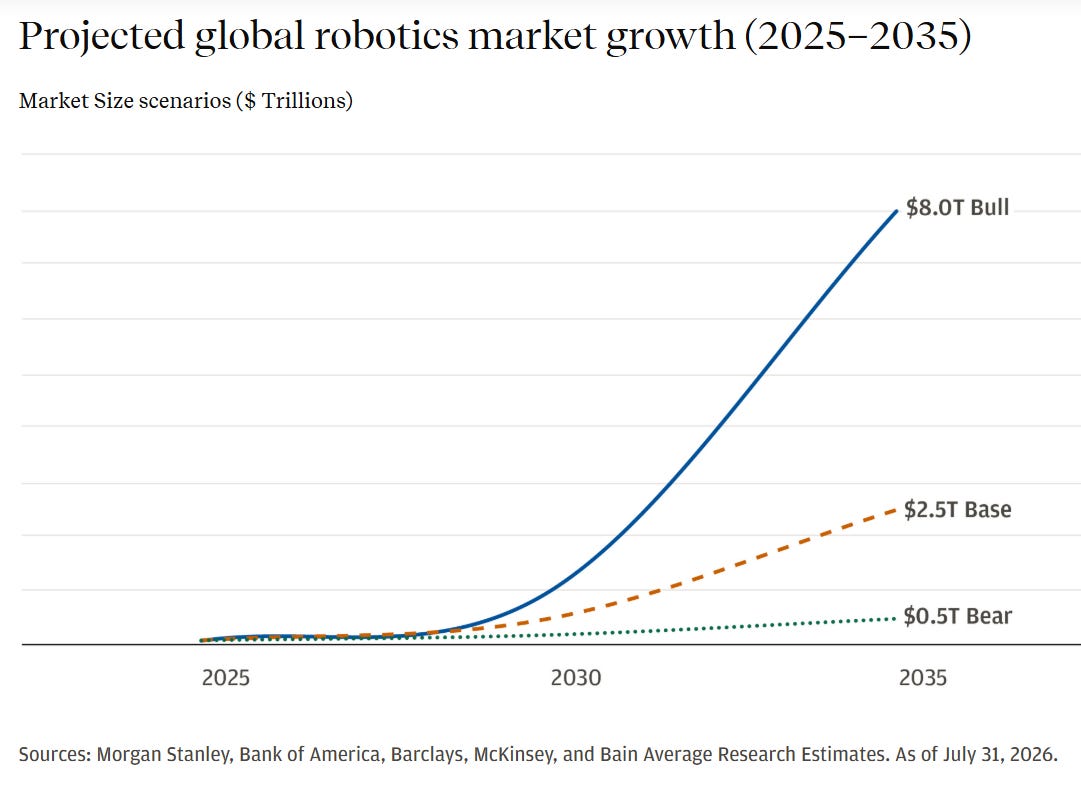
Robot makers shipped nearly 25,000 humanoids in the first half of 2026, more than five times the number a year earlier, according to research house IDC. Chinese companies built 78% of them.
IDC expects shipments to pass 750,000 a year by 2030. Research firm Berg Insight has them at 26 million a year by 2040, in a market worth US$554 billion.
Tesla lined up US$30 billion of bank credit in late September, partly to build Optimus.
In early October the robot arm of Chinese carmaker XPeng raised more than US$900 million at a US$6.3 billion valuation, with Tencent and Alibaba among its backers. XPeng plans to start mass production of its Iron humanoid by the end of the year.
Rutile already sells into paint and jet engines, so we see the robots as a bonus on top of a deposit we like anyway.
Our Take on Fortuna Metals
Today’s assays are the first from below eight metres at Mkanda. The Kahuna and Agogo prospects are next, with the rest of the 7,618 metre program behind them.
If they carry their grade as deep as Mlongo, we think the next resource could be a good deal bigger than 298 million tonnes, and Mkanda could move up from its current place in the world’s top six.
An independent geologist still has to turn the assays into tonnes, and Fortuna hasn’t put a date on the update.
We’re also watching the graphite assays from the deeper holes, and whether WndrCo brings a US partner to the table.
At 7.6c, FUN is close to double our 4c entry and below the 11c WndrCo paid in June.
Take the cash off the $33 million market cap and investors are valuing a top-six rutile deposit at roughly $21 million, against $325 million for Sovereign 20km up the road.
It’s a small batch of holes with decent grades, and the rest of the program has to back it up.
CEO Tom Langley said on site late last year he wanted to prove the rutile ran down to 20 or 25 metres, and today’s best holes carried it as deep as 33.
We like his chances of finding the same at Kahuna and Agogo.