


Never heard of Leopold Aschenbrenner? Spare a thought for him anyway.
Two years ago he wrote a 165-page manifesto arguing that only a few hundred people on earth truly understood where AI was heading, and he was one of them.
He called it Situational Awareness. Then he (somewhat ironically in hindsight) named his hedge fund after it.
The fund was an all-in bet on AI, juiced with borrowed money. For two years it worked. Returns over 1,000%, and US$20 billion under management by the start of July. He was 24 years old, and had never worked at a hedge fund.
Then this month AI stocks rolled over and his biggest holdings halved in a few weeks. The banks wanted their money back, and on Thursday Ken Griffin’s Citadel bought the portfolio.
And because markets have a cruel sense of humour, the stocks bounced almost the moment they hit Citadel's books, with some closing 30% off their lows within the day.
Leopold went from manifesto to margin call inside two years.
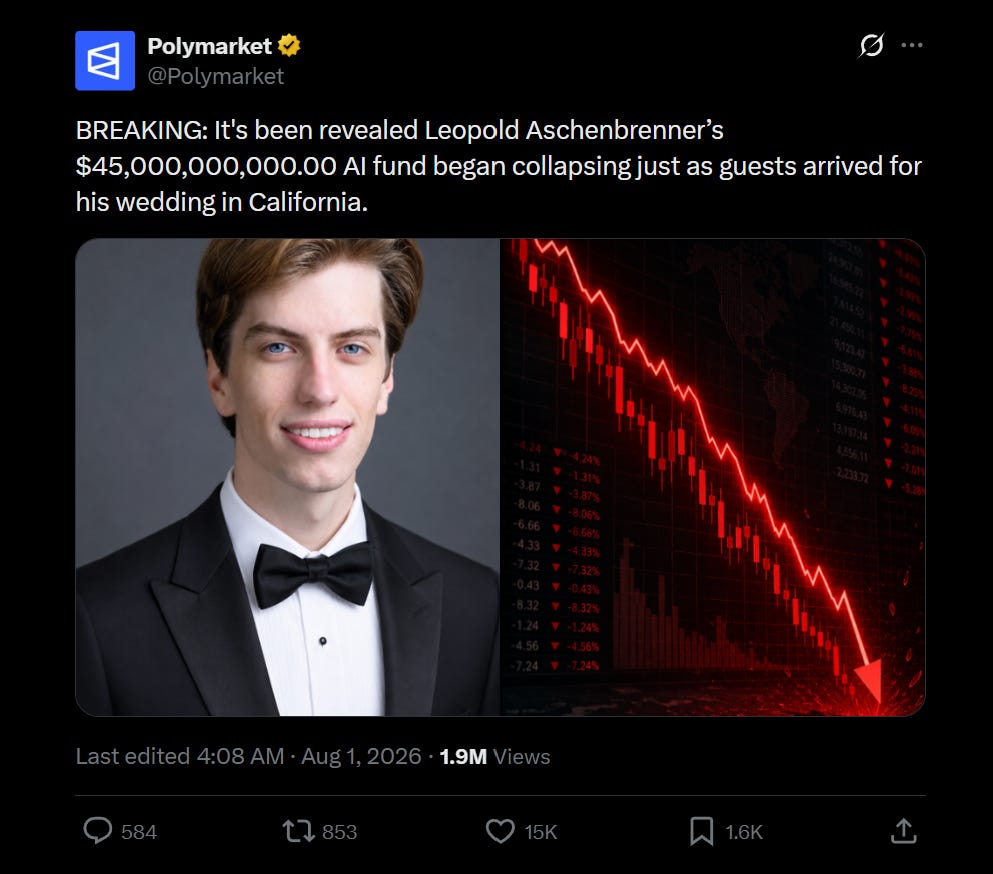
We’re not here to dance on the bloke’s grave. Down our end of the market, everyone knows someone who borrowed against a sure thing. Like Leopold, they usually had the thesis right too. The market just took their money before it proved them correct.
And plenty moved fast at the small end of town this week too.
Here’s what caught our eye:
A new name joins the Equities Club portfolio
Adisyn builds a wall around its tech, landing its second US patent allowance
Tungsten play Group 6 Metals makes a wild return to trading
Gina Rinehart writes a cheque for gallium, the metal America doesn’t have
Evion sends geologists back onto a Nevada fluorspar mine
KTK's first quarterly has a scary number in it, and the number is wrong
Another IPO doubles on debut with barely a share free to trade
Jade Gas gets stood up on settlement day
Amazon joins Alphabet in the US$200 billion club as the AI build-out rolls on
Copper’s tightening, and Robert Friedland reckons the warehouses could run dry
Let’s get to it.
A New Name Joins the Portfolio This Week
This week we're introducing a new portfolio addition, a gold story we've been working on for months (and keeping quiet about it hasn't been easy). Without giving the game away, here's what you're getting:
A gold project in the US with historical high-grade hits that made us sit up the first time we saw them
A permitted mine and processing infrastructure already in place, a head start most early-stage listings would kill for
Tens of millions of dollars of prior spending by previous operators, all inherited on day one
An entry price we like against what recent gold floats have fetched
Full breakdown lands in your inbox before market open. If you’re subscribed, keep an eye out. If you’re not, enter your email below.
AI1 Builds the Wall Higher
Adisyn (ASX: AI1) picked up its second US patent allowance this week, and the shares rose 8% on the news.
For anyone joining late, AI1 spent six years working out how to grow graphene, a sheet of carbon one atom thick, on the wiring inside advanced chips, using machines chip factories already run.
Copper wiring is hitting its limits as chips shrink, and graphene has been the industry's chosen fix for a decade. AI1 was the first to make it at temperatures a chip survives.
The first patent, allowed in May, covers the way AI1 makes that graphene. The new one covers the graphene-coated wiring itself, however it gets made.
So say Samsung spends the next five years and a few hundred million dollars working out its own way to coat chip wiring in graphene. Their own chemistry, their own machines, with none of AI1’s process anywhere near it. If what comes out the other end matches the specifications in AI1’s claims, Samsung is still writing AI1 a cheque.

The lawyers put it as “irrespective of how the coated surface or interconnect is produced”, which is a dry way of saying there’s no back road around it.
Any chipmaker wanting to license the technology will want protection over the recipe and the finished article before signing anything, and as of this week AI1 has both. We went through the patent claims line by line in Friday’s article.
AI1 is a portfolio company of ours and one we’ve seen double since it joined the portfolio. Both patents still need their formal grant, and with the examiner's call already made, the official stamps usually land within a few months.
Gina Buys into Gallium
It’s been a busy week for Australia’s richest person. Gina Rinehart spent part of it suing the ABC and the rest backing a critical minerals play in the US.
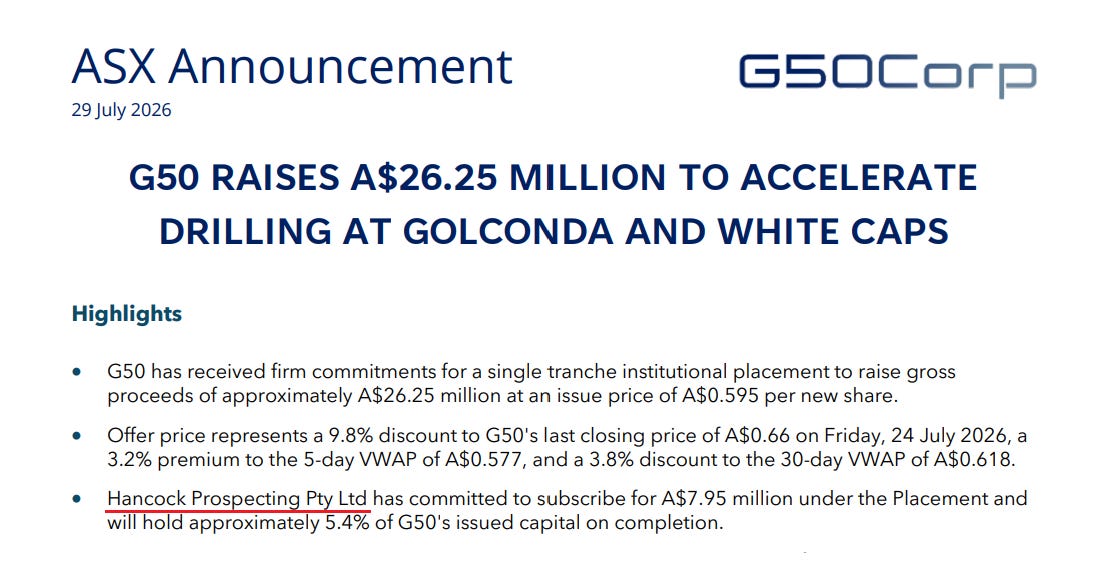
Rinehart’s Hancock Prospecting wrote a $7.95 million cheque this week for a slice of G50 Corp (ASX: G50), part of a $26.25 million placement that leaves Hancock holding about 5.4% of the company on completion.
Every project G50 owns sits on American soil, starting with Golconda in Arizona, an old zinc, lead, gold and silver mine where they’ve been pulling up high-grade gold and silver along with something far rarer, a gallium discovery.
Over in Nevada there's White Caps, an old gold mine that Freeport McMoRan last drilled in the early 1980s and nobody has properly touched since.
Gallium is a metal most people have never heard of, and it sits inside the chips running radar systems, defence electronics, LEDs and phone chargers, so there's a fair chance some is in the plug next to your bed right now.
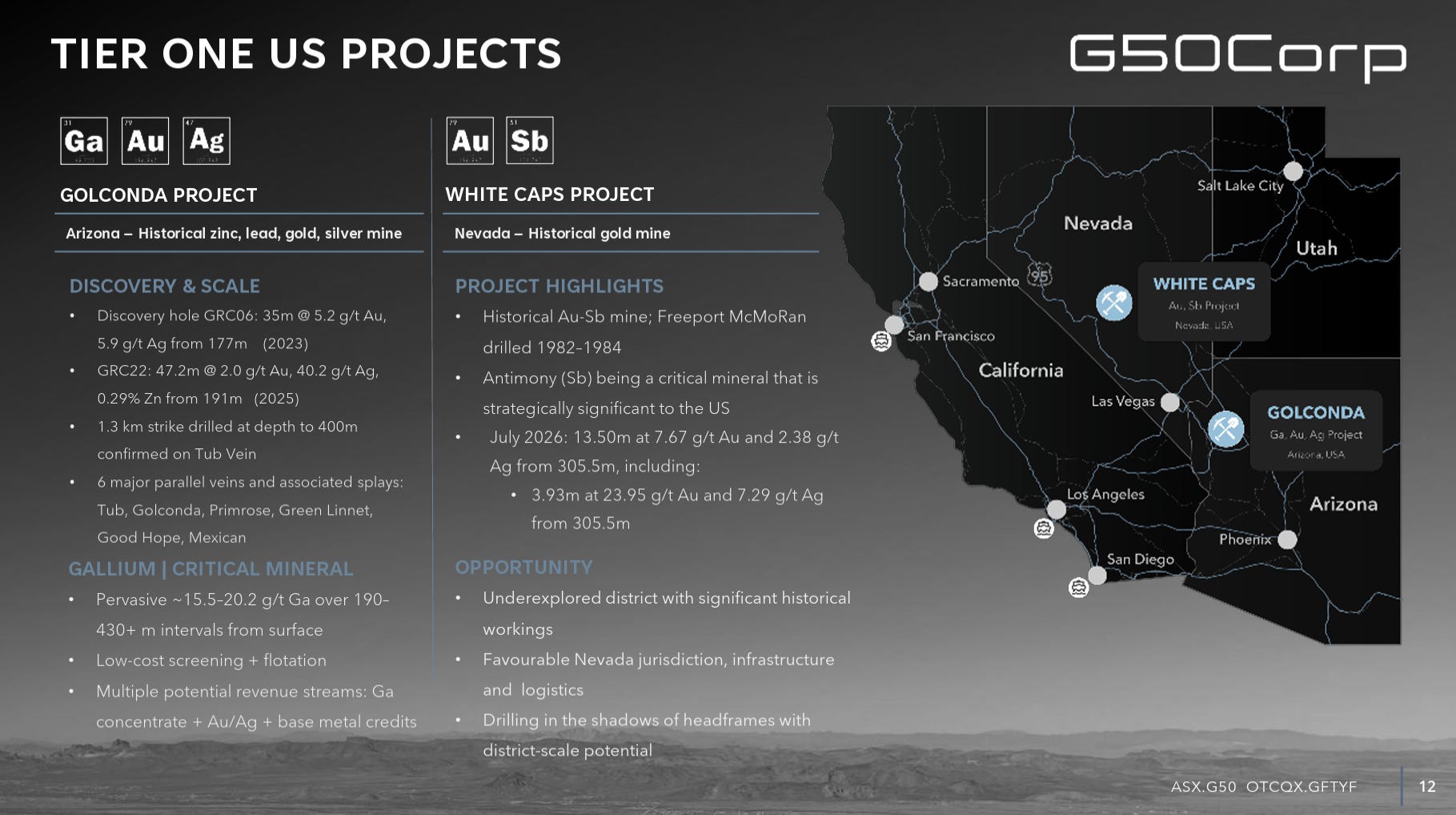
America produces none of its own, China controls most of the world’s supply and banned exports to the US in late 2024, so an American company drilling out gallium on American soil is suddenly holding something Washington badly wants.
The raise funds more drilling and gallium test work, plus early permitting at Golconda. With Hancock on the register, G50 now has some of the most serious resources money in the country behind its US push.
EVG Puts Boots on the Ground at Carp
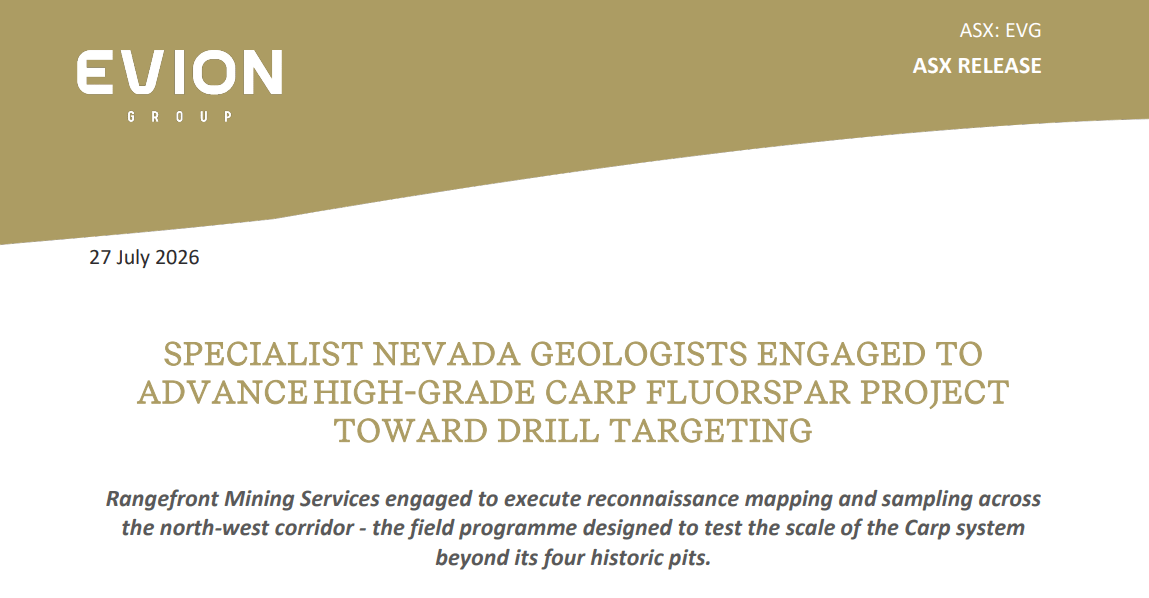
Evion Group (ASX: EVG) is sending geologists back onto its Carp Fluorspar Project in Nevada, and the ground they're walking has quite the story behind it.
Between 1958 and 1971 the old-timers pulled about 44,900 tonnes of fluorspar out of four shallow pits at Carp and sold it straight to Kaiser Steel as it came out of the ground. The grade was good enough that nobody bothered building a processing plant.
Sampling in 2024 returned grades even higher than what the old boys were digging, and nobody has run a modern exploration program over the system since the 1970s. The mine shut when cheap imports killed the economics of small US producers, and the fluorspar itself never ran out. The market just walked away from it.
Fluorspar is one of those unglamorous minerals the modern world quietly cannot function without. It goes into making semiconductors, lithium batteries, nuclear fuel, refrigerants and steel, and the US imports every single tonne it uses, most of it from China.
EVG’s next task is working out how big Carp really is, so Rangefront Mining Services, a geological outfit based in Elko, Nevada, has been engaged to map and sample the newly identified north-west corridor, the ground EVG believes extends the system well beyond the four historic pits.
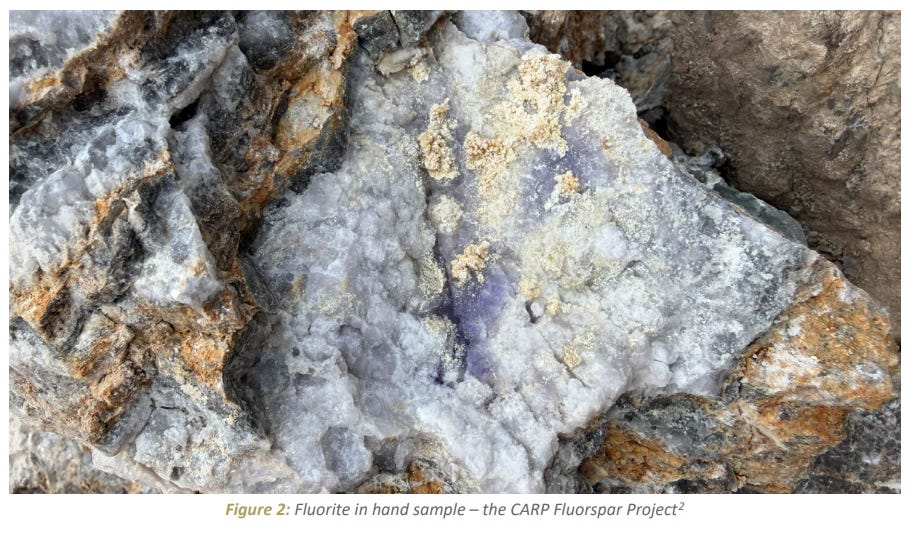
Assays come back first, then surveys, and drill targets after that.
Washington has also woken up to its fluorspar problem, with the US Defense Logistics Agency just awarding a US$168.9 million contract simply to secure supply.
Half a century ago, Carp fed American industry with this mineral. EVG is about to find out how much the old operation left behind.
KTK’s Scary Number That Isn’t
KTEK Aerosystems (ASX: KTK), one of our portfolio companies, handed in its first quarterly report since listing in May, and there’s a number in it built to spook people.
The report says KTK has 1.9 quarters of cash left. For a company that raised $10 million 10 weeks ago, that reads like something has gone badly wrong.
The number comes from a formula that takes the quarter just gone and assumes every quarter from here looks the same. For KTK, that means assuming a war and an IPO both turn up again every three months.
The war between Israel and Iran shut the corridor KTK ships through, so receipts came in at just $273,000, with finished product sitting there and the customer waiting on it. At the same time, the one-off bills of going public all landed at once.
Strip out the one-offs and the company puts its underlying costs at $0.8 to $1.0 million a quarter, against $4.62 million in the bank. That’s about five quarters of runway even if not another dollar arrives, and no dollars arriving is the bear case here, with deliveries slated to restart in September.
KTK’s actual problem is one most small caps would swap for. A customer that wants every airframe it can build, and a factory that can’t yet keep up. The new higher-capacity tooling goes through final qualification in August, with output building month by month from there.
Another IPO Doubles on Debut
Gwardar Resources (ASX: GRS) hit the boards this week after raising $6 million at 20 cents, traded as high as 47 cents, and closed its first session at 41 cents for a 105% gain on debut.
The company listed at a valuation of just $6.6 million, with 33 million shares on issue, and the register goes a long way to explaining the pop.
The top 20 shareholders hold an incredible 89% of the company, many with equal parcels, so there was barely any free stock available on day one and eager buyers had to pay up for what little was around.
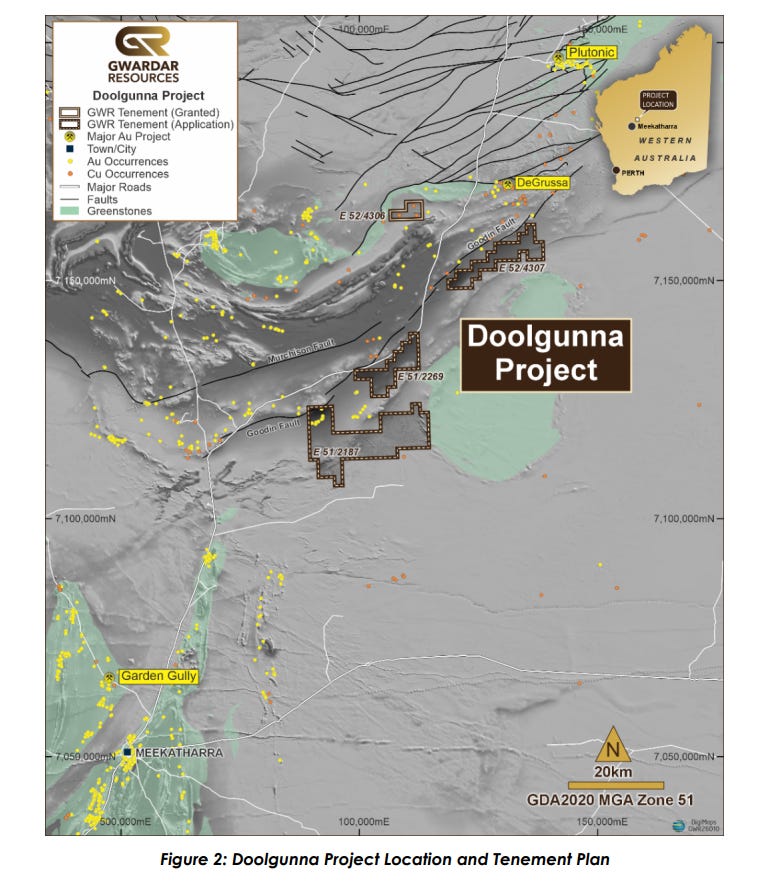
Doolgunna, the flagship, sits in the Murchison in the district that delivered the DeGrussa copper-gold mine, with historical drilling at Goodins Find returning 15m at 1.36 g/t gold.
The other asset, Kurnalpi, covers gold ground 90km northeast of Kalgoorlie. Even after doubling, GRS is valued around $13.5 million, which remains tiny by ASX standards.
The move was pure demand for the float, with no new drill results behind it, and it extends the run of new resources paper getting bid hard straight out of the gate.
GRS’ next test is whether the valuation holds once early listing demand settles and all eyes are on the drill bit.
Tungsten’s Wild Return
We’ve watched plenty of wild sessions over the years, and we can’t remember one like Thursday’s.
Group 6 Metals (ASX: G6M) came back from a two-year suspension, opened at 8 cents, ran as high as $4.00, a 4,900% gain from the opening bell, and closed the week at $2.76.
When G6M went into suspension it was a struggling developer trying to get its Dolphin tungsten mine on King Island, Tasmania, up and running. The company that returned on Thursday is a producer making serious money.
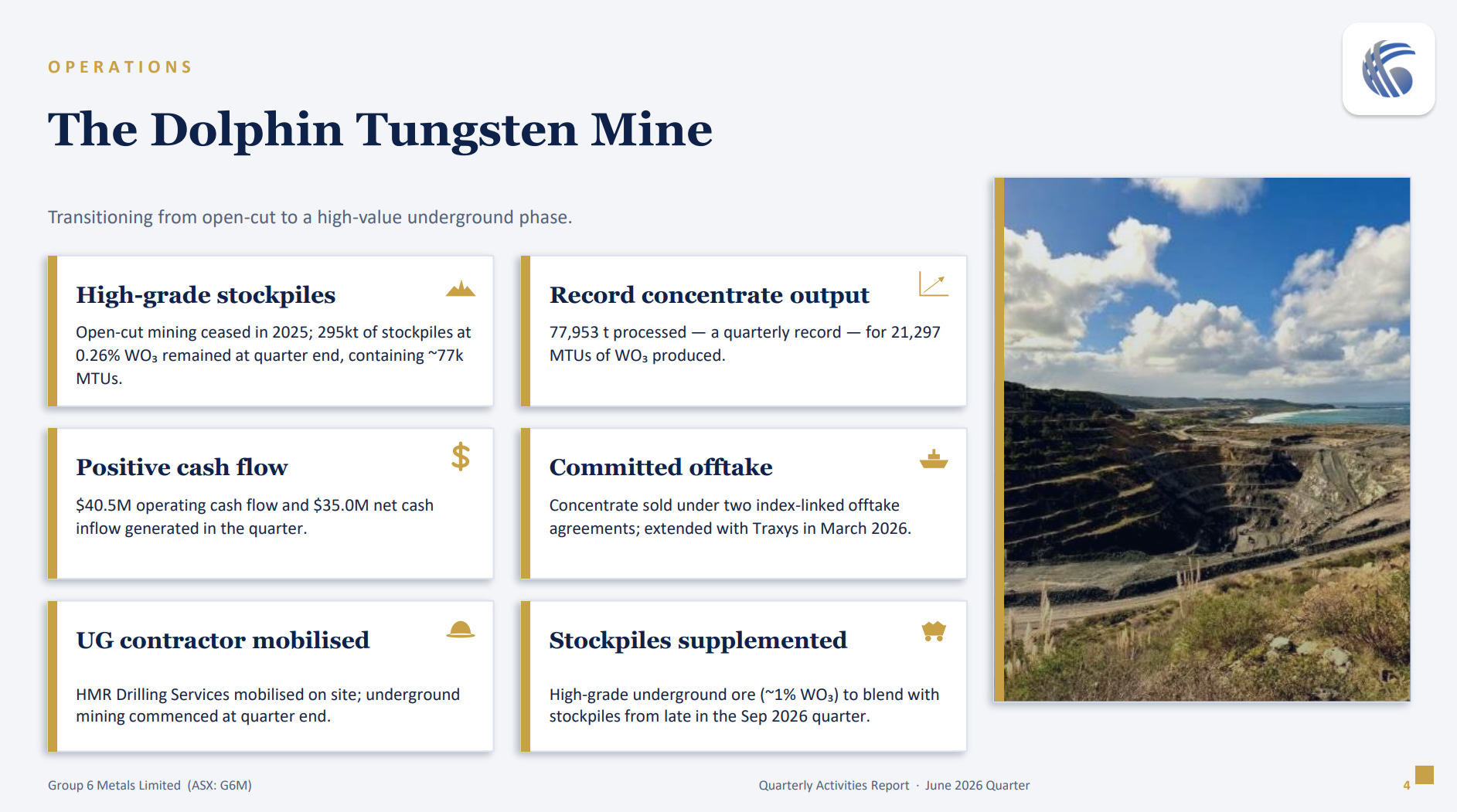
The June quarter delivered a record 77,953 tonnes of ore processed, $61 million of cash receipts up 142% on the prior quarter, and $49.5 million sitting in the bank.
Underground mining kicked off at quarter end, bringing ore roughly double the grade the plant has been fed, expected from the September quarter.
While the lights were off, the tungsten price went vertical, from under US$500 per tonne unit a year ago to around US$3,000 now.
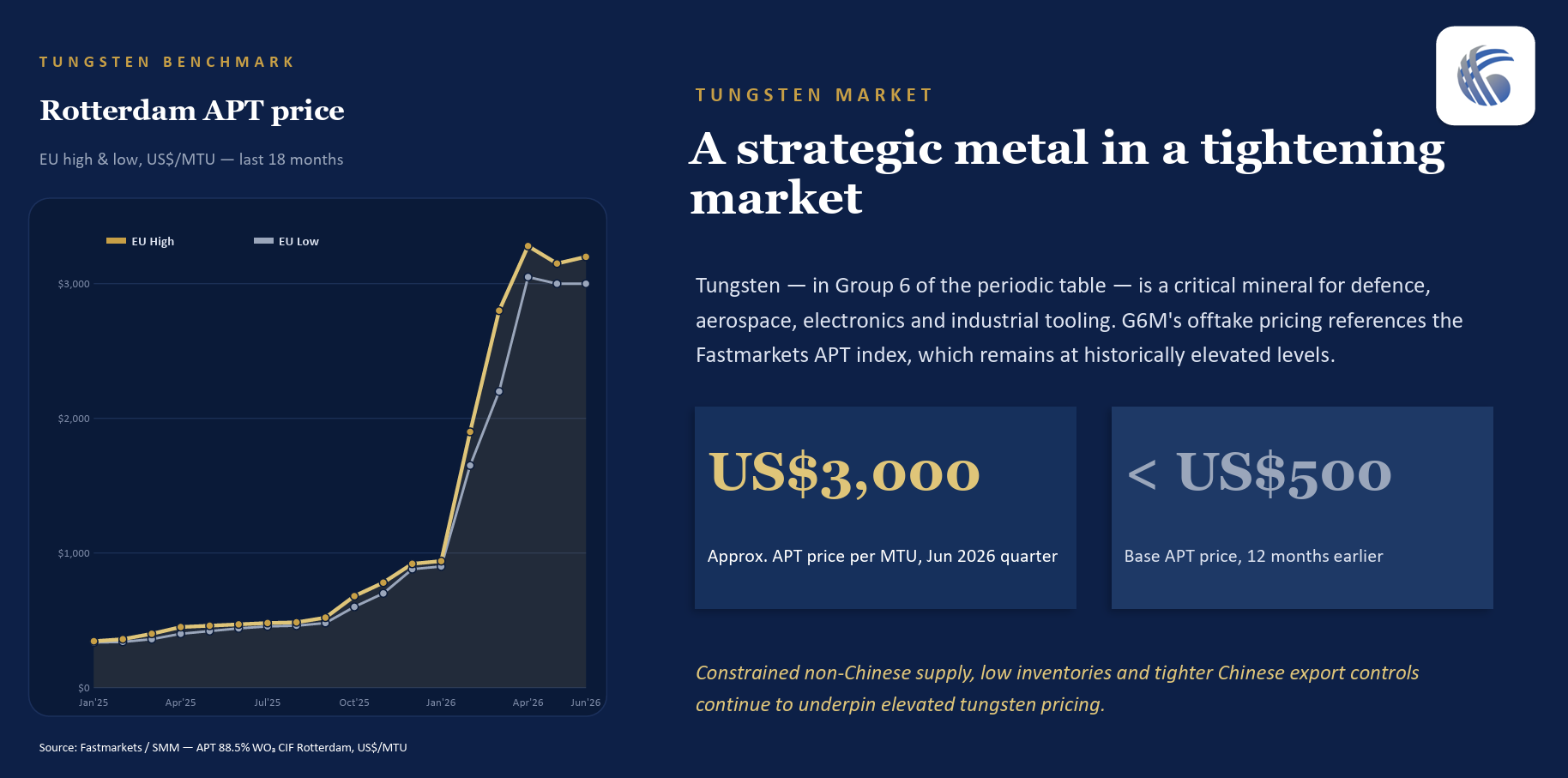
Six times higher, with China choking exports at one end and defence and aerospace buyers pulling hard on the other end.
Before anyone rings the holders to congratulate them, the company consolidated its shares during the suspension, so anyone who sat through the two years is up far less than the headline suggests.
Two years of locked-up demand met a company transformed, and the scramble to own it did the rest (and spare a second thought this week for whoever sold at 8 cents in the opening minutes).
Jade Gas Hits a Settlement Snag
Jade Gas (ASX: JGH) put out an announcement you don’t see every day on the ASX.
Jade is a coal bed methane developer in Mongolia, sitting on the country’s first formally approved natural gas reserves and a proposed $1.1 billion non-binding funding deal with a Chinese consortium to drill out Phase 1 of its Red Lake project.
Back in July the company announced an $11 million placement at 12 cents, and when settlement day rolled around, Jade had to tell the market that a number of the investors who put their hand up were unable to come up with the cash.
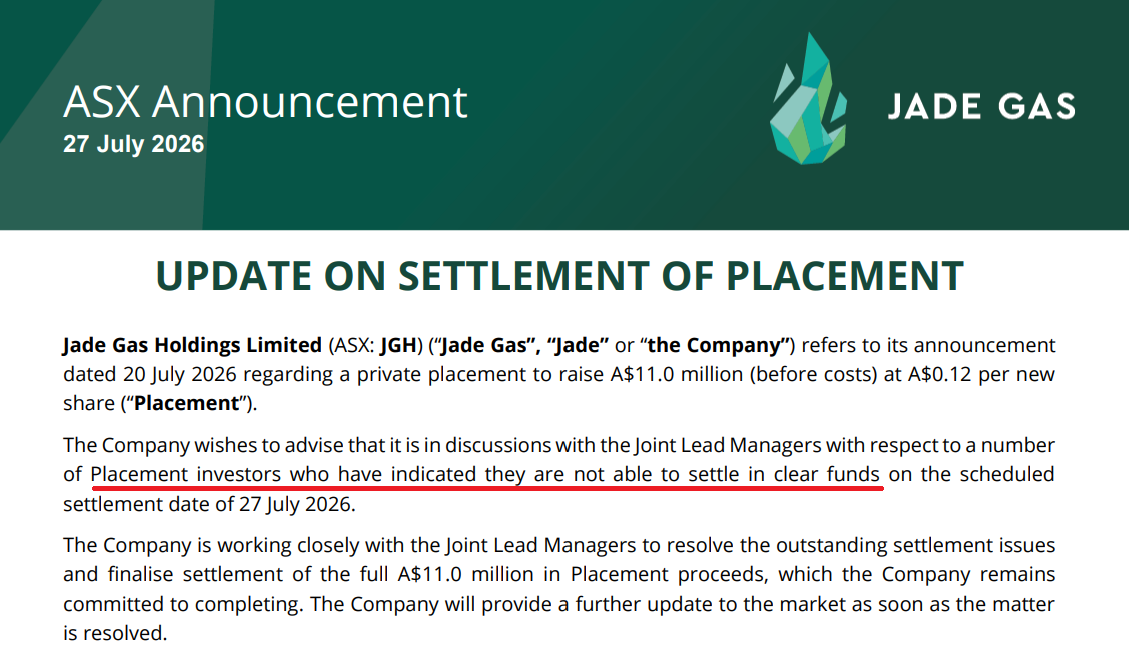
The stock closed the week at 8.3 cents, about 31% below the price those investors agreed to pay. Nobody enjoys paying 12 cents for an 8-cent stock.
Committing to a placement and then failing to stump up the money is about as bad a look as it gets in this market, and it usually says more about the register than the asset. We’ll be watching what happens next.
The Tech Giants Keep Writing Cheques
Amazon told the market this week it plans to spend around US$220 billion in 2026, most of it building the data centres and computing power behind the AI boom.
Its cloud business grew 37% to US$42.2 billion for the quarter, customers have already signed contracts worth US$496 billion for computing power Amazon hasn’t even built yet, and the company says demand keeps running ahead of what it can construct.
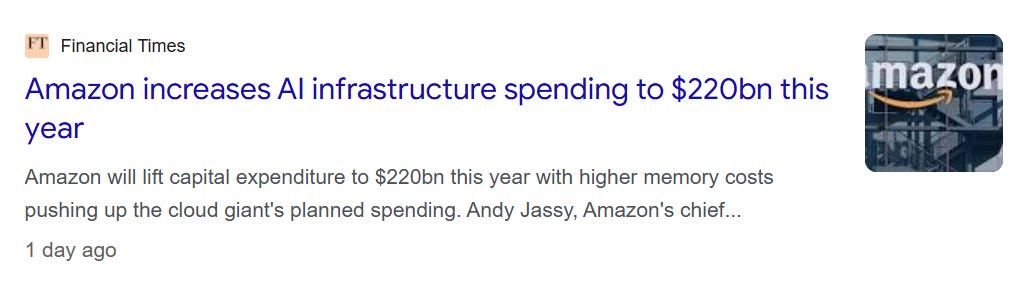
That follows Alphabet’s US$195 to 205 billion spending plan we covered last week, so between two companies alone, over US$400 billion is going out the door in a single year, with customers queued up and contracts signed years in advance.
Anyone still calling AI a bubble has to explain why the world’s biggest companies keep finding the demand to justify it. Even Leopold we spoke to in the intro makes the point. He got the direction right, but the leverage wrong.
We’ve been data centre and tech bulls for a while now, and weeks like this one show why.
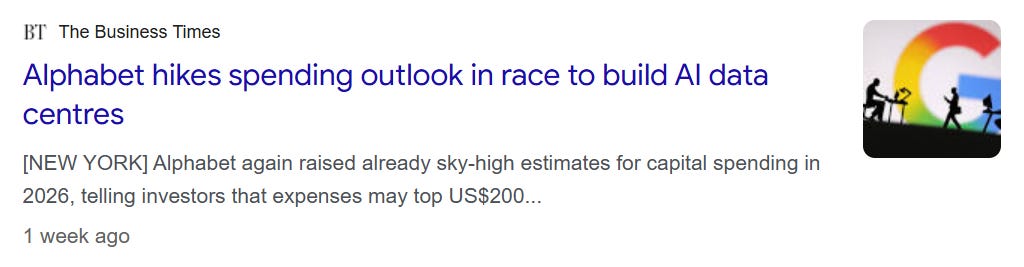
All that money flows somewhere, into construction, cooling, electrical gear, fibre, chips and backup power, and on the ASX it firms up the ground under the smaller names feeding that build-out.
The winners from here will be the ones holding signed contracts, and punters have got better at spotting the companies that slapped AI on the cover of the investor deck and hoped for a re-rate.
Our own exposure sits with Adisyn (ASX: AI1), whose graphene chip wiring leans straight into the semiconductor end of this build-out. We’ve also been watching PathKey AI (ASX: PKY) closely, and there’s one more name coming soon with direct exposure to the US data centre thematic.
Copper Keeps Tightening
Rio Tinto reported a 43% jump in first-half earnings this week, with copper doing plenty of the lifting as the global data centre build-out chews through the metal.
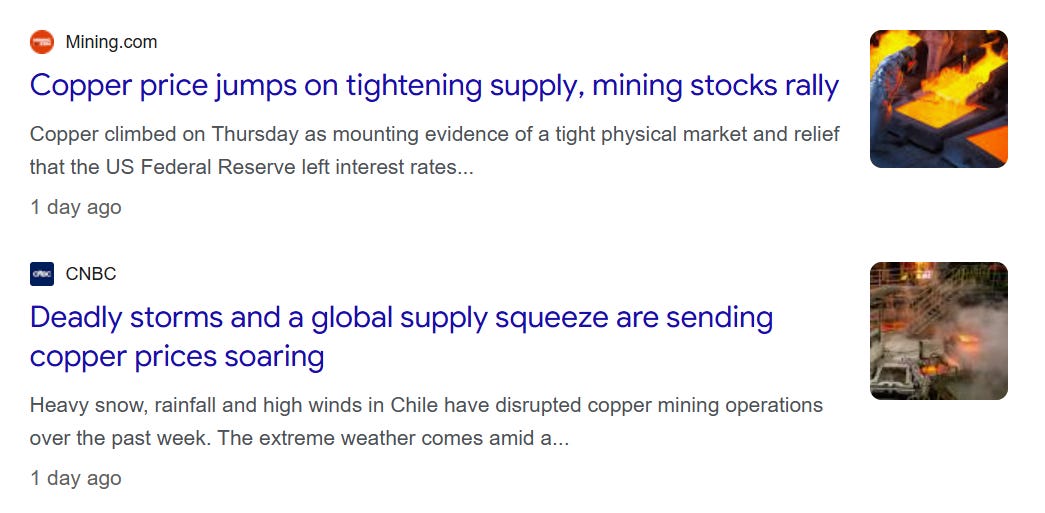
Robert Friedland, the billionaire behind copper giant Ivanhoe Mines, put out a post this week we haven’t stopped thinking about. Copper in the US is trading at US$6.50 a pound, around US$14,000 a tonne on the LME, within a whisker of all-time highs during what is normally the sleepy part of the year.
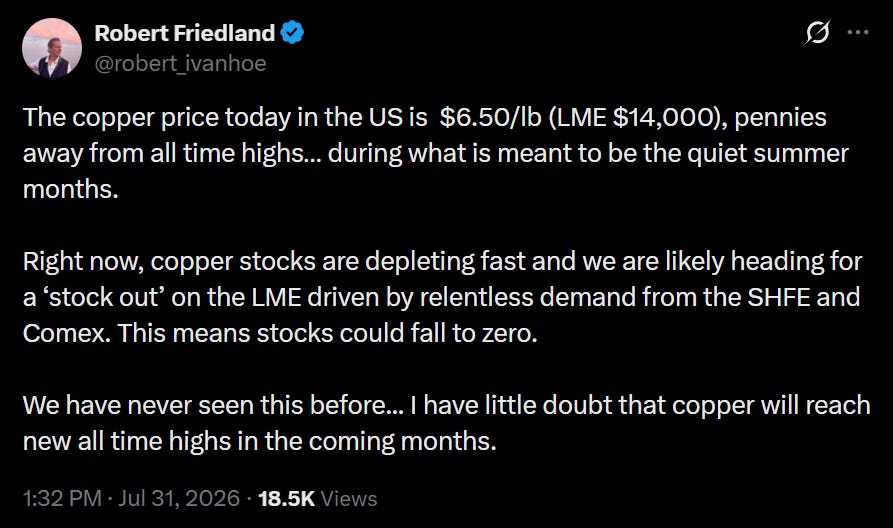
The LME warehouses are where the world keeps its spare copper, and buyers in Shanghai and New York are emptying them faster than fresh metal arrives.
Friedland believes the exchange could run out of copper altogether. Nobody knows what the price does on the day the world goes looking for its spare copper and finds none, because nobody has ever seen it. Friedland's guess is new all-time highs in the coming months.
A quick lap of the world’s biggest copper miners shows why the cupboard keeps emptying:
Rio’s own output fell 7% with Kennecott still down.
BHP slipped 5% and flagged further declines in Chile.
Freeport’s production dropped 18.2% year on year.
Codelco’s new chairman says there is no possibility of hitting its old 1.7 million tonne target within five years, at the world’s largest copper miner no less.
Ivanhoe’s production nearly halved. Deadly storms in Chile added fresh disruption, and the IEA is warning sulphuric acid shortages put more than a seventh of global output at risk.
Everywhere you look, less copper is coming out of the ground while demand keeps climbing, and that’s why we’re spending our time hunting copper juniors.
Any small-cap with a large copper asset or a fresh discovery is being rewarded handsomely in this market, and with supply this constrained we expect that to continue. (copper juniors, you know where to find us.)
The Week ahead
We’ve got a big week ahead.
We’ll be at Australia’s biggest mining conference, Diggers and Dealers in Kalgoorlie, and we’ll wrap up everything from the event next weekend.
We have a new portfolio addition joining the Equities Club portfolio. We only back a handful of stocks a year and this gold junior has us excited.
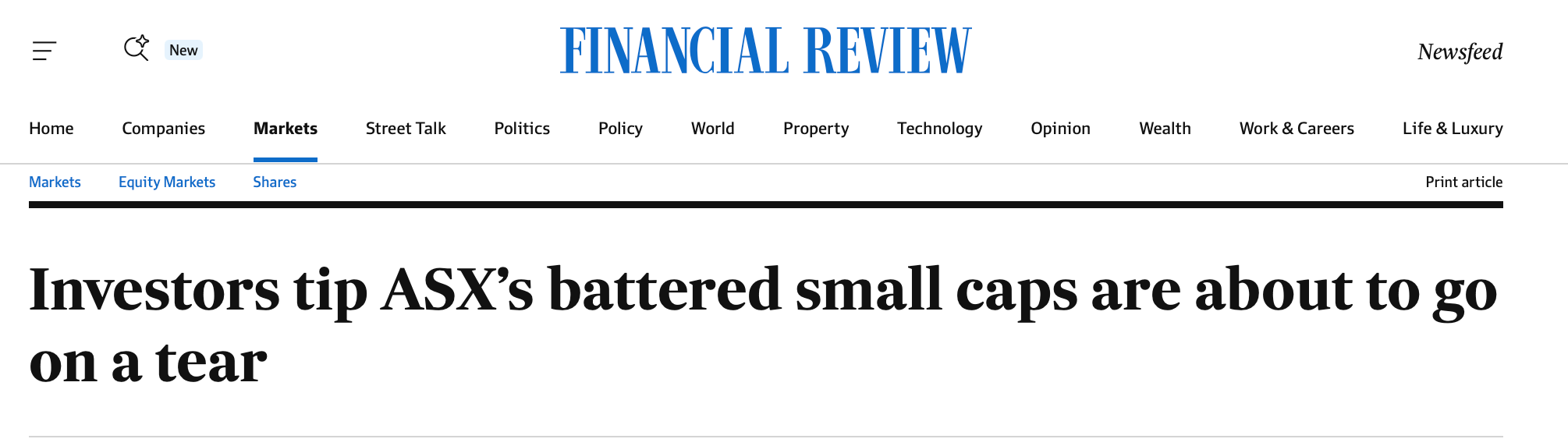
We’ve seen deals start to land over the past week, and we’ve been flat out on calls with companies. There is a lot happening out there and we think it will start to flow through in the coming weeks. And let’s hope The AFR is right…
Data centres, tech, drones, it’s all been busy out there. We’re gearing up for a big second half of 2026 and we feel like it’s just getting started.
Till next week.