


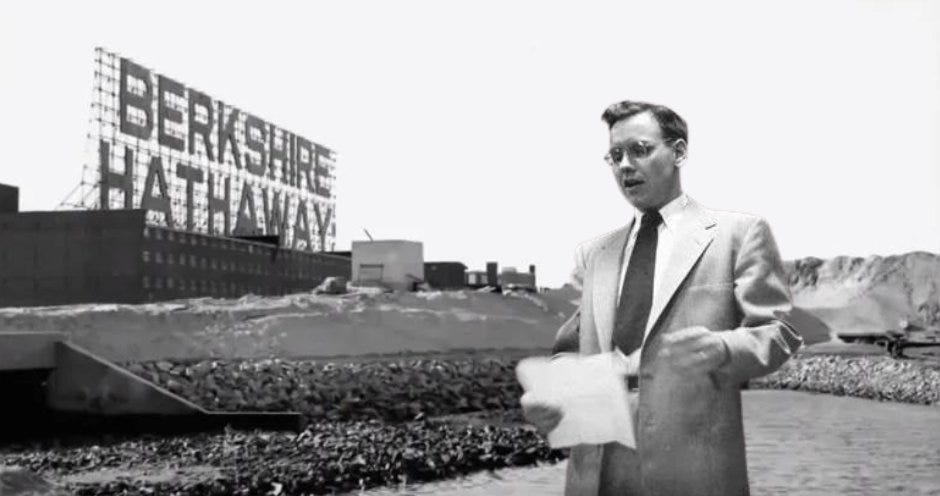
Warren Buffett stepped down as chairman of Berkshire Hathaway on Friday night after 56 years in the job. He is 96 and the most famous investor alive, and he explained it to shareholders in four words. “Father Time always wins.”
Buffett took control of a failing textile mill called Berkshire Hathaway in 1965 because the bloke running it tried to shave an eighth of a dollar off the price he’d promised for Buffett’s shares. Buffett bought more instead and sacked him.
He paid around US$15 a share back then. One of those same shares closed on Friday at US$763,600.
The whole mill was worth about US$22 million when he took it over. He used the mill’s cash to buy an insurance company, then the insurance company’s cash to buy everything else, and today Berkshire is worth US$1.09 trillion.
His most famous investment is Coca-Cola. He spent US$1.3 billion on the shares between 1988 and 1994 and the stake is worth about US$25 billion today. Coke now pays Berkshire more in dividends every year than the shares cost him.
By Berkshire's own count the shares are up more than 6,000,000% since 1965. A hundred bucks in the mill back then was worth US$6.1 million at the end of last year. The bloke is a legend of the game.
Down the small-cap end this week we saw a fair bit of news despite lower trading volumes, visible gold hit in drill cores in the US, copper continues to attract attention, and a biotech lost a third of its value.
What caught our eye this week:
ELK hits visible gold in hole one at Friday
MRD pulls more metal out of Grass Patch on half the chemicals
Copper juniors: FMR hits 60c and Gina buys into WCN
Attacks in Saudi send the Oil price north, what it means for juniors
AI1 gets its third US patent
Minerals 260 goes from small-cap to $2 billion gold developer
EVG is in Washington presenting on multiple fronts
Immutep loses a third of its value on a manufacturing answer
Where the money went this week: we dive into trading volumes
ELK Hits Visible Gold in Hole One
Elk Range Mining (ASX: ELK) found visible gold in its first drill hole at its Friday gold project this week. Seven specks turned up 122 metres down.
Edward Keys sat down with us in Perth this week, a long way from the mill floor at Friday where he keeps his sleeping bag. The trip home cost him the town’s annual picnic, and the locals let him know about it.
Friday has been mined on and off for the best part of a century, and the town has grown up around it. Friday’s site administrator is fourth-generation Idaho and lives in the cabin her great-grandfather built on a lease he pegged, and the guy scanning the old assay sheets for ELK lives 100 metres from the office and walks up.
It’s all to say Keys arrived in a town that knows the mine better than he does, and he’s hiring from the experienced pool.
Our launch write-up is here and Monday’s piece on the gold in the old core is here.
Keys told us the new hole started eight metres from the 2014 hole, and the new gold sits about 14 metres above the gold his team spotted on Monday in the old core.
“If you think about a big boulder in a stream, you’re going to find those nuggets in the pressure vortex downstream,” Keys said.
“The same physics applies to the gold we’re seeing in the core.”
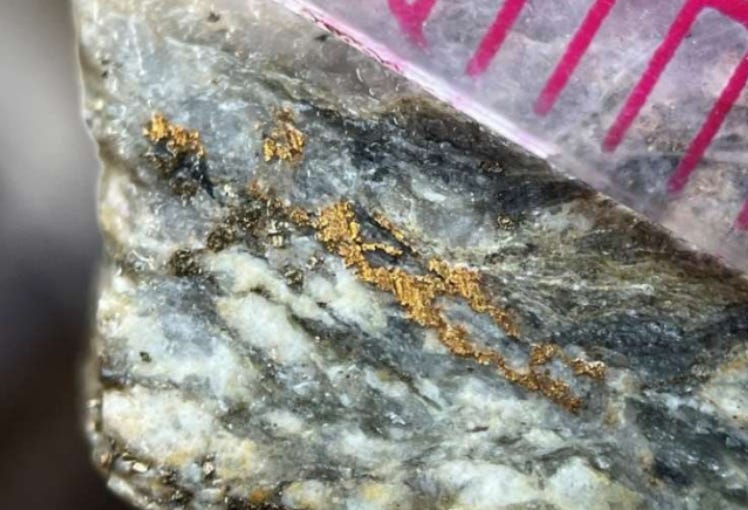
The veins at Friday pinch and swell, the gold sits just behind the pinch, and now his geologists have seen it in two holes 10 metres apart, they know what to look for in the next seven.
The rig has drilled past the point where the 2014 crew went home (450 feet), and the same veins keep coming up in the core.
It’s now running day and night shift, and the pad for the next three holes is already dug.
The assays for the new hole and the old core land late October or early November.
ELK closed the week at 17c and a $15 million market cap with $10 million of IPO money in the bank, so the market is paying $5 million for a mine someone else spent US$40 million building.
Keys flies back to the mill floor in two weeks.
MRD Gets More Metal on Half the Chemicals
Our critical minerals explorer Mount Ridley Mines (ASX: MRD) finished the week up 17.5% after its third Selectro test pulled 91.8% of the scandium out of Grass Patch clay on half the chemicals. You can find our full write up here.
Grass Patch is a clay deposit 25km north of Esperance in WA with the world's largest scandium resource in it, and the same clay carries the heavy rare earths that go into EV and wind turbine magnets.
Chris Larder spent a decade building Selectro before he joined MRD as chief technology officer in July and shared the recipe. A leach is the chemical bath the industry uses to pull metal out of crushed rock, and for clay like this everyone uses hydrochloric acid.
Every test came out of one bucket. The lab ground 16.8kg of Grass Patch core into one lot and took a 90 gram scoop for each run, so the acid and the three Selectro runs all started from the same dirt and the only thing changing between them was the recipe.
The acid got 27.6% of the scandium out. Selectro got 62.1% on its first run and 80% on its second, and on Thursday Larder halved the reagent and got 91.8%.
“Being able to manage the process to get outcomes like that is genuinely exciting,” Larder said.
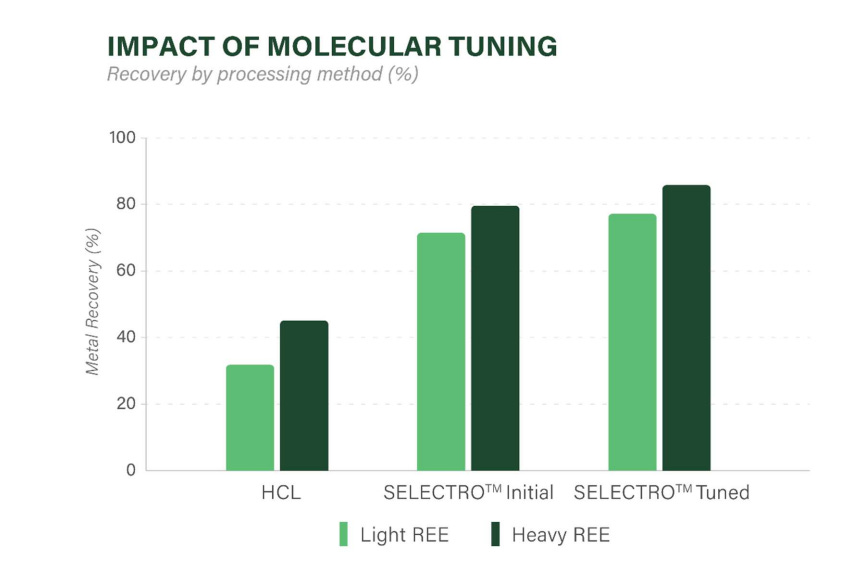
Dysprosium is the heavy rare earth inside EV and defence magnets, and it went from 39.4% under acid to 85%. Gallium went backwards to 41.5% from 55.8% in August because the same cut in reagent took it down, and MRD expects a richer feed from flotation to claw it back.
We backed MRD at 2.4c in March for the ground they had, and three tests in we think the process might be worth more than the ground.
After the bulk sample MRD wants to run Selectro over another company’s clay. If it works there, MRD clips the ticket on a deposit someone else digs, and there are a lot of clay rare earth projects out there looking for a cheaper leach.
Copper: BHP Now Makes More From It Than Iron Ore
Copper set a record of US$14,875 a tonne a few weeks ago.
We wrote in August about copper making BHP more money than iron ore for the first time in its history, and we’ve written “we’re hunting for a copper junior” in every wrap since.
This week two we’d already put in front of readers ran without us.
FMR Resources Hits 60c
We called FMR Resources (ASX: FMR) at 16c last year when the Chilean copper ground went into the company.
This week it hit an all-time high of 60c, up nearly 300% from our call.
FMR hunts porphyry copper in Chile. Porphyries are the big low-grade systems the majors mine, and FMR now has three of them north of Santiago.
Managing director Oliver Kiddie picked up La Lorena in May because it sits on the same structure as Los Pelambres, which Antofagasta runs as one of the biggest copper mines in Chile, and rock chips there ran 5.32% copper.
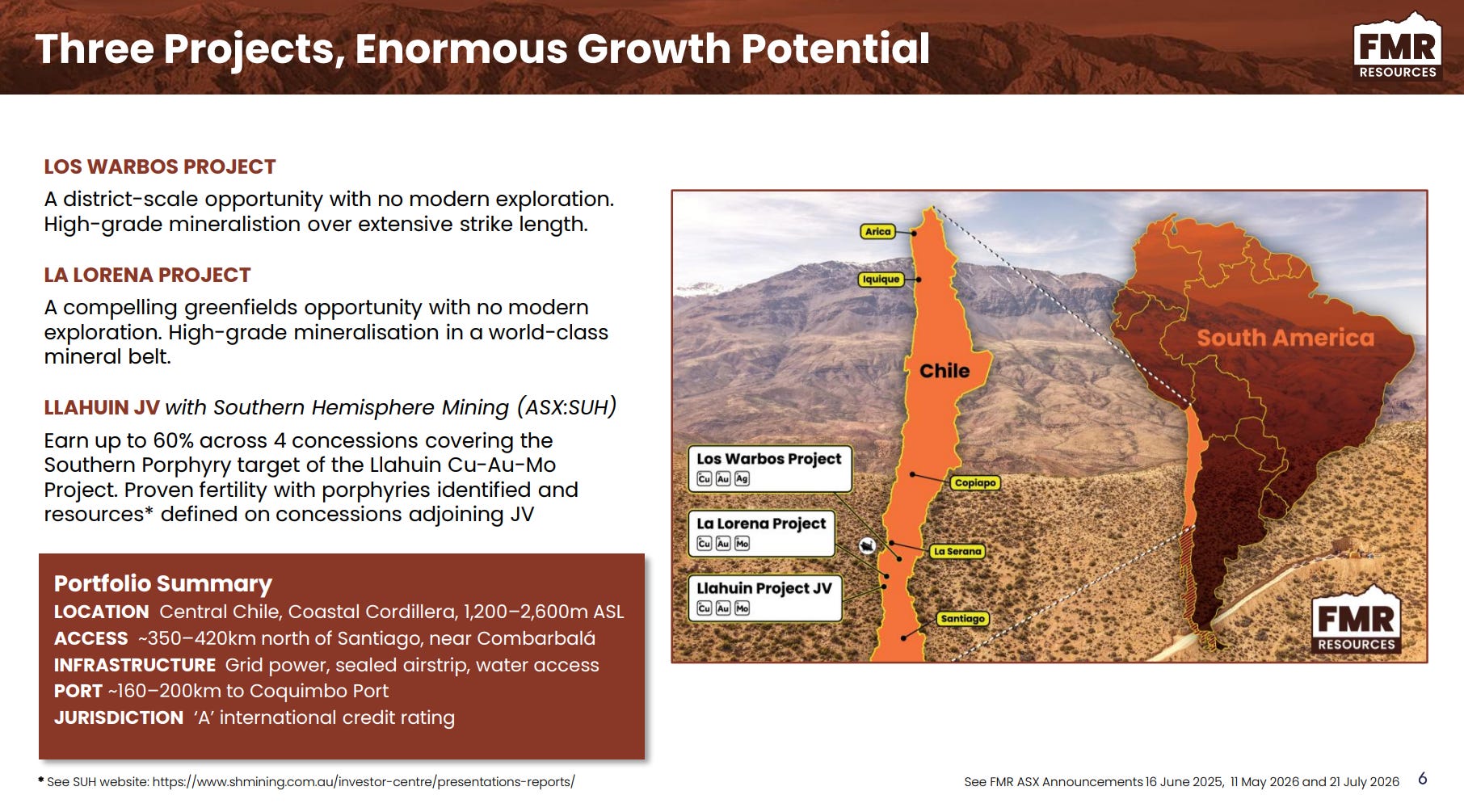
FMR optioned Los Warbos in July and its rock chips ran 10.77%. Neither has ever been drilled.
FMR is paying for the drilling at Llahuin to earn up to 60% of the project, and four holes there have confirmed a porphyry system with the main centre due to be drilled this quarter.
Legendary prospector Mark Creasy cornerstoned the drilling money, and the top 50 holders own 65% of the register.
Gina Rinehart Buys Into White Cliff Minerals
White Cliff Minerals (ASX: WCN) made our broker picks for the second half of 2026 at 1.7c in July.
On Monday Gina Rinehart’s Hancock Prospecting agreed to put $8.77 million into WCN at 1.7c for 13.5%, and the stock hit 2.4c. Shareholders vote on it in October.
The money goes into Rae, WCN’s copper project in Canada’s far north, where drilling at Danvers hit 175 metres at 2.5% copper. Hancock pays for the drilling, and when Australia’s biggest private company buys into a junior at market price, the next raise gets a lot easier.
We’ve spent six weeks looking for the perfect copper junior while two we’d already named went and did it.
Oil: The Pipeline Attack and Your Diesel Bill
Last week we told you to fill the car up before the weekend. Six months after Hormuz shut, drones hit Saudi Arabia’s East-West pipeline on 11 September, and the pump price has kept climbing since.
The pipeline is the one route for Saudi crude that skips the Strait, and knocking it out took up to 4% of the world’s supply off the table.
Brent jumped from US$96 to US$104 in the week it happened, touched US$108.75 on Tuesday, and closed this week at US$103.87 once the Saudis said the line would restart within days.
The fuel excise cut ended in early August and Treasurer Jim Chalmers says it’s staying ended. Australia holds about a month of fuel, and most of the diesel we burn comes in on a ship from Singapore or Korea.
Diesel is the biggest line on an explorer’s bill. Rigs, trucks and generators run on it, so every dollar on the barrel makes a metre of drilling dearer, and a junior with a year of cash gets a shorter year.
AI1 Gets Its Third US Patent
Our tech graphene play Adisyn (ASX: AI1) had its third US patent allowed this week.
We added AI1 to our portfolio in April at 6.8c, and it closed the week at 14c off the back of the news.
Every chip is a stack of copper wires, and each wire is wrapped in two layers. A barrier layer stops the copper leaking into its surroundings, and an insulating layer keeps one wire’s signal from bleeding into the next.

As chips shrink under five nanometres, the wires get thinner but the wrapping can only get so thin before it stops working. Engineers call the space lost to wrapping the barrier tax.
Adisyn grows graphene one nanometre thick at under 400 degrees, cool enough for a chip factory. The first two patents covered laying it on the copper. This one covers laying it on the insulator, so AI1 now owns the recipe for both sides of the barrier.
For a company like this, a patent is the difference between a lab result and something a chipmaker will pay to license. Executive chairman Kevin Crofton spent 30 years selling equipment to those chipmakers, and he now walks in with three allowed US patents and a 200mm wafer.
From Monday AI1 joins the All Ordinaries, the 500 biggest companies on the ASX, which puts it inside the size limit a lot of fund managers work to.

Minerals 260 Grows From Small-Cap to $2 Billion
In January last year Minerals 260 (ASX: MI6) was an 11c explorer with Tim Goyder in the chair, the size of company we write about in this wrap every week.
Then it wrote a $156.5 million cash bill, added $10 million in shares, and bought Bullabulling, an old open pit gold project 65km west of Kalgoorlie with 2.3 million ounces already in the ground.
The bill was many times what the whole company was worth at the time.
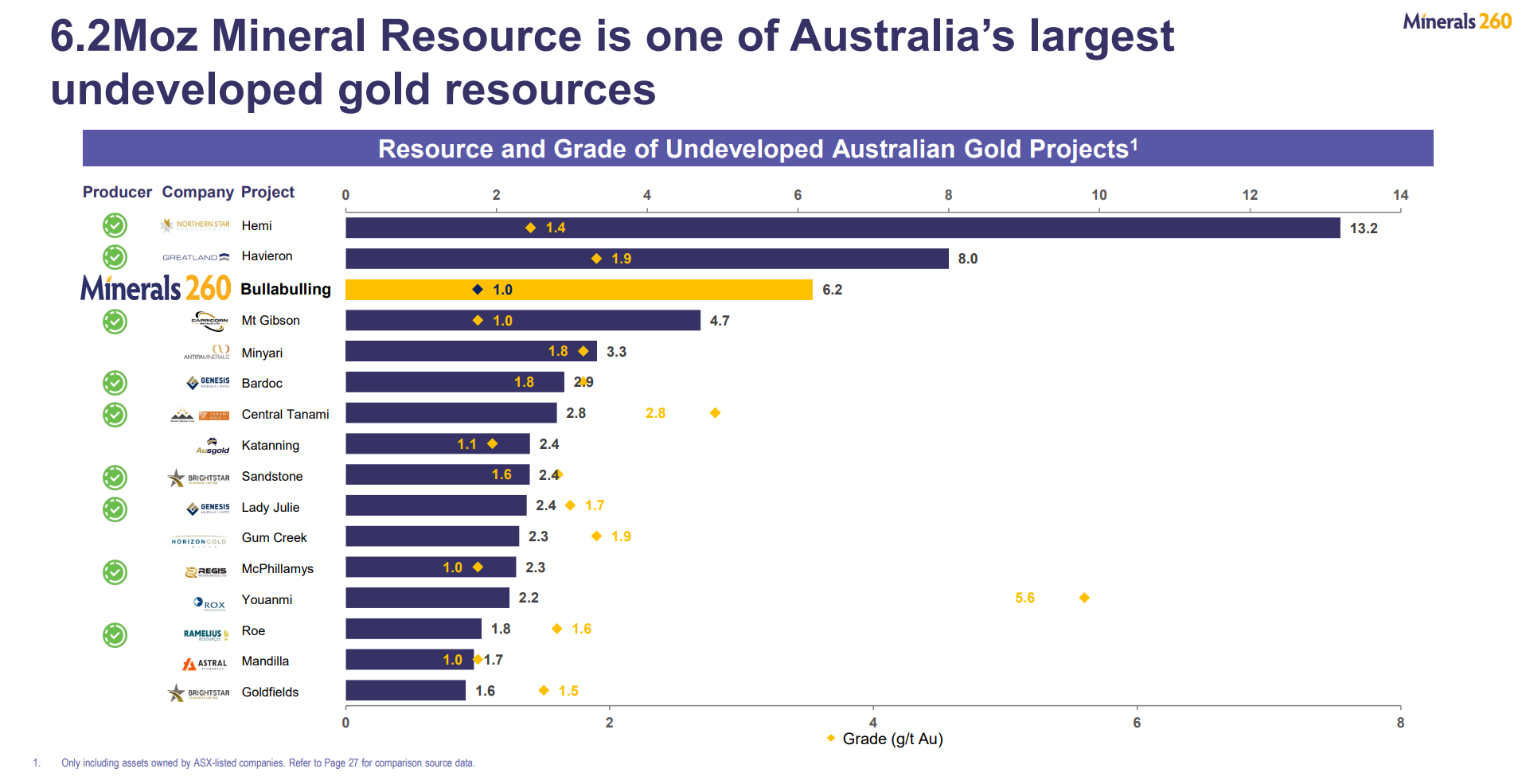
Eighteen months on, the resource sits at 190 million tonnes for 6.2 million ounces, nearly three times what they paid for, and Franco-Nevada, the biggest gold royalty company on earth, has put $420 million into the project since February in its largest commitment ever made in Australia.
This week MI6 raised another $250 million at 88c (no discount to the share price) with a $30 million share purchase plan for the retail holders who backed it early. The company now has $633 million towards an $855 million mine, with first gold pencilled for 2028.
MI6 closed the week at 94c, a touch over $2 billion. Eight-and-a-half times the price on the day they bought the ground, and they are still years away from pouring gold.
EVG Gets a Second Door Into the Pentagon
The US hasn’t mined fluorspar since 1995 and imports every tonne it uses, which is a handy fact to have on your side when you’re asking the Pentagon for money.
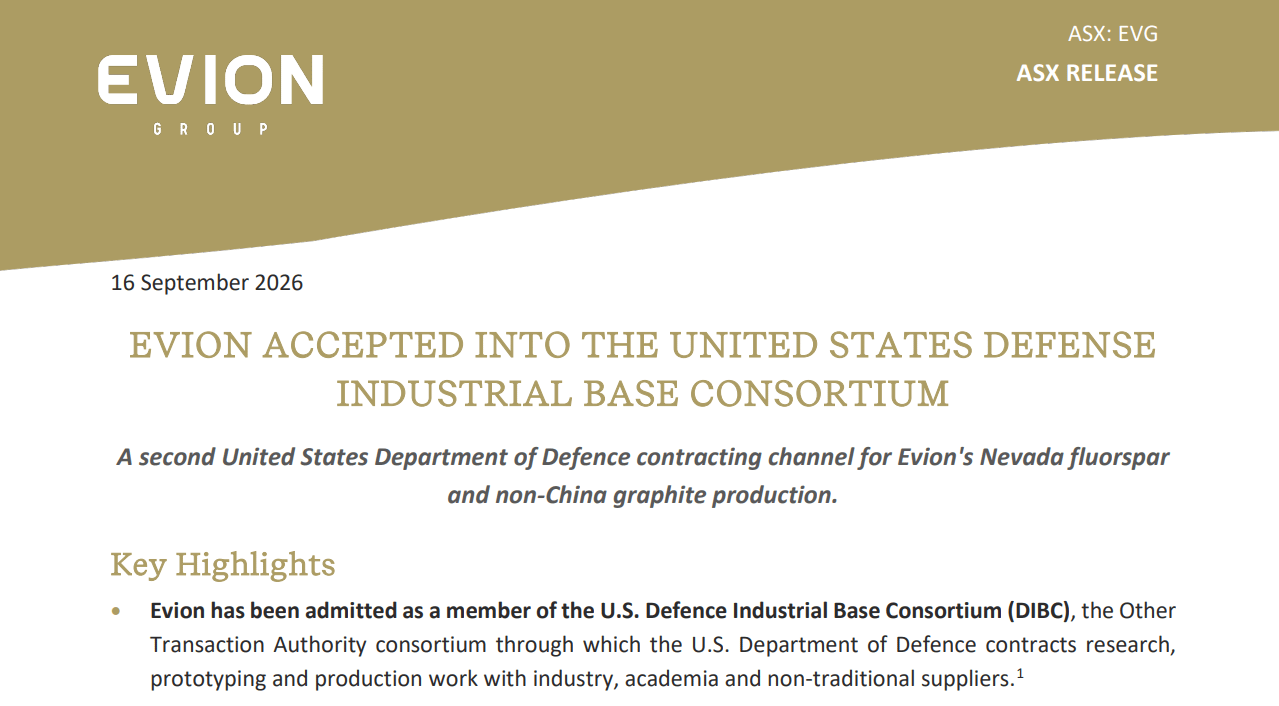
Our graphite and fluorspar company Evion Group (ASX: EVG) was accepted into the Defense Industrial Base Consortium this week, the second US defence buying group it has joined since August.
Members get to see the Pentagon’s requests before anyone else and bid on them, and this one has handed out US$362 million across 51 projects since 2024, with US$159 million of it going to critical minerals.
EVG turns up with two minerals the Americans desperately want. Carp is an old fluorspar mine just over 100km out of Las Vegas. On the graphite side it has a fully permitted mine in Madagascar and a plant in India making the fireproofing material for warships and armoured vehicles, which hardly anyone outside China makes.
None of the US$362 million has come EVG’s way yet. The next time the Pentagon puts money up for fluorspar or graphite, EVG is on the list of companies allowed to ask for it.
And the Carp rock chips are still at the lab.
Immutep Falls 32% on a Manufacturing Answer
A Sydney biotech with one drug lost a third of its value this week for telling the market why its big trial failed.
Immutep (ASX: IMM) makes efti, which is meant to wake up the immune system so it attacks tumours. Biotechs like this earn nothing for years. They raise money and run trials, and the share price lives or dies on what the patients do.
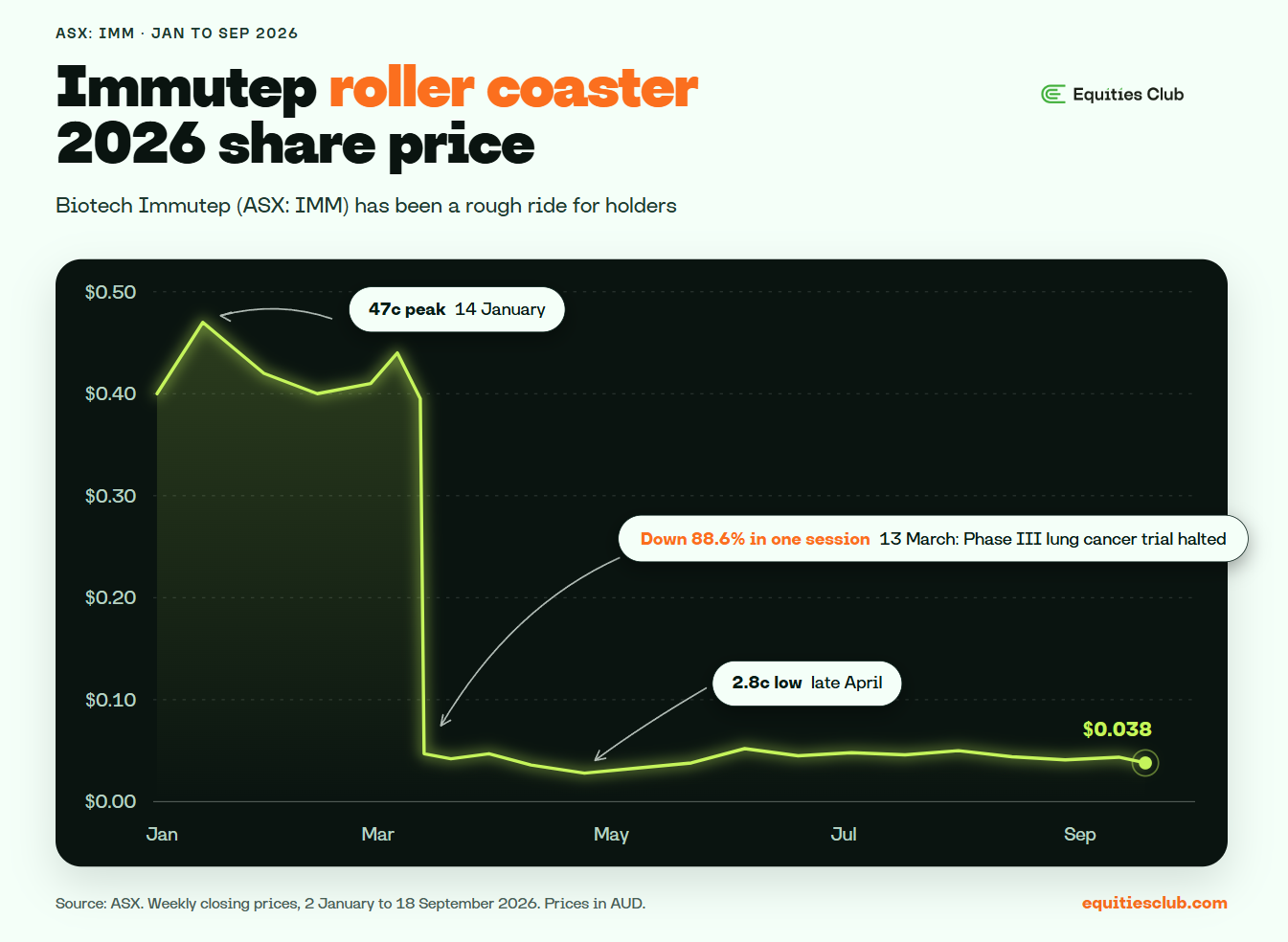
In March Immutep stopped its Phase 3 trial in lung cancer. Half the patients got chemo and Keytruda and the other half got chemo and Keytruda plus efti.
Chemo and Keytruda is the standard treatment for that cancer, and the patients who got efti on top finished about level with the other half.
The stock lost about 90% of its value in one day.
Friday last week the company said it thinks it knows why. The drug in the failed trial was brewed in a 2,000 litre tank. Every earlier trial that worked used a 200 litre tank, and the bigger batch came out with a slightly different sugar coating on the protein.
So Immutep has ordered a fresh 200 litre batch and plans new trials in head and neck cancer and sarcoma, starting in the second half of 2027.
Holders sold anyway. IMM fell from 5.7c to 3.8c on nearly $6 million of turnover, because a reason for the failure is two years and a lot of money away from a result.
Where the Money Went This Week
If it feels like nobody is trading the small end lately, you have company. This week we pulled the turnover for every one of the ~1,800 companies on the ASX to find out how much money has left our end of the market.
The whole market did $56 billion of trade this week. A month ago it did $46 billion and this time last year it did $53 billion, so on the face of it the market is busier than it was.
Friday alone did $22 billion, that’s because the third Friday of September is when S&P rebalances its indices and the futures expire, so every index fund in the country has to trade at the close.
Take Friday out and the big end did $34 billion against $29 billion a year ago. The ASX 200 is down 3.6% since August, so most of the extra was people selling.
The ~1,000 companies under $100 million in market cap traded $179 million for the week. The same week a year ago they traded $390 million, and back then the gold and copper fever had punters buying anything with a drill rig in the photo.
Punters are still trading, they have just moved up the register. Winners like MI6 graduated out of the small end and took their turnover with them, and the investors still down here have stopped buying on a drill photo.
They want a real asset and a management team with a track record before they part with their money. These are the type of opportunities we chase as small-cap investors.
What to Watch this Week
AI1 joins the All Ords on Monday, and the quarter ends on Wednesday, so every junior on the ASX is counting its cash for the September quarterly.
The drones hitting Saudi pipelines keep oil above US$100, and the ones KTK builds start shipping again this month with a new Israeli customer on the books.
Copper sits near its record with the Chinese back from holiday on 8 October, FMR drills in the coming weeks as our copper junior search continues.
Gold is at US$4,392 and ELK’s assays land late October. Until then Keys has seven more holes to drill and a picnic to make up for.
Most importantly, Freo’s in the AFL grand final next Saturday, which is a sentence we've waited a long time to write. It's wharfie time. We hope. And we can’t vouch for the quality of next Sunday’s piece if they get up.
Till next week.
Always interesting, thanks for the best read on shares