


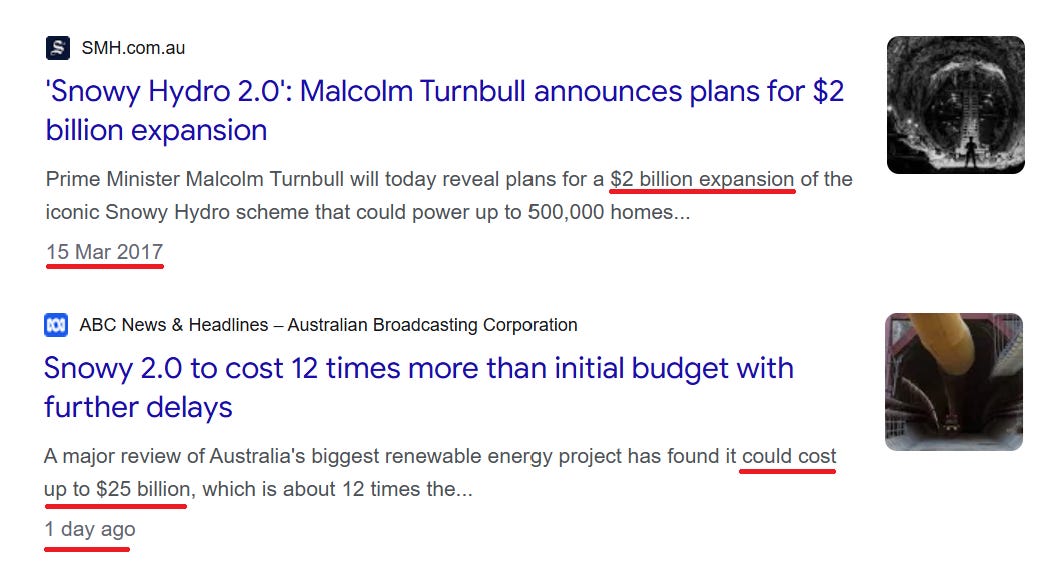
Malcolm Turnbull announced Snowy 2.0 in 2017 as a $2 billion job that would take about four years.
Nine years later the power storage scheme sits unfinished and the bill has grown more than 12 times, with Snowy Hydro, the government company building it, now putting the cost at up to $25 billion.
It’s the latest in a long line of government bin fires, with French submarines, Comm Games, the Big Build and Inland Rail among the ones stoking the flames before it.
As Reagan once said, a government bureau is the nearest thing to eternal life we’ll ever see.
In Melbourne’s west, NextDC lived through the power shortage Mark Zuckerberg and Anthropic have both warned about, losing about $3 billion of value in a day after locals blocked the power poles its data centre needs. More on that below.
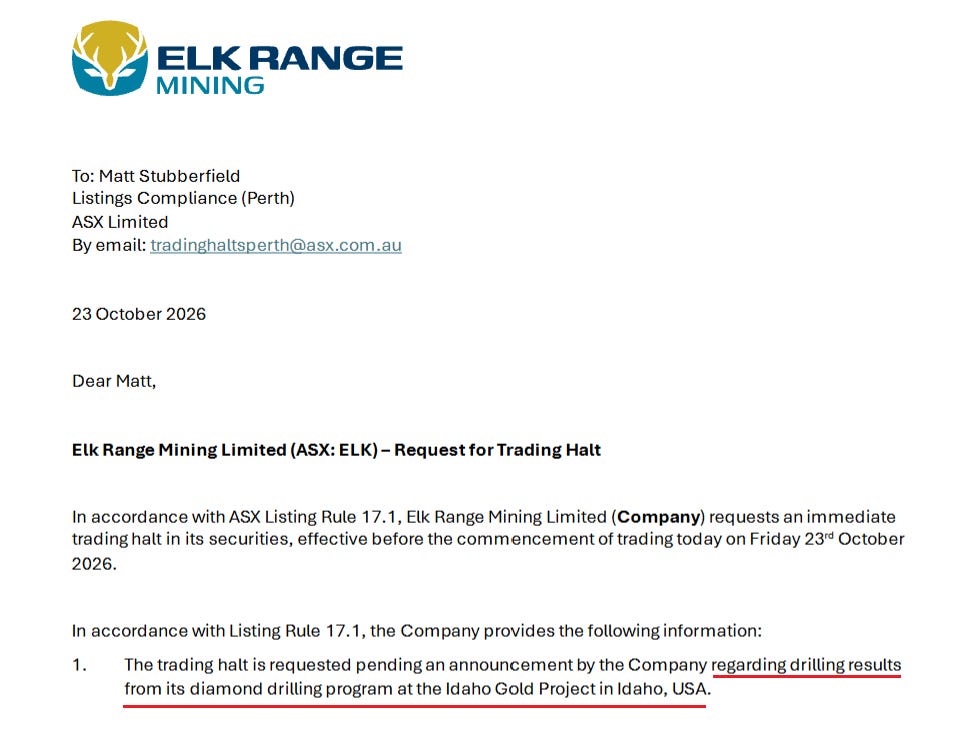
Our Idaho gold explorer Elk Range has a shorter wait than nine years. It went into a trading halt on Friday for the assays from its first hole and we find out the grade this coming week.
What caught our eye this week:
Elk halts for the first grade from its hole beside the old 112 metre hit
Copper in FMR’s first Chilean hole and a new high for the shares
MRD pulls 95% of the gallium out of WA bauxite
Adisyn hires the man who ran Tower’s chip factories
Fortuna maps Mkanda from the air with $12.8 million in the bank
NextDC loses $3 billion in a day over power poles in Melbourne’s west
Hawk’s first lab assays land 60 times under the handheld readings
Evion maps the faults under its old Nevada fluorspar mine
10X’s copper corridor at Watsons grows to 3km
Let’s get to it.
Elk Range Halts for Its First Grade
Our Idaho gold explorer Elk Range Mining (ASX: ELK) asked for a trading halt on Friday with the assays from its first hole at the Friday gold mine on the way.
The halt came at 13.5c, which values Elk at about $17 million.
Friday is a built and permitted underground gold mine in central Idaho the last owner parked during Covid.
The best hole anyone drilled there ran 112 metres at 5.22 grams of gold a tonne in 2014, and the crew stopped it at 137 metres with gold still in the core.
Elk put its first hole eight metres from it and kept going 200 metres past where the old crew stopped. The geologists logged visible gold at five depths on the way down, as deep as 234 metres.
We wrote last week that US$100 billion gold major Agnico Eagle paid US$14.8 million for a slice of the ground around Friday.
When Elk listed in August we said the ground below the old hole was why we bought it. The assays are due by Tuesday’s open.
FMR Finds Copper and Hits a New High
We called copper explorer FMR Resources (ASX: FMR) at 16c last year, and this week it hit an all-time high of 71c after its first hole at La Lorena in Chile came up with copper in the core.
La Lorena sits on the same structure as Antofagasta’s Los Pelambres, one of the biggest copper mines in Chile. Locals once dug copper out of the hills there by hand, and rock chips from their old workings ran up to 5.32% copper.
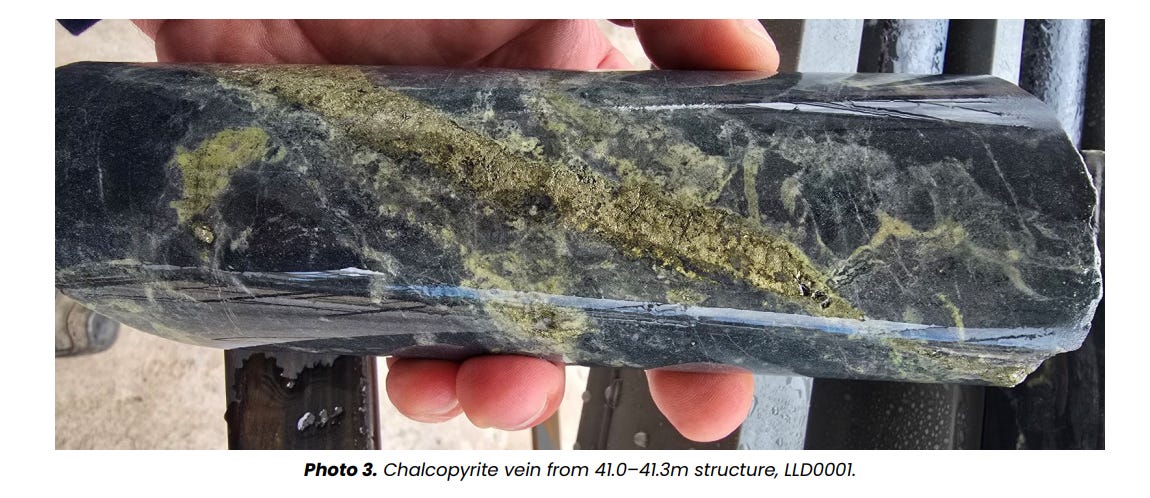
A rock chip is the best-looking piece of rock a geologist can find on the surface, and the drill hole is the first look at what sits under the workings.
The first diamond hole under the old workings logged copper minerals across several structures and reached the edge of a porphyry. Porphyries are the giant copper systems most of Chile’s big mines are built on.
The assays are due in four to six weeks.
A run from 16c to 71c in a tough market is why we get into explorers early.
MRD Gets 95% of the Gallium
China refines 99% of the world’s gallium, and the chips inside American radar run on it. Beijing banned gallium exports to the US in December 2024, so Washington is paying for a plant at Alcoa’s Wagerup refinery south of Perth to pull gallium out of WA bauxite. Japan and Canberra are chipping money in too.
Alcoa’s plant will get at about 70% of the gallium in the bauxite.
On Wednesday the critical minerals explorer in our portfolio Mount Ridley Mines (ASX: MRD) said its Selectro leach got 95% out of the same bauxite in a lab on its first go.
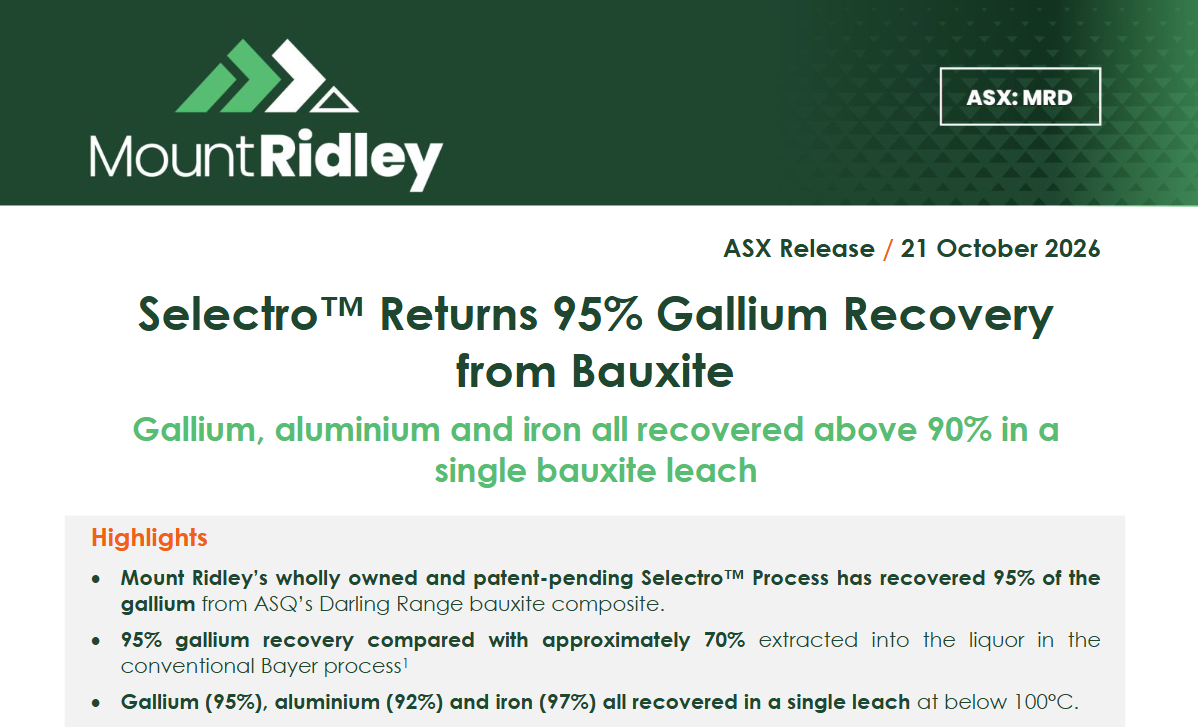
The three governments paying for Alcoa’s plant should be reading our full write-up on the gallium result, which is here.
Selectro is the leach MRD built for the scandium clay at its Grass Patch project near Esperance. It pulled the aluminium and the iron out of the same bauxite a week earlier, and what it left behind was a pile of sand, compared to a dam of caustic red mud that a refinery leaves.
Beijing paused its ban for a year last November. The pause runs out on November 27, and if China lets it lapse the ban is back on.
MRD wants to make its money inside other people’s refineries. It lodged a patent on the bauxite chemistry last week and wants to license Selectro to the refiners who own the bauxite, so the refiner would do the digging and the refining and MRD would get paid every time its chemistry ran.
A second bauxite test is under way, and MRD has pulled forward a demonstration plant in Perth to run the process in bulk.
The shares ran as high as 5.4c on Wednesday and finished the week at 4.2c. We bought MRD at 2.4c in March for the scandium in the clay, and Selectro has beaten our expectations four announcements in a row. The company is worth about $60 million today.
Adisyn Hires the Man Who Ran Tower’s Factories
For 20 years Ephraim Koltin was the man a materials company had to convince before its process got anywhere near a chip production line at Tower Semiconductor.
On Tuesday Adisyn (ASX: AI1) hired him to go and do the convincing.
Tower is a US$22 billion chipmaker, and Koltin ran every factory it owned in Israel, Japan and the US with 2,700 staff reporting to him.
AI1’s subsidiary 2D Generation grows graphene inside the same machines Tower runs, and Koltin is its incoming CEO.
Our article on the hire is here.
The chips in phones and AI servers are wired with copper tracks called interconnects, and below two nanometres the copper runs hot and chokes.
Graphene is a sheet of carbon one atom thick, and a chip wired in it runs faster and cooler on less power.
Across a data centre full of AI chips, the electricity lost to hot copper adds up to a small city’s power bill.
Koltin’s job from day one is to get AI1’s wafer results in front of the chipmakers and sign the first one to a binding deal.
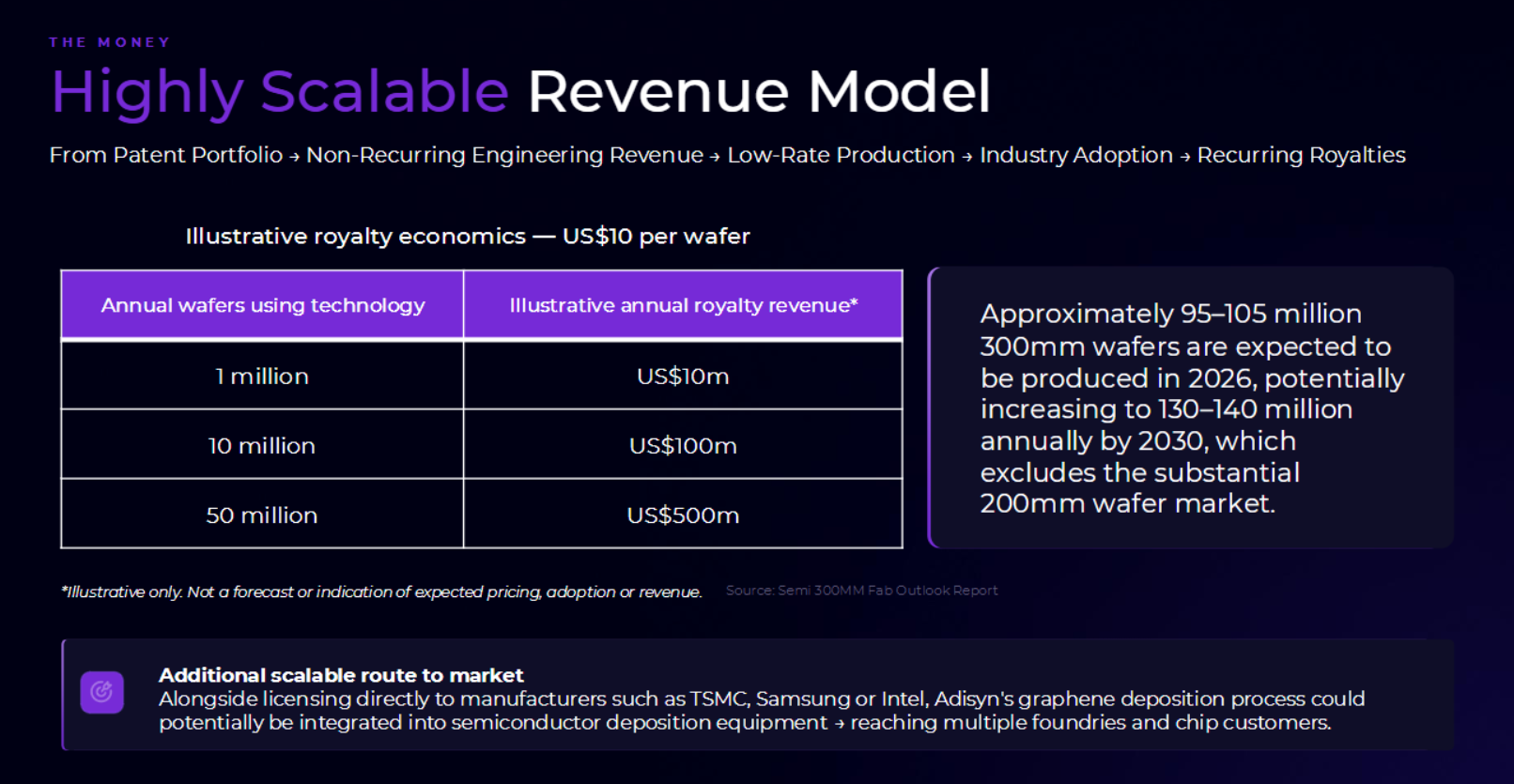
Of his 10 million performance rights, 8.5 million are worth nothing until AI1 holds 34c, which is more than four times today’s price. Another lot only pays once two contracts with people he introduced are worth US$1 million between them.
The board has basically written his list of contacts into his pay.
A heavy hitter taking the job at a $92 million company is the biggest vote of confidence in the graphene we’ve had yet.
AI1 finished the week at 7.8c with about $15 million in the bank, and we’re sitting down with Koltin in the coming weeks.
Fortuna Maps Mkanda From the Air
Rutile explorer Fortuna Metals (ASX: FUN) has a drone with a laser scanner flying over 180 square kilometres of Malawi farmland this week, mapping the ground around its Mkanda project to the metre.
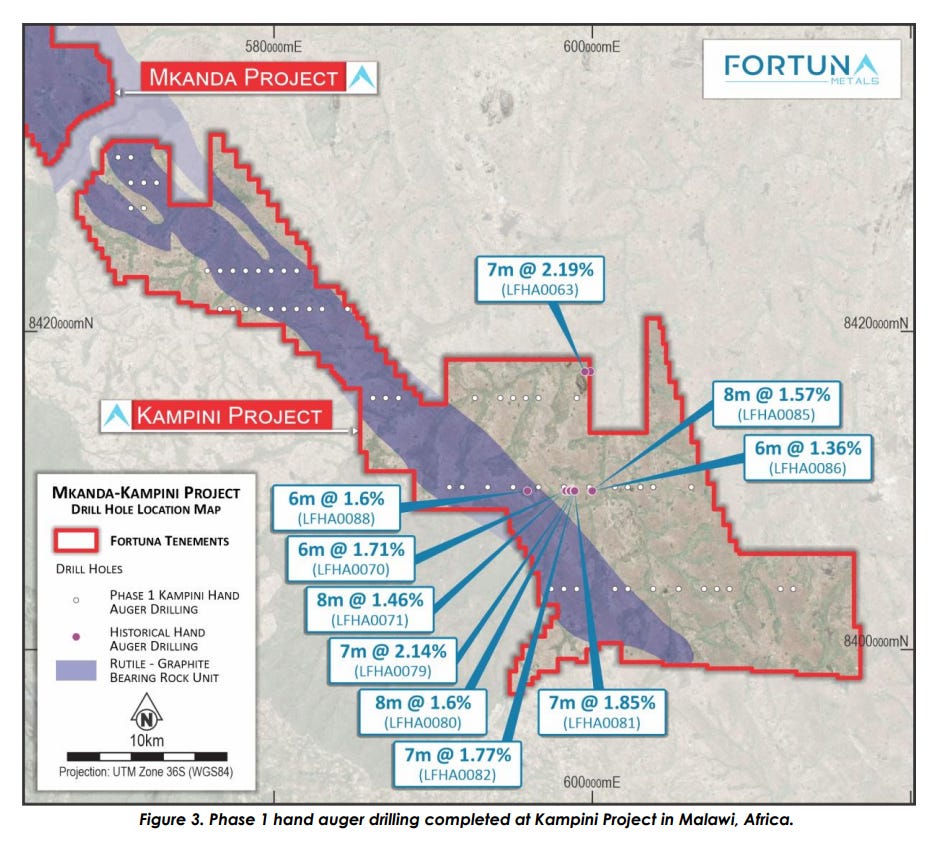
Mkanda holds 298 million tonnes at 0.87% rutile, and all of it sits in the top eight metres of soil. When the ore is that shallow, knowing where the surface is to the metre decides how many tonnes go into the resource.
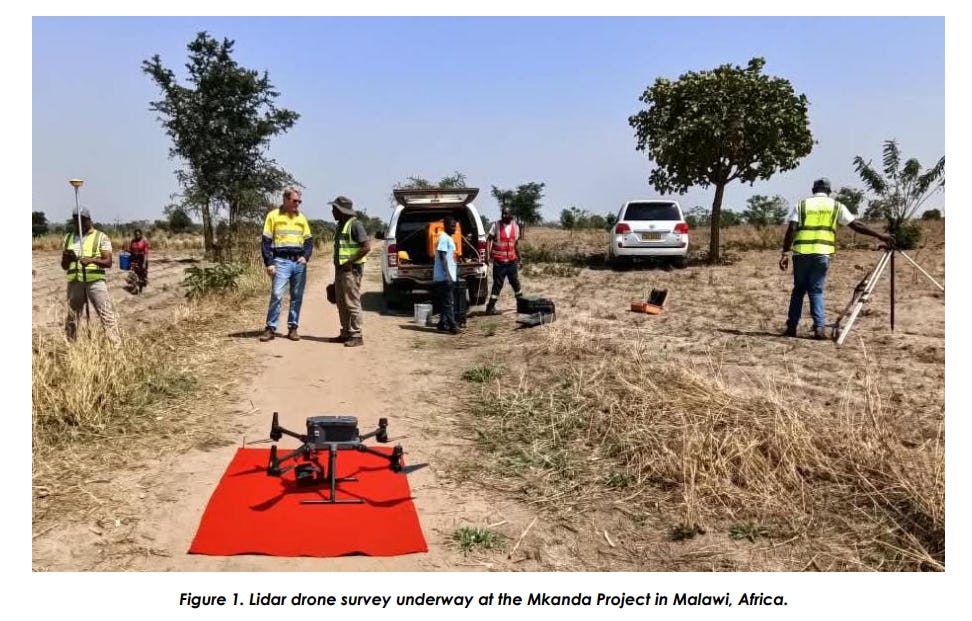
FUN needs the map to lift the resource from inferred to indicated before its pre-feasibility study starts in December.
A fortnight ago FUN drilled below eight metres for the first time and the rutile kept going.
The survey will be done by the end of October, and the next aircore assays from the Kahuna and Agogo prospects land shortly after. Hand augers are also drilling the first 66 holes at Kampini, FUN’s second tenement, along 50km of the same rutile trend.
FUN had $12.8 million in the bank at the end of July, so all of it gets paid for without a raise.
FUN slid from 8c to 6.6c this week in thin trade and is worth about $28 million.
We’ve backed FUN since it was 4c last September. At $28 million for one of the six biggest rutile deposits in the world, with $12.8 million in the bank and a study starting in December, we think the slide is the market and the project keeps getting better.
NextDC Loses $3 Billion in a Day
We were escorted through one of NextDC’s Perth data centres a few years back for a look around. The security was tighter than anything we’d been through. The room at the end was spotless and white and full of racks, and in the pre-AI era it just looked like a very expensive place to keep other people’s hard drives.
NextDC (ASX: NXT) is the biggest data centre company on the ASX, and its M3 campus in West Footscray needs more power from the grid to keep growing.
The extra power needs taller poles down the streets of Yarraville and West Footscray, and the locals didn’t want them outside their houses. The power company stopped putting them up in September and won’t start again before February.
NextDC came out of a trading halt on Wednesday and cut next year’s earnings guidance from up to $410 million to at most $265 million.
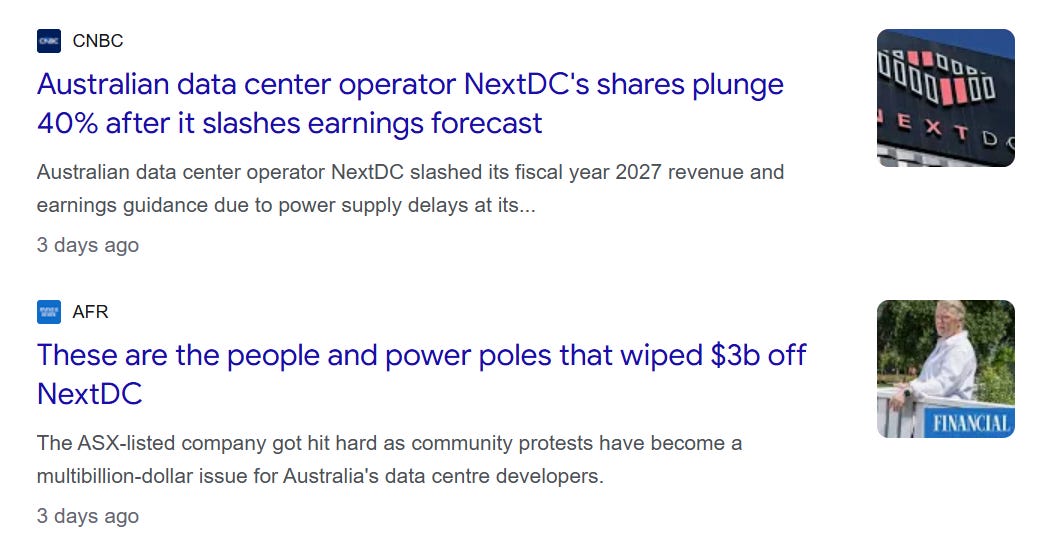
The shares closed at $5.35 on Wednesday, down 42% and their lowest since 2018. They finished the week at $5.61 and have now fallen eight weeks in a row.
Mark Zuckerberg said on a podcast a couple of years ago that Meta would probably build bigger data centres than it can now if it could get the energy to do it.
Last week Microsoft walked away from a data centre in England because the grid can’t feed it until the 2030s. Anthropic listed community opposition to data centres as a risk to its business in the draft IPO prospectus reported this week.
Morgans upgraded NextDC to a buy on Thursday at $7.50, about what its buildings are worth on paper.
Hawk Falls 70% on Its First Lab Numbers
A scandium explorer lost 70% of its value on Friday when its first lab assays came back a long way under the handheld readings it bought the project on.
Hawk Resources (ASX: HWK) holds a 7km by 4km patch of WA’s West Musgrave called Olympus. A handheld analyser is a screening tool a geologist points at dirt in the field, and old readings from one ran above 500 parts per million scandium at Olympus.
The first batch of soil samples through a lab topped out at 11.2.
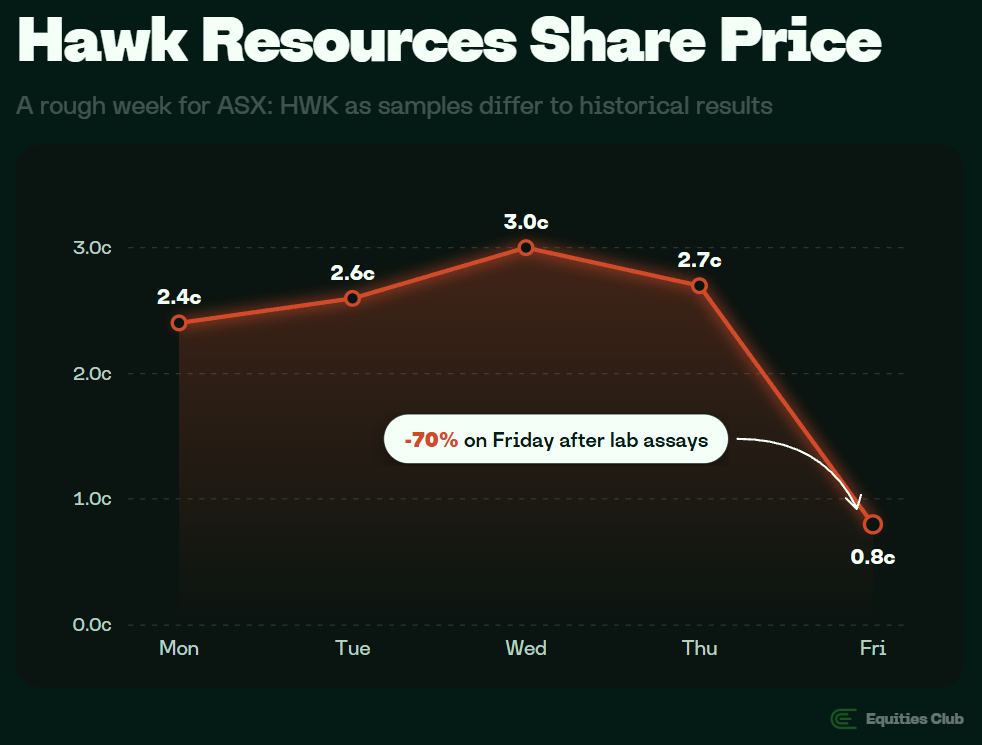
Hawk closed at 2.7c on Thursday and got smashed down to 0.8c on Friday.
The readings were 20 years old and came from another explorer, and it’s a tough road back for holders from here.
Evion Maps the Faults Under Carp
Carp is a fluorspar mine in Nevada the previous owners dug 44,900 tonnes out of between 1958 and 1971, and the ground under the old pits has never been drilled.
The graphite and fluorspar company in our portfolio Evion Group (ASX: EVG) has the right to buy Carp, and this week it flew a drone with a magnetometer over the whole claim.
Fluorspar is where the fluorine in refrigerants and lithium battery electrolyte comes from, and the US imports nearly all of it.
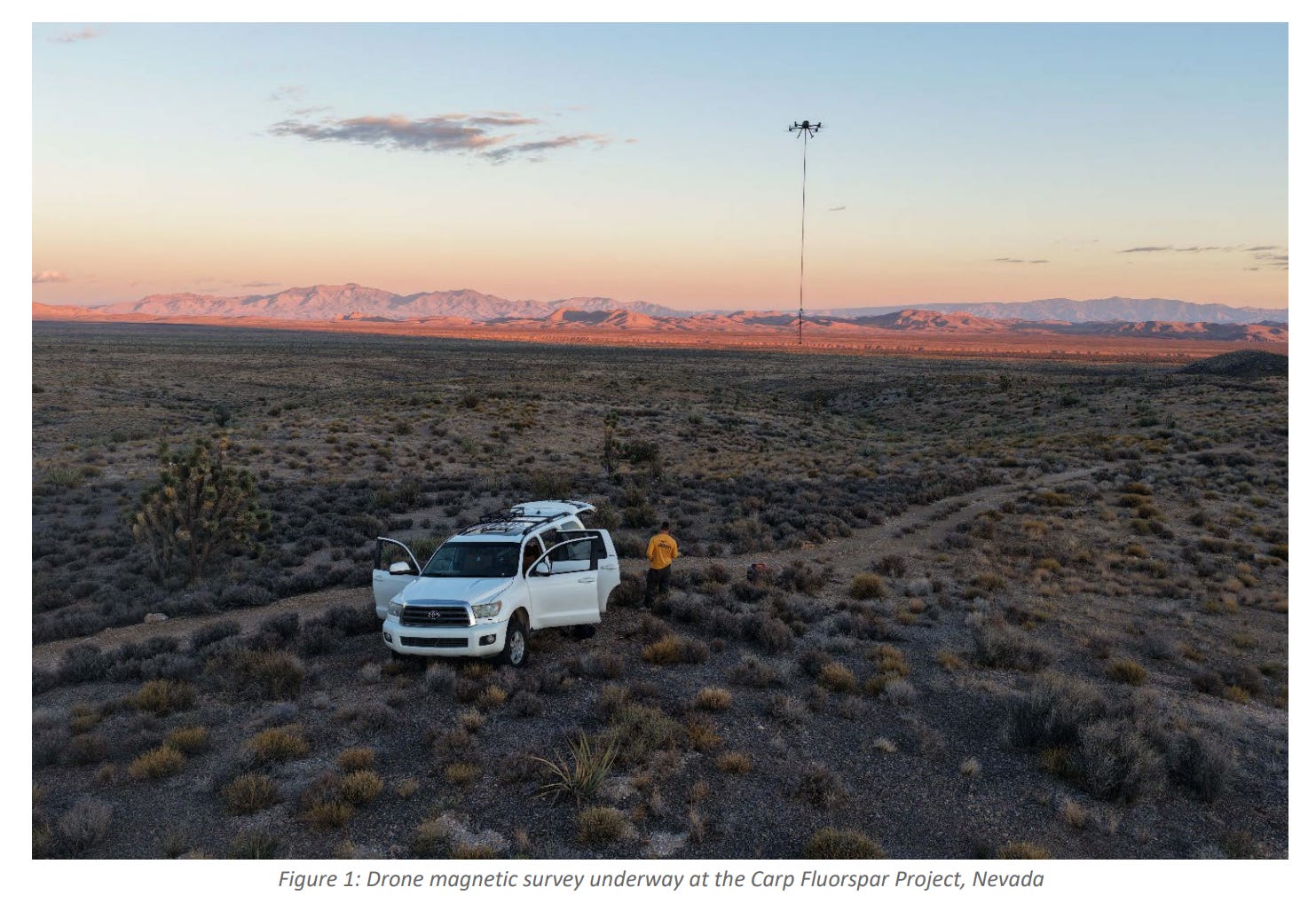
A magnetometer reads the magnetism in the rock below, and a fault shows up as a break in it. EVG will use the survey to find the faults the fluorspar sits along and place its first drill holes there.
The data lands in about a month, and assays on 41 hand-picked rock chips are due through November.
At 1.3c EVG is worth about $11 million with $5.7 million cash at bank, and we like a company that maps its faults before it spends a dollar on a drill rig.
Exultant’s Copper Corridor Grows to 3km
The smallest company in our portfolio made its copper corridor 600 metres longer this week, and all it took was the landholder to the south signing an access agreement.
We wrote last week that Exultant Mining (ASX: 10X) had gone back over a 2.4km line of 1970s copper and zinc soil readings at Watsons.
Watsons sits inside Black Hammer, 10X’s copper-gold project three hours west of Sydney in the same belt as Newmont’s Cadia mine.
Exploration manager Seb Hind’s crew took 99 more readings with the handheld analyser, and the corridor now runs 3km. They found where it ends in the south and it’s still running in the north. The best new reading was 173 parts per million copper and 255 zinc.
Next 10X pushes the grid northeast and looks at ground geophysics to pick the first hole at Watsons.
Executive chairman Brett Grosvenor calls it two phases of cheap soil work turning a 1970s anomaly into a 3km target.
10X is worth under $5 million at 12c with about $2.8 million in cash, and from a company that size, cheap is a word we want to hear.
The Week Ahead
Elk comes out of its trading halt this week, and we haven’t waited on a lab result like this in a long while.
We’ll be at IMARC in Sydney from Tuesday to Thursday with about 12,000 people from the mining game. Will report back.
Agnico Eagle’s vice president of Australian operations Ion Hann is on the speaker list, and after his company’s deal next door to Elk we’ll be in the front row when he speaks.
The data centres we opened on turned up in the Reserve Bank’s thinking on Wednesday, when deputy governor Andrew Hauser said the inflation outlook has got materially worse and named the data centre boom as one of the reasons.
Inflation numbers land on Wednesday morning and the RBA decides on rates on Melbourne Cup day, with two of the big four banks tipping a rise. A rise makes every capital raise at our end of the market harder.
Every junior on the ASX has to put out its quarterly by Friday, with how much cash it had on September 30 and how fast it’s spending it. After a quarter like this one, we’ll be reading the cash line before anything else.
Till next week.
The NextDC episode is a good example of power access becoming the binding constraint for data centre builds, with about $3 billion of value lost in a day over blocked power poles.