


Just when you start to get too down about the state of Australian markets, a billionaire comes along and kickflips a car over a row of Teslas to remind you how unpredictable the future is.
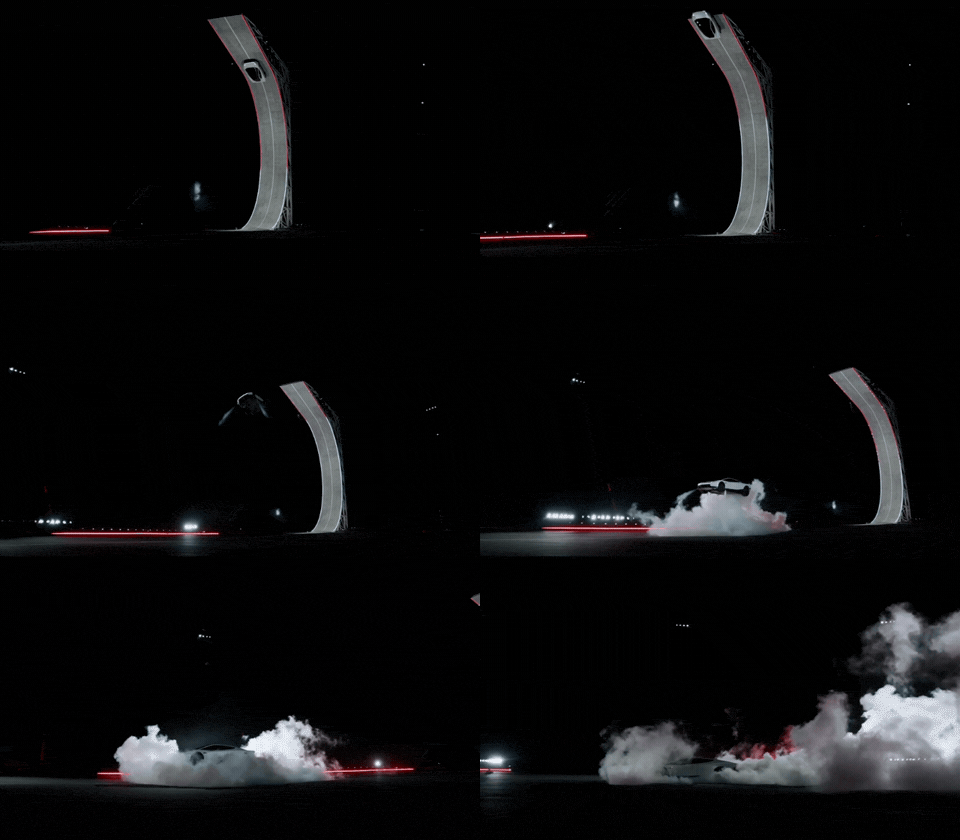
You’ve all seen it by now. Elon Musk put the new Roadster on a livestream from SpaceX’s yard in Texas, sent it up a ramp and flipped it upside down, and landed on its wheels on rocket thrusters.
“Well, it worked,” he said. An understatement, after delivering the George Jetson moment we were promised as kids.
Elon’s haters were out before the thrusters had cooled, saying it’s years behind schedule and it’ll never be legal on a road. They’re right, but who cares. He just showed us a flying car, and god knows what, if anything, that means for the future.
People have been betting against Musk since Tesla listed in 2010. In 2020 the short sellers lost US$38 billion on Tesla, the biggest loss anyone had ever recorded on one stock, and he’s now the richest man alive.
It’s all to say it’s never as bad as it seems (or as good).
We’ve heard small-caps declared dead at a few barbecues recently, and it’s been said about bigger markets than ours.
In August 1979 BusinessWeek put “The Death of Equities” on its cover in big white letters. Three years later the biggest bull market in history began, and the S&P 500 has returned close to 7,000% since with dividends.
And the people at our end of the market are still having a go.
What caught our eye this week:
Agnico pays US$14.8 million for the ground around Elk
Powerhaus jumps 24% on no news
MRD pulls 92% of the aluminium out of a pile of bauxite
Copper sets a record in a year with zero new discoveries
KAO finds out what visuals weigh
A 20c pregnancy test company lists into the sell-off and doubles
10X finds the copper the 1970s left behind
Let’s get to it.
Agnico Backs the Ground Around Elk
We nearly fell off our chair on Friday when a deal landed right next door to our Idaho gold explorer Elk Range Mining (ASX: ELK), at a price that makes Elk look cheap to us.
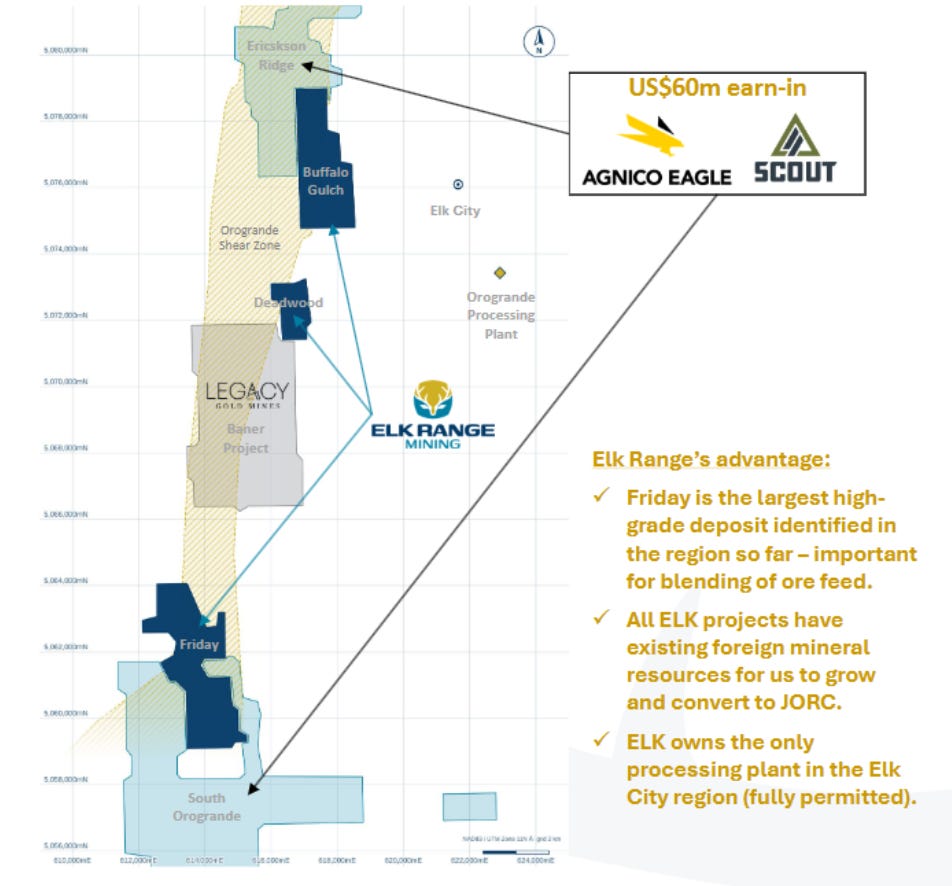
Canadian gold major Agnico Eagle paid US$14.8 million for 14.9% of Scout Discoveries, a private explorer whose ground almost completely surrounds Elk’s Friday gold mine.
For anyone new to the name, Agnico is one of the biggest gold miners on the planet, worth just under US$100 billion. It owns Victoria’s Fosterville mine and expects to produce more than 3.3 million ounces of gold this year.
US$14.8 million for 14.9% puts Scout at close to US$100 million.
Agnico’s US$14.8 million works out at about A$21.5 million, and the whole of Elk is worth about A$17 million at 13.5c.
Scout’s best hole in its latest investor presentation ran 100.6 metres at 1.2 grams of gold a tonne from surface.
Elk’s 2014 hole at Friday ran 113 metres at 5.22 grams a tonne from 24 metres down.
The last owner of Friday spent more than US$40 million on it and mined underground from 2018 to 2022.
On top of the shares, Agnico can earn up to 70% of Scout’s ground in the Elk City district by paying for US$60 million of exploration over the next eight years. Scout runs the drilling and Agnico pays for it. After the first US$20 million of exploration spend Agnico owns 51%.
Our guess is Agnico is chasing 10 million ounces or more in the district.
We wrote last week that Elk’s first hole went about 200 metres deeper than the 2014 hole and the geologists saw gold at five depths. The core is at the lab on a rush order.
The first assays are due in the coming weeks, and this deal has us more bullish on Elk than ever.
Powerhaus Jumps 24% on No News
The uranium company in our portfolio jumped nearly 24% on Friday with no news out.
It was the second-biggest day of buying since Powerhaus Uranium (ASX: POW) listed in August, the day we added it to the portfolio.
Malbec is POW’s uranium project in Chubut province in southern Argentina, and POW plans to start drilling it in November once the environmental permits come through. We’re keen to see the rig turning, and we’ll share the permit news as soon as it lands.
The rig will drill about 5,000 metres hunting roll fronts. A roll front is a crescent of uranium that groundwater left behind in the sandstone millions of years ago.
We’ve written about roll fronts before. Kazakhstan mines about 40% of the world’s uranium from them by pumping a solution down one well and drawing it back up another, and it’s some of the cheapest uranium on earth to mine.
Uranium is about US$90 a pound, up about 13% in a year.
While POW waits on permits, its crews are sampling a calcrete terrace at Malbec. Assays are due later this year.
Calcrete is the hard white crust you see across WA’s Goldfields, and it can hold uranium just below your boots.
The calcrete assays and the first holes at Malbec both land before Christmas.
MRD Explains Selectro With a Tea Bag
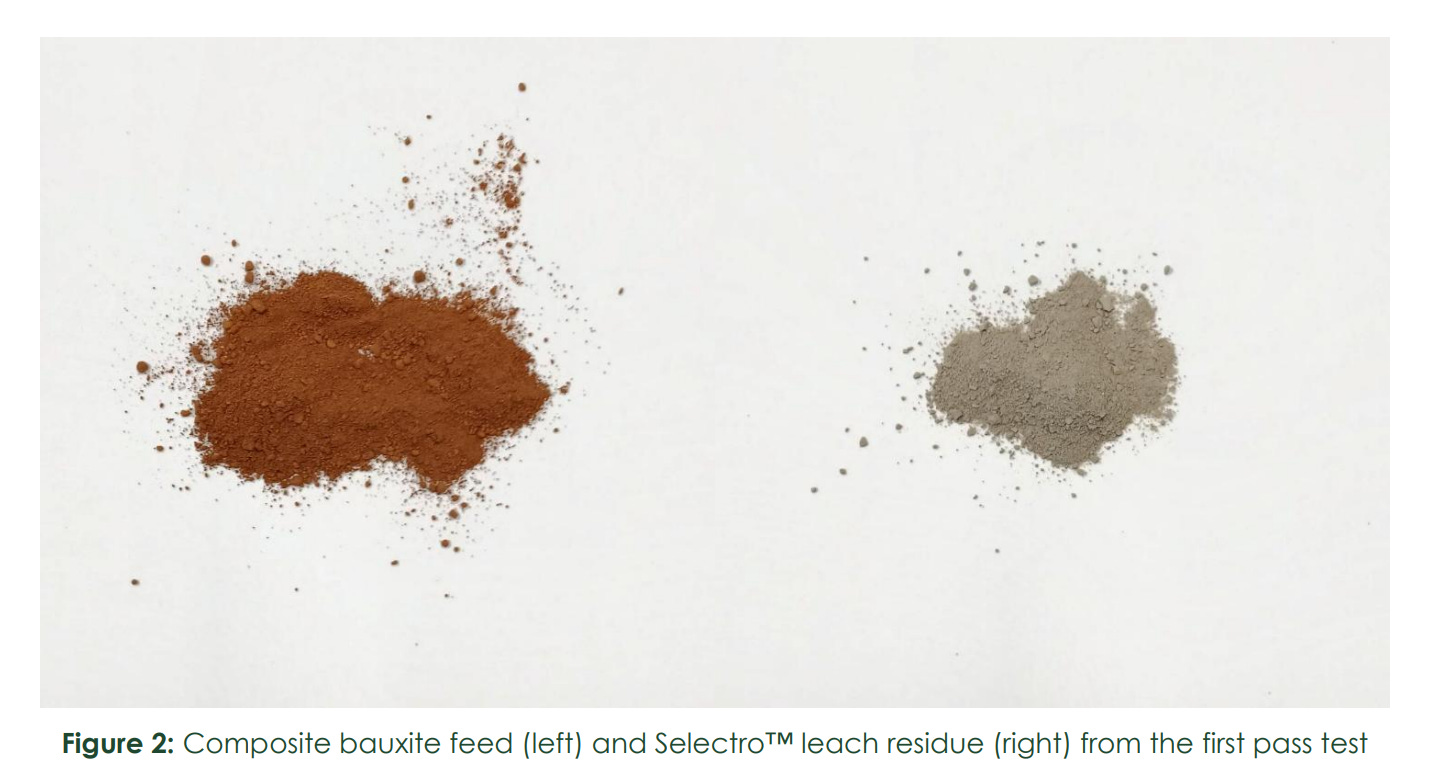
The photo in Monday’s announcement from our critical minerals explorer Mount Ridley Mines (ASX: MRD) is a pile of red dirt next to a small pile of grey sand.
The red dirt is Darling Range bauxite, the ore every aluminium can starts out as. The grey sand is what was left after MRD’s leach pulled 92% of the aluminium out of it.
A refinery cooks the same bauxite in caustic soda (the chemical in drain cleaner) and what it has left is red mud. Red mud burns skin, and the only place to store it is a dam.
There’s about four billion tonnes of it in dams around the world, and Alcoa keeps its share behind its refineries south of Perth.
Refineries sell about US$235 billion of aluminium a year. A refinery is left with a third to just under half of every tonne of bauxite as red mud, and MRD wants to sell them a way to make the same aluminium and leave sand behind.
MRD’s leach is called Selectro, and managing director Allister Caird sat down with us this week and explained it with a tea bag. The bauxite is the leaves and the leach is the hot water. The aluminium ends up in the water, where you collect it.
MRD built Selectro for its scandium clay at Grass Patch near Esperance, and this was its first go on somebody else’s ore. Caird had been asking around for bauxite and Australian Silica Quartz gave him samples from the ground next to Alcoa’s leases.
“We haven’t adjusted anything to find where the sweet spot is,” he told us. The lab ran the bauxite on the recipe MRD uses for its own clay, and Caird expects the recoveries to improve once the team tunes it.
It pulled out 97% of the iron as well, and Caird told us MRD can separate it out and turn it into a product.
A refinery also burns gas to cook its bauxite at about 145°C in pressure vessels. Selectro did the whole job below the boiling point of water, so a Selectro plant pays for a lot less fuel.
MRD was worth about $50 million at the start of the week, and it wants every refinery in the world paying to use the tea bag.
We’d have taken 80% on a first run and called it a win. We bought MRD at 2.4c in March, it finished the week up more than 20% at 4.3c, and the gallium result from the same test is still at the lab.
Our interview with Caird got a lot of love this week. It’s below if you missed it, and you can read our full write-up here.
Zero Copper Discoveries and a Record Price
S&P Global keeps a count of the big copper discoveries made around the world each year. Through the 1990s and 2000s it counted more than 10 a year. In 2025 it counted zero.
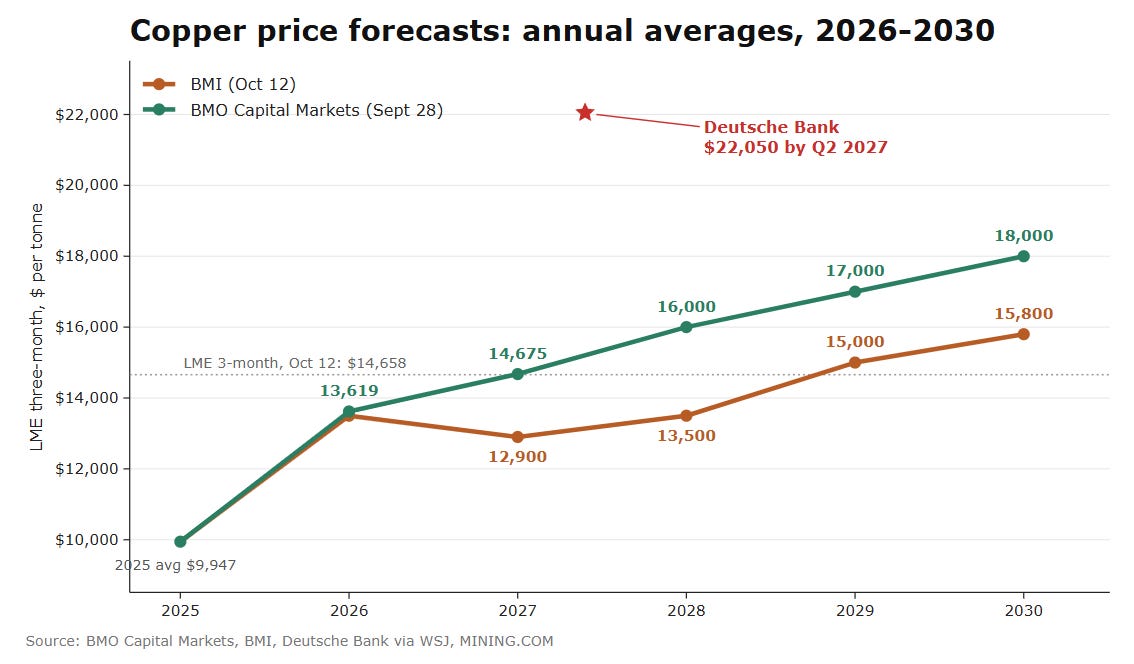
Copper set a record on the London Metal Exchange this week, and the big banks have lifted their price forecasts to keep up.
Bank of Montreal (BMO) now has copper at US$14,675 a tonne next year and US$18,000 by 2030. Its analysts call today’s price of around US$14,500 “fundamentally supported”, which is banker-speak for here to stay.
Deutsche Bank tips about US$22,000 a tonne by mid-2027, because China and the US are locking up most of the world’s spare copper in reserves and warehouses.
Data centres are sized by the power they draw. A gigawatt is about what one large power station puts out, and BMO estimates every gigawatt of data centre built takes about 35,000 tonnes of copper.
The US has about 62 gigawatts of data centres today and S&P expects 152 by 2030. The extra 90 gigawatts need more than three million tonnes of copper, and the whole world uses about 28 million tonnes a year.
Ivanhoe Mines founder Robert Friedland says the world has to mine as much copper in the next 18 years as it has in the past 10,000.
We called FMR Resources (ASX: FMR) at 16c in 2025 and it hit 65c last month, and at these prices we think there’s another one of those at the small end of the ASX.
KAO and the Risk of Buying on Visuals
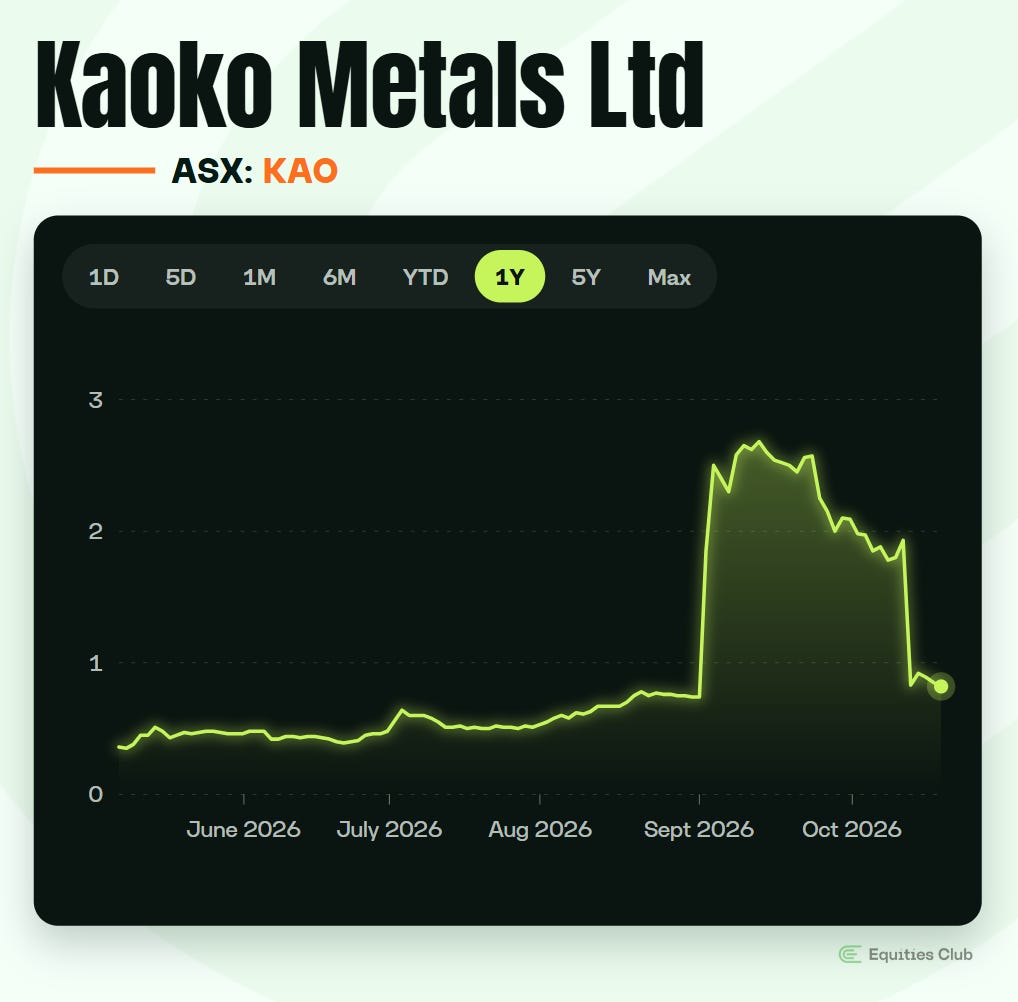
Kaoko Metals (ASX: KAO) listed in May at 20c to hunt copper in Namibia, and by September 1 the shares were at 73.5c.
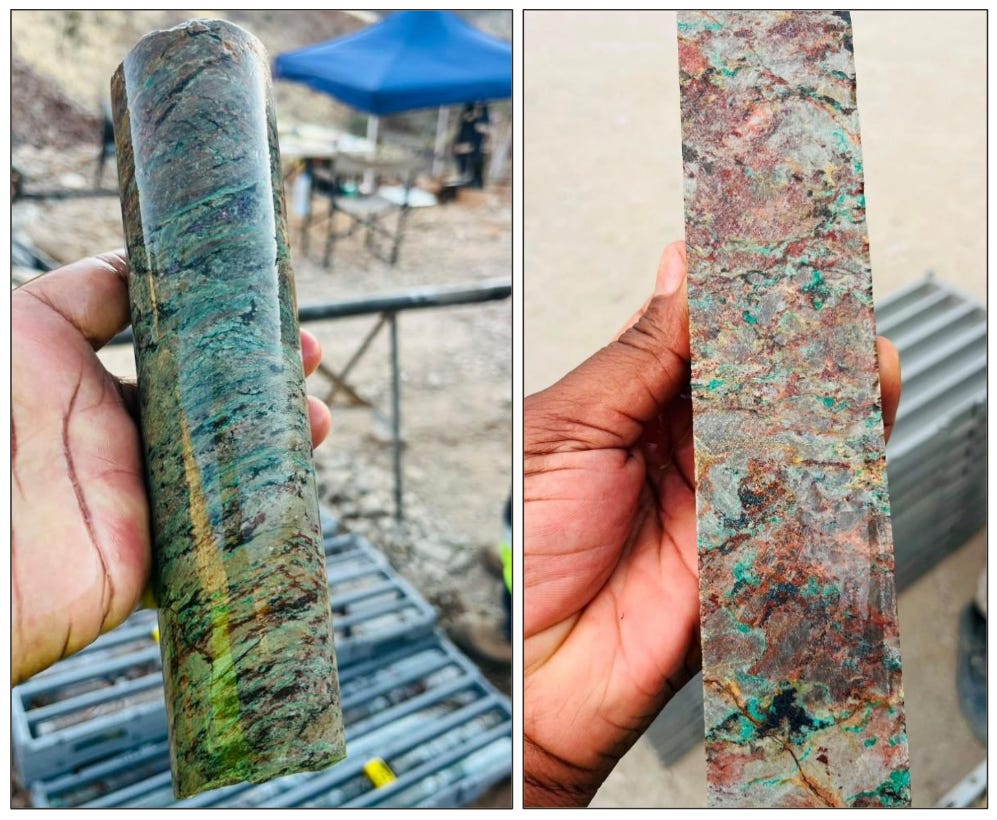
The next morning it told the market the first two holes anyone had ever drilled at its Chalkos project had visible copper over 60 metres and 51 metres. The shares closed the day up 145%.
Visible copper is the green malachite and sooty black chalcocite a geologist can see on the core tray. The grade comes from the lab weeks later.
KAO kept running until it passed $3 and was worth 15 times its float price, and it raised $20 million at $2.20 on the way up.
The assays came back on Monday. The best hole ran 37 metres at 1.23% copper from 54 metres down, which is about 12 kilos of copper in every tonne.
For a first two holes on ground nobody had drilled before, plenty of explorers would take it. The buyers who took KAO past $3 had been expecting a lot more than 1.23%, and the shares got smashed back to 82c, about where they were before the visuals.
More holes are at the lab and two rigs are still turning, so KAO has plenty of results to come.
A visual means copper is in the hole. Until the lab says how much, everyone buying is guessing at the grade, and the number can be a good one and still fall short of the guess.
An IPO Doubles Through the Firmus Hangover
Firmus pulled the biggest float in decades last week, and on Tuesday a pregnancy blood test company pressed ahead with a A$10 million raise at 20c and listed anyway.
Identifai Genetics (ASX: ID1) ran as high as 54c through the Firmus drama and finished the week at 40c, double what the IPO buyers paid.
Its test is called Windrose and it came out of Professor Noam Shomron’s lab at Tel Aviv University.
Mums-to-be have paid for a blood test since 2011 that screens for Down syndrome and a handful of other chromosome problems. Windrose reads the same blood sample for more than 280 single-gene conditions such as cystic fibrosis.
Today the mum gets tested first to see if she carries one of those conditions. If she does, the father gets tested next, and if he carries it too the only way to know whether the bub has it is a needle into the womb.
The prospectus says more than half the fathers never get tested.
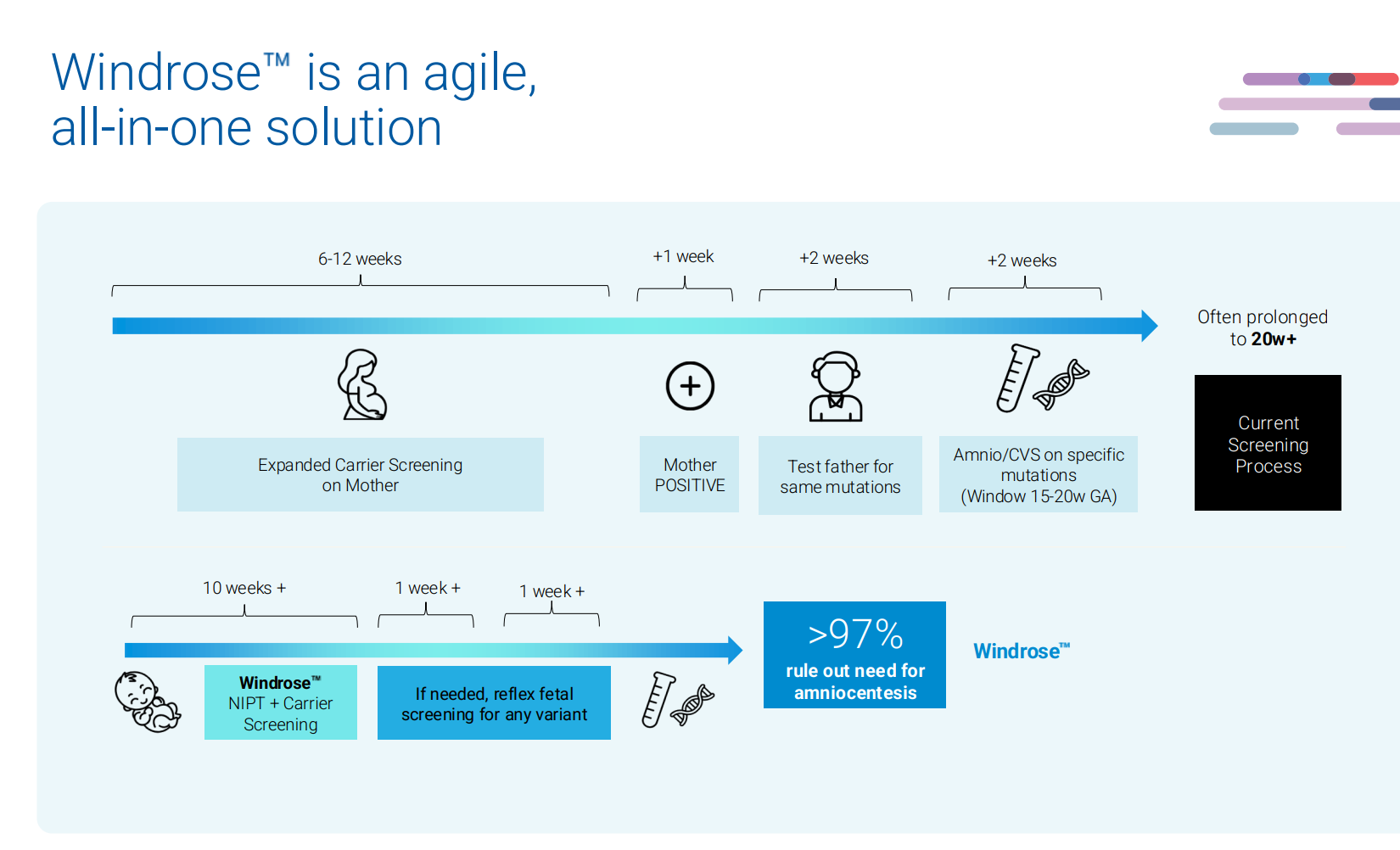
Windrose checks the bub straight from the mother’s blood at nine weeks and skips the father and the needle.
The IPO money will pay for a 600-patient trial at six to eight American hospitals. It starts this year and the first results are due in the second half of 2027.
Identifai hasn’t said what a Windrose test will cost, and American insurers won’t pay for it until the trial data is in, so the first customers will pay for it out of their own pocket. We’d guess most of them are IVF patients, who’ve already spent a small fortune getting pregnant and won’t blink at one more test.
The real prize is a deal with one of America’s giant pathology chains like Labcorp or Quest Diagnostics. Identifai says it’s talking to the biggest of those chains.
American mums-to-be spent about US$1.1 billion on the standard pregnancy blood test in 2024, and Identifai wants a slice of it.
10X Soils Back Up the 1970s Copper at Watsons
In 1974 the copper price fell 40% in the world recession, and two exploration companies walked off a line of hills three hours west of Sydney with copper and zinc in their soil samples and never drilled a hole.
With copper at a record, the smallest company in our portfolio went back over the same 2.4 kilometres and found the copper and zinc where the old crews left them.
Exultant Mining (ASX: 10X) calls the ground Watsons. It sits inside Black Hammer, 10X’s copper-gold project in the same belt of old volcanic country Newmont mines at Cadia near Orange, where it has around 50 million ounces of gold and 9.5 million tonnes of copper.
Exploration manager Seb Hind’s crew pushed a handheld analyser into the soil at 190 points, and the readings were still high at both ends when the grid ran out. They also picked up a new patch of lead at the northern end reading close to double anything the 1970s crews found.
Next 10X extends the grid once more landholders sign access, then runs geophysics to see whether sulphides sit under the best readings. If they do, 10X has its first drill target at Watsons.
We sat down with executive chairman Brett Grosvenor this week. He told us Black Hammer was meant to be the main asset when 10X listed last December, the team got a little distracted by early results at Peak View, its gold project near Cooma, and now the crew is back where it started.
10X listed with just 37 million shares, which Brett calls unusual for an IPO. In 12 months the top 20 holders have gone from 40% of the register to 48% and the number of shareholders has climbed from about 380 to more than 500.
The company came through its first drill campaign with about $3 million still in the bank.
“Everybody’s fighting for equity and capital right now. Thankfully we don’t need it,” he said.
Full write up here.
At 13c 10X is worth under $5 million with about $3 million in cash, so investors are paying around $2 million for 390 square kilometres of ground, which looks cheap to us.
The Week Ahead
Monday is 39 years since Black Monday. The ASX lost about a quarter of its value in a day in October 1987, and anyone who sold into it has spent four decades wishing they hadn’t.
This week trading was thin and we’ve heard small-caps declared dead many a time this past fortnight.
In the same week, one of the biggest gold miners on earth agreed to spend up to US$60 million drilling the ground around Elk, and a 20c IPO doubled.
Elk’s assays are due in the coming weeks and MRD’s gallium number is still at the lab, so we’ve spent most of the week sitting down with companies we’d like to bring you while we wait.
We’ve watched enough of these cycles to know the mood swings back, and we want our homework done when it does.
Till next week.