


Less than two weeks ago we wrote about Adisyn (ASX:AI1) locking up the global licence on graphene-based stealth coatings out of Tel Aviv University.
Today the company put the first name on the advisory board for the subsidiary that holds it.
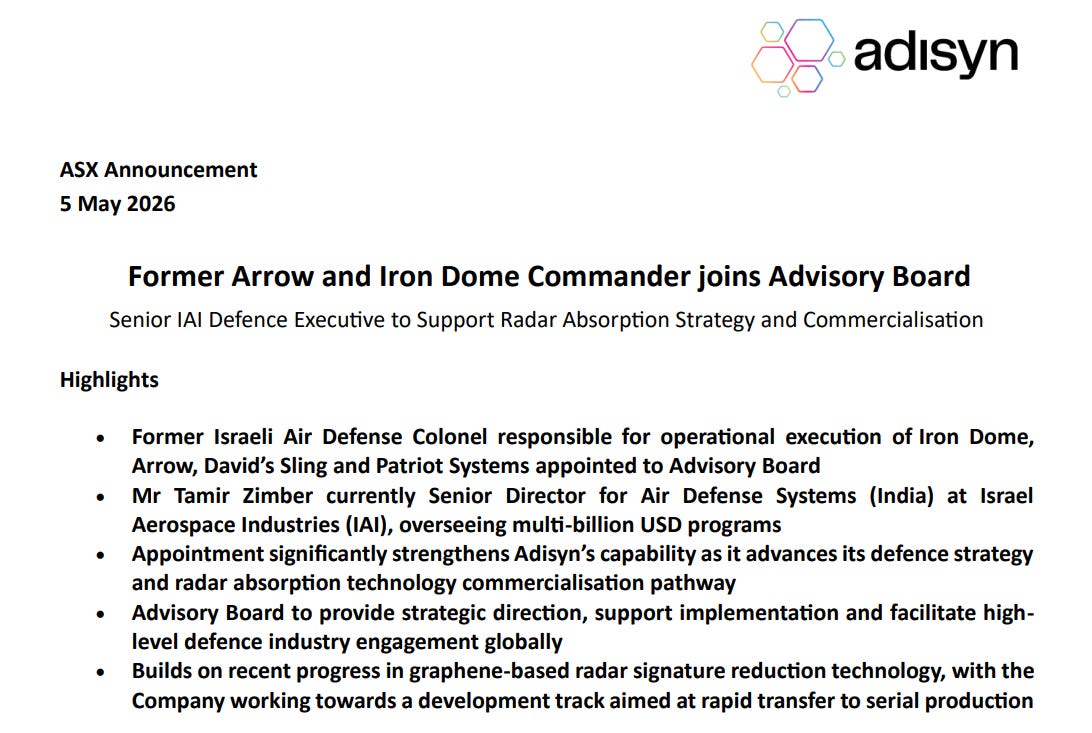
The name is retired Colonel Tamir Zimber.
If you were drawing up a wishlist of who you’d want advising a company building radar-evading materials for drones, you’d start here.
Who is Tamir Zimber
Zimber spent more than two decades in the Israeli Air Defense Array, and retired as a Colonel.
The Air Defense Array is the unit inside the Israeli military that runs every system designed to shoot down anything coming through Israeli airspace. Rockets, drones, cruise missiles, ballistic missiles, the lot.
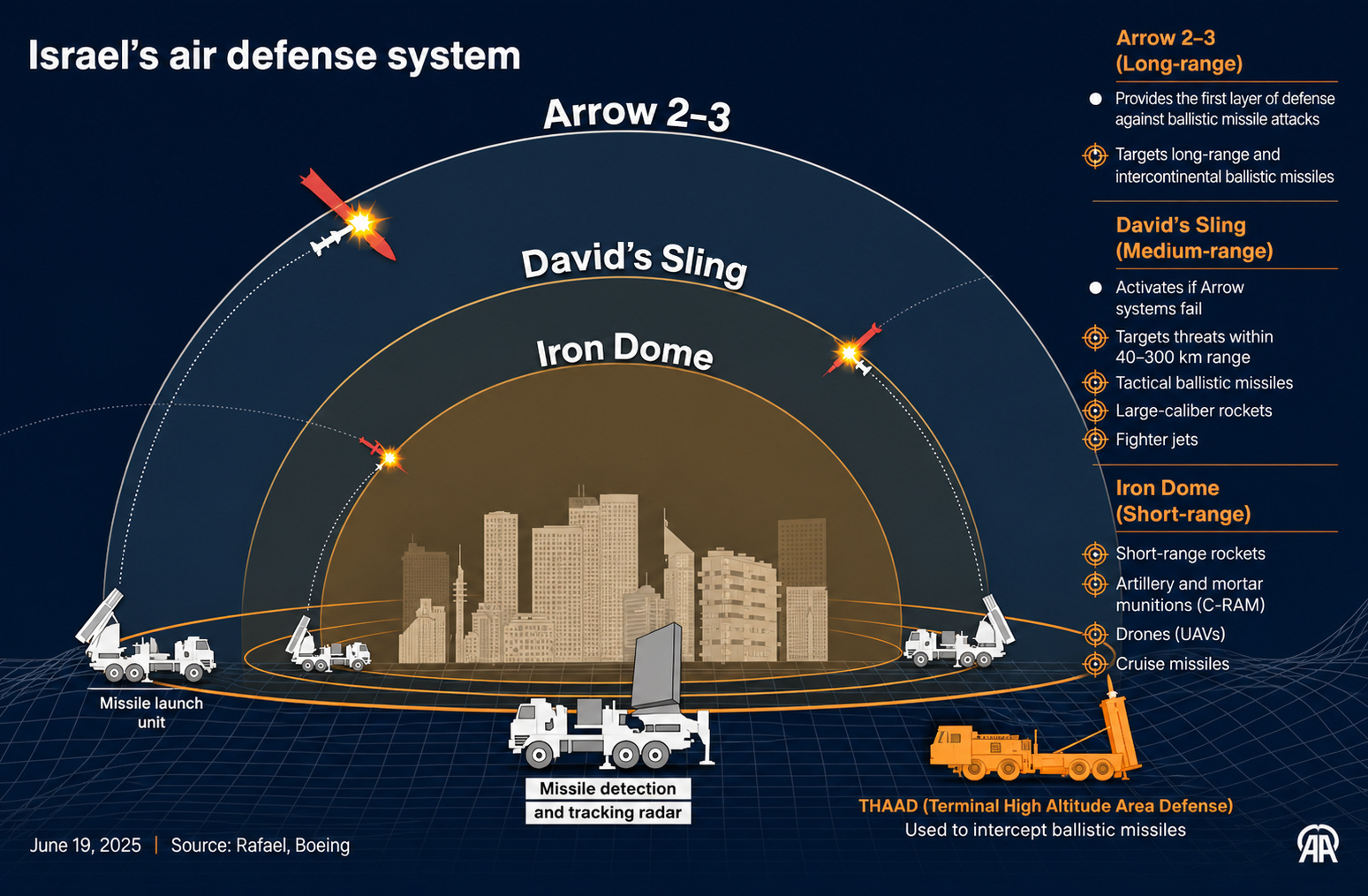
The role he retired from had him in operational command of every major Israeli air defence system at once - Iron Dome, Arrow, David's Sling, and Patriot.
Together these systems form the four-layer shield that has intercepted thousands of rockets, cruise missiles, drones and ballistic missiles over Israeli airspace for nearly two decades.
Iron Dome alone has logged over 5,000 interceptions at a a roughly 90% hit rate.
Zimber commanded the personnel, the readiness and the execution of the lot.
After the army he moved to Israel Aerospace Industries (IAI), Israel's largest defence company and a global top-tier exporter of UAVs, missiles, radars and air defence systems.
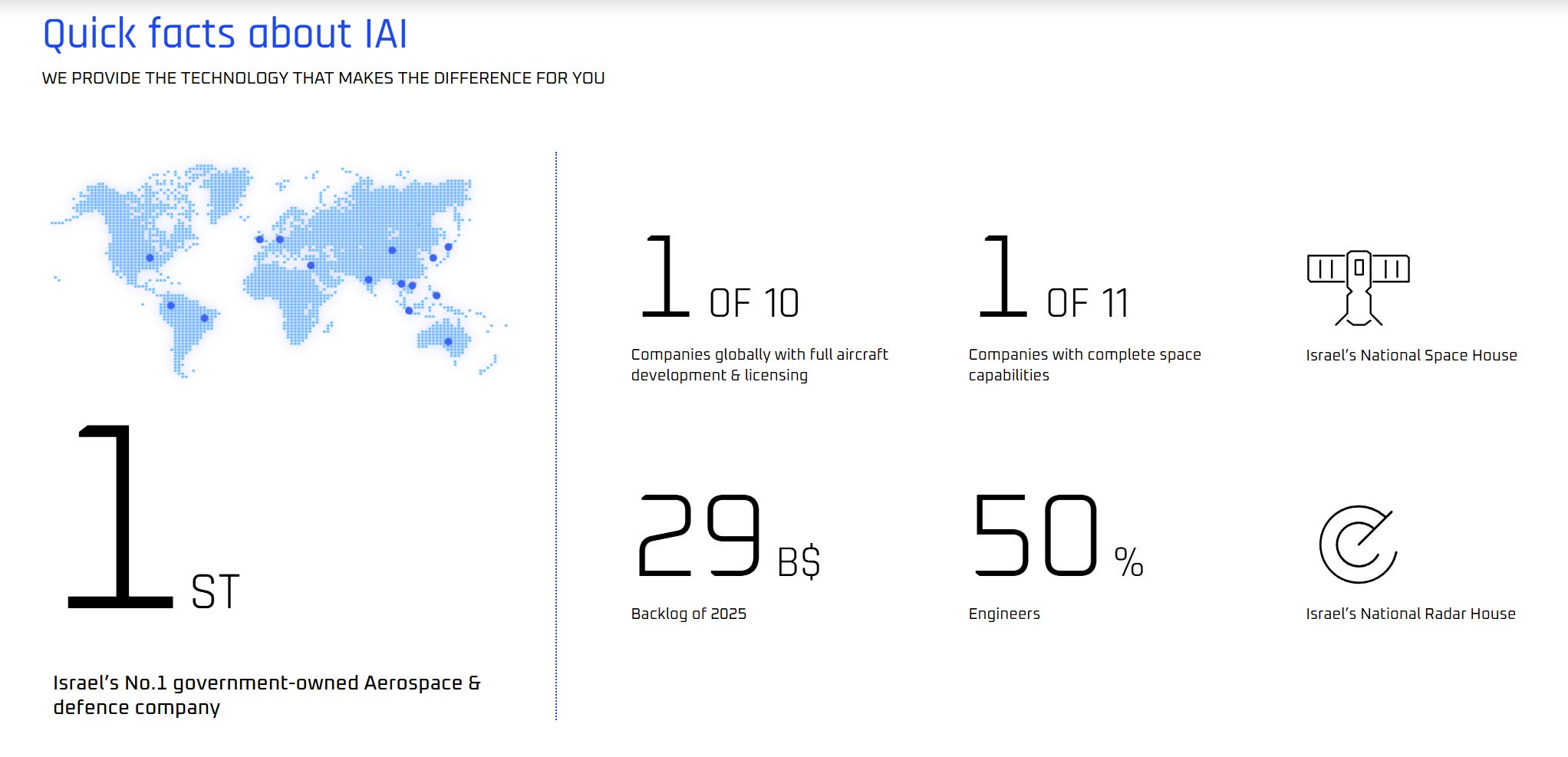
His title at IAI is Senior Director, Air Defense Systems (India). India is the largest single-country buyer of Israeli weapons in the world, and IAI's biggest foreign customer.
The role oversees multi-billion dollar programs and runs business development across government and military customers in one of the fastest-growing defence import markets on earth.
In other words: he sells advanced air defence systems to governments for a living.
It’s a pretty handy day job for a man now working with a company looking to commercialise its work on stealth material in drones.

Where AI1 Sits Today
A quick recap for anyone catching up. We announced we’d added Adisyn to the portfolio just over 2 weeks ago when it was 6.8 cents.
AI1 is a graphene technology company pointed at two enormous markets. The first is chipmaking, where its low-temperature graphene process cleared a decade-old semiconductor roadblock.
The second is drones, where the same graphene platform is being developed into a coating that effectively hides drones from radar.
Inside four trading days the company cleared the chip industry milestone, signed the exclusive worldwide stealth drone licence with Tel Aviv University, and filled a $14 million placement.

The book was cornerstoned by Meitav, Israel’s largest investment house with roughly A$190 billion under management, and Regal Funds Management with A$20 billion under management.
The share price ran from 6.8c to 20c across the week. Three of the biggest volume days in the company’s history landed in the same week, and roughly $110 million in market cap was added between Sunday and Friday. It’s now sitting at a very healthy 19.5c.
The stealth drone licence sits inside a subsidiary called 2D Radar Absorbers Ltd.
That’s the entity AI1 just appointed Zimber to advise.
Why This Hire Matters
Stealth materials live or die on one question: do they meet end-user requirements?
A graphene composite that performs in a Tel Aviv lab is interesting. A graphene composite that drops radar return at the exact frequencies a defence ministry’s procurement spec calls out is a contract.
Zimber has spent his career on the buy side of that equation. He knows which signature reduction targets matter, at which frequencies, against which threats, on which platforms.
He also knows the people writing the cheques.
AI1 chairman Kevin Crofton brings the semiconductor commercial network. MD Arye Kohavi brings the Israeli defence relationships and an ex-IDF Special Forces background. Professor Pavel Ginzburg at Tel Aviv University runs the radar physics.
Zimber's been the man on the other end of the phone for twenty years. Now he's on AI1's side of it.

What He’s Actually Doing
The release lays out the advisory board’s brief:
Tell AI1 which radar-related work to prioritise
Help translate lab results into specs that end-users will actually buy
Open doors to defence contractors and government procurement offices
Plug AI1 into global defence networks
Lend credibility when AI1 walks into procurement meetings
That last point is worth backing over.
A pre-revenue ASX small-cap walks into a defence contractor with a graphene material, and the buyer's first question is, ‘Who's vouching for this?’.
A former Israeli air defence colonel currently running multi-billion dollar IAI programs is a serious answer.
The Bigger Picture Hasn’t Changed
The drone race is now a stealth race.
Military drone spending is forecast to triple from US$20.7 billion to US$66 billion by 2035. The global counter-UAS market is on track to grow from US$4.9 billion in 2025 to US$36 billion in the same window. Australia just put A$7 billion behind counter-drones over the next decade.
Every dollar going into radars to detect drones is a dollar putting pressure on drone-makers to find ways past those radars.
Now for the not so tech-savvy like us, here’s the part worth slowing down on.
Radar performance moves on a log scale. Every 10 decibels (dB) of radar signature reduction means a tenfold drop in what the radar picks up. So 20dB is 100 times less radar return. 30dB is 1,000 times less.
AI1 has already hit 20dB in lab testing at Tel Aviv University. The 12-month program now under way is targeting 30dB.
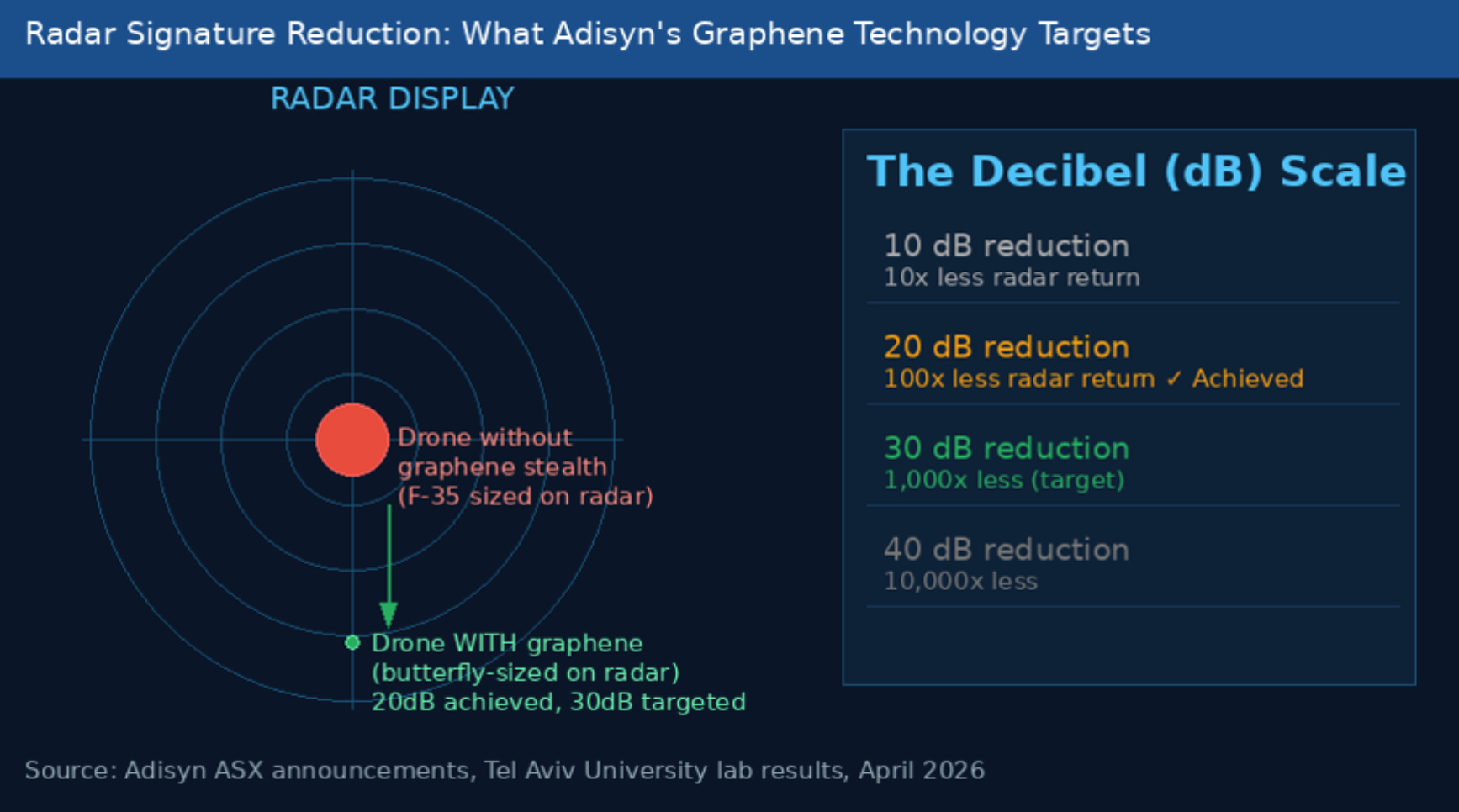
Getting from 20 to 30 looks like a small bump on paper. In radar physics, it’s a tenfold leap in stealth performance.
At 100 times less radar return (where AI1 are now), a quadcopter drone that used to read on radar like an F-35 fighter jet now reads like a bird. The radar operator spots the threat too late.
At 1,000 times, the drone shows up looking more like an insect, and gets through undetected.
The country that builds it first gets a lethal edge in the next decade of airborne warfare.
What We’re Watching From Here
Three things on the radar (so to speak) over the next 12 months:
More advisory board appointments. Zimber is described as the first member. The release calls this “a further step in positioning the company to translate technical capability into commercial outcomes.” More names, particularly from Western primes or US procurement, would build that out.
Lab results pushing toward 30dB. It’s the same milestone we flagged last time. This is the number that turns their lab work into customer conversations.
First commercial engagements. Advisory board members open doors. The next signal is who walks through them.
Did you know the companies receiving the $1.2 trillion Golden Dome contracts are invested in by JD Vance and Donald Trump Jr. Both set up their positions before the inauguration. They just needed a war to destroy the old air defense first. Full investigation at Waves and Positions.
https://wavesandpositions.substack.com/p/the-golden-dome
I am up almost 200% on Ai1 so thankyou and well done! I am disappointed in the directors isuing shares to them selves at less than 7cents when the share price is above 20Cents if it was not wor that the shares would be worth even more now.