


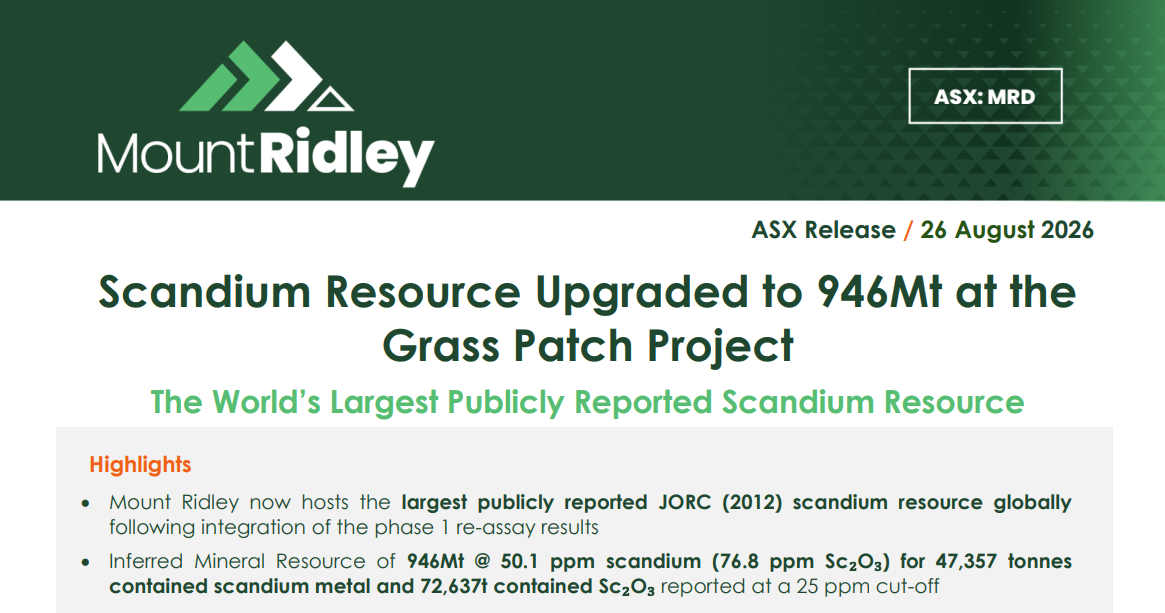
Mount Ridley Mines (ASX: MRD) now has the biggest scandium resource on earth.
“The World's Largest Publicly Reported Scandium Resource” is the line MRD plastered across the top of this morning's announcement, and it had the intended effect.
Grass Patch, 25km northeast of Esperance, holds 946 million tonnes at 50.1 ppm scandium. That works out to 72,637 tonnes of scandium oxide, which is how the metal gets sold. And the whole planet only made about 80 tonnes of it last year.
Most of that 80 tonnes goes into two things.
Solid oxide fuel cells, the boxes that sit beside AI data centres and power the racks, run on a scandium ceramic. Those cells took close to half the world’s scandium last year.
Most of the rest went into aluminium. A pinch of it gives an alloy that welds without cracking, which is why it ends up in aircraft frames and defence platforms.
China mines about 80% of the world’s scandium and processes almost all of it. In April last year Beijing started requiring a licence for every kilogram leaving the country, so China now decides who gets to buy it.
That is the metal MRD now holds more of than anyone.
The Grass Patch mineralisation starts at surface and runs about 70 metres deep. Strike is more than 25km. It’s soft clay the whole way down, so it gets dug with an excavator and skips the blasting and crushing, which strips out two of the most expensive steps in building a mine.
Fifty ppm is a lower grade than Sunrise Energy Metals (ASX: SRL), the best performing stock on the ASX last year. SRL is building its mine on 414 ppm dirt at Syerston in NSW, and anyone who has looked at both deposits will spot the gap straight away.
Grass Patch gets away with it because an excavator does the mining and because of a leach process called Selectro (more on that soon).
We added MRD to our portfolio in March for three critical minerals it has in one deposit. What it didn't have was a way to get most of the scandium out of the clay. Fifty ppm across a billion tonnes is a big number on paper, but hydrochloric acid leaves nearly three quarters of it in the rock.
Then Chris Larder joined as CTO and brought Selectro with him, the leach process he’d spent a decade building and MRD lodged a patent on last week. In its first test it pulled 80% of the scandium out of raw Grass Patch dirt. Hydrochloric acid got 27.6% from the same sample.
The tonnes make the headline and Selectro is what turns them into a possible mine, and that pairing is why we’re happy holding a $42.5 million company at 3.2 cents as we type.
Investor Webinar
Mount Ridley is holding an investor webinar on Thursday, 27 August at 10:00am AWST (12:00pm AEST). Managing Director Allister Caird will run through Grass Patch, Selectro, and take questions live.
It’s an MRD event rather than one of ours. Registration is free via the link below.
https://us06web.zoom.us/webinar/register/WN_WPMqVaqSTNemqQJgmyMZfQ
The Tonnes Came Out of a Storage Shed
Every explorer has boxes of old drill samples sitting somewhere. MRD's had scandium in them.
Between 2014 and 2022 the company drilled 410 holes at Grass Patch looking for nickel and copper, and the base metals never came in. The pulps, which are the crushed leftovers the lab sends back, went into storage. Nobody assayed them for scandium because nobody was looking for it.
MRD pulled 3,271 of those pulps out and sent them to ALS in Perth to test for scandium. The resource was 368 million tonnes in January. It's 946 million today, and the company got there without turning a drill bit.
We’ve watched plenty of $40 million explorers raise money to drill holes that go nowhere. MRD grew its resource two-and-a-half times for the cost of assays.
The old holes were good ones, too. One came back with 20 metres at 115.3 ppm scandium from four metres down, another with 22 metres at 90.1 ppm, both well above the 50.1 ppm average.
Across both blocks the clay mostly runs 40 to 60 ppm, with patches over 80 that sit in continuous bands. Those two holes are the best of a consistent lot.
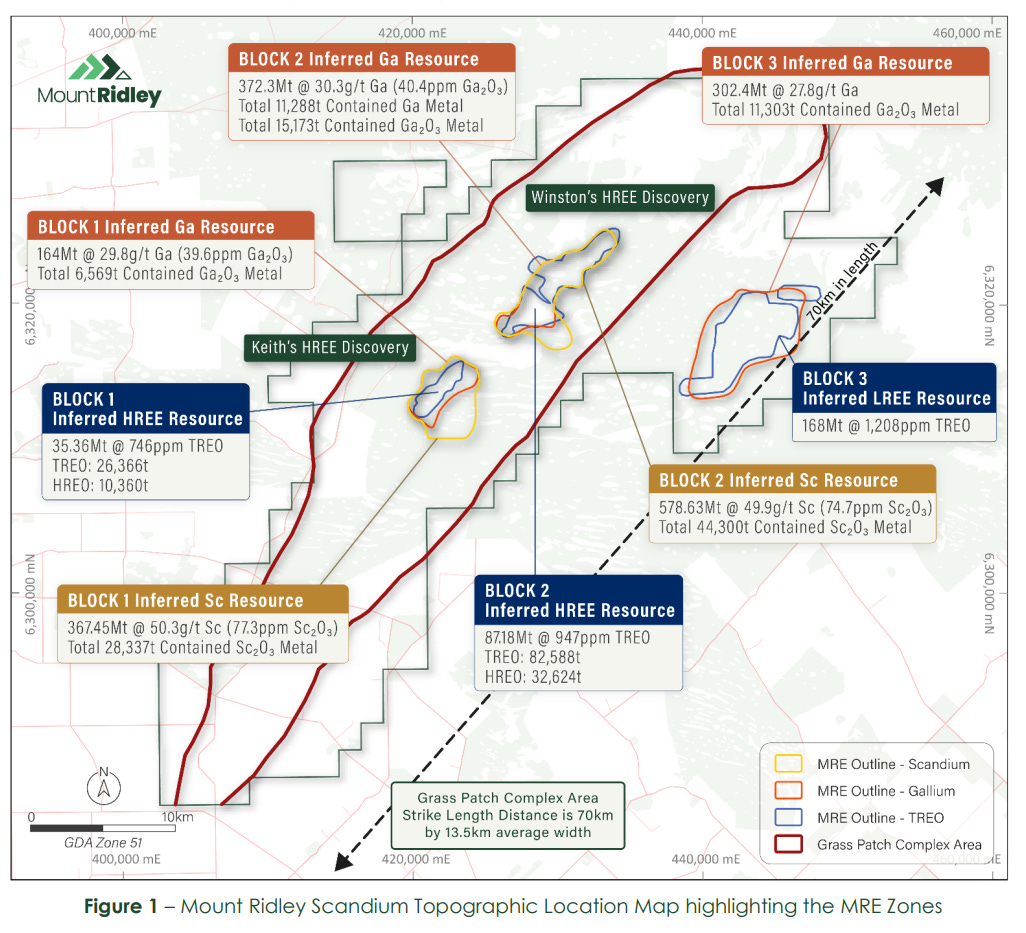
A lot of the old holes ended in scandium. Aircore rigs stop when they hit hard rock, so the hole finishes wherever the clay does, and the scandium was still there at the bottom.
The system is open below them and open to the south-west for about 4km off Block 1 alone, so there is more scandium down there before Mount Ridley tests anything new.
Roughly 80% of the tenure has never been tested for scandium at all, and seven gravity targets covering about 33km of strike sit outside the current resource, already mapped.
One Leach Circuit for All Three Metals
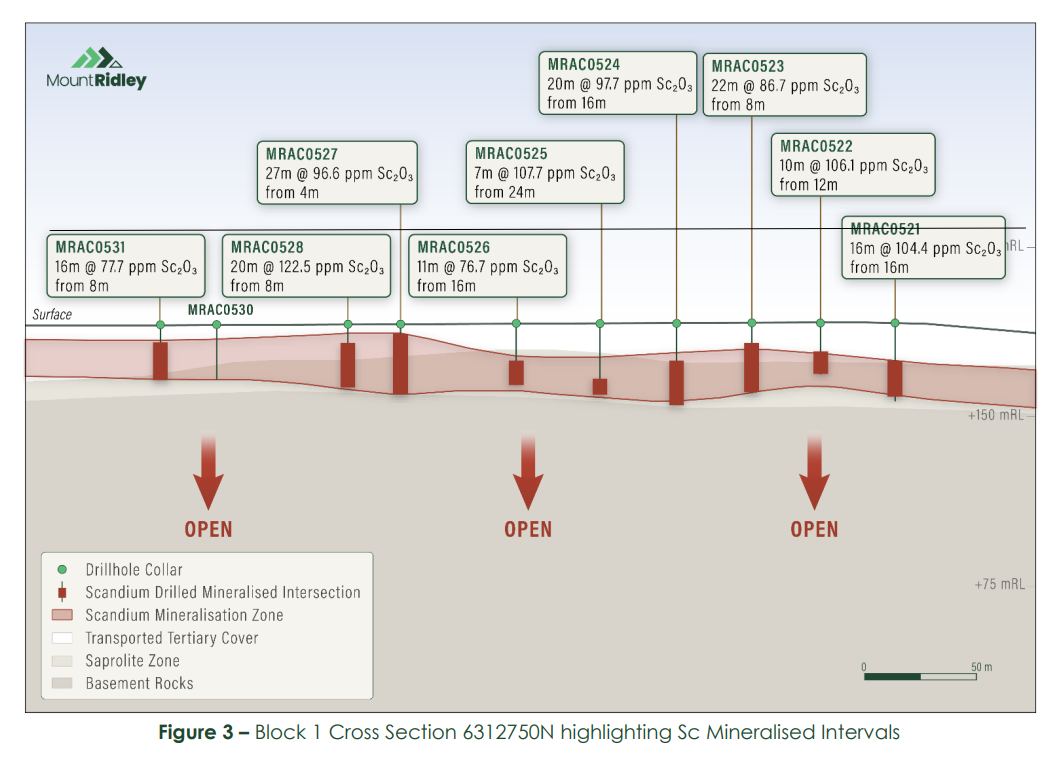
Three critical minerals sit mixed through the same weathered clay at Grass Patch, not in separate zones you would have to mine apart.
Alongside the scandium sits a 122.5 million tonne heavy rare earth resource at 889 ppm total rare earth oxide with a 41% heavy split, and a gallium resource running to 838.7 million tonnes across the broader project.
All of it comes out of the same pit, and all three are metals the US and Europe are trying to source outside China.
Most explorers holding that combination end up making a hard choice. You design your processing plant around whichever metal pays best, you build it for that metal, and everything else either drops out as a low-value byproduct or stays in the tailings dam where it earns nothing.

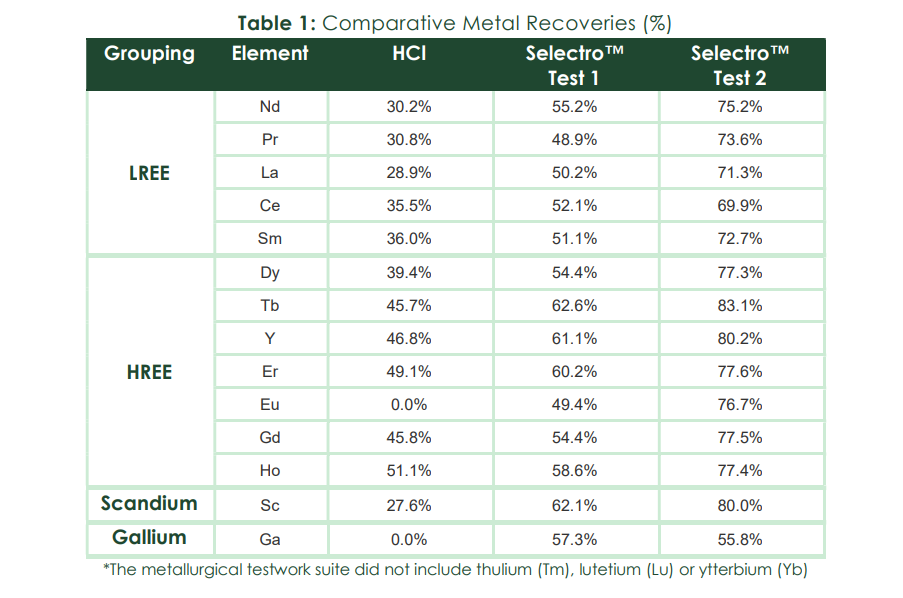
The second Selectro test, run earlier this month, suggests Mount Ridley gets to skip that choice. It pulled 80% of the scandium, 77 to 83% of the principal heavy rare earths, 70 to 77% of the light rare earths and around 56% of the gallium out of the same untreated feed in a single leach circuit.
The hydrochloric acid baseline, the traditional method, run on portions of the identical composite sample, recovered 27.6% of the scandium and no gallium at all.
If scandium prices run because the US keeps putting money into supply, Grass Patch leans into scandium. If the heavy rare earths do the running because dysprosium and terbium stay in short supply, the same pit and the same circuit lean towards those. Gallium comes along either way.
Mount Ridley can follow whichever market is paying best at the time. Most explorers lock in their commodity bet years before they produce anything.
Washington is Writing Cheques for Scandium
Every kilogram of scandium in circulation today arrives as a byproduct of something else. There is no dedicated scandium mine operating anywhere in the world, so supply stays flat no matter what demand does.
On August 10 the US Department of War’s Office of Strategic Capital signed a conditional 25-year loan of up to US$400 million with Sunrise Energy Metals, and took first call on everything Syerston produces before the project has produced anything.
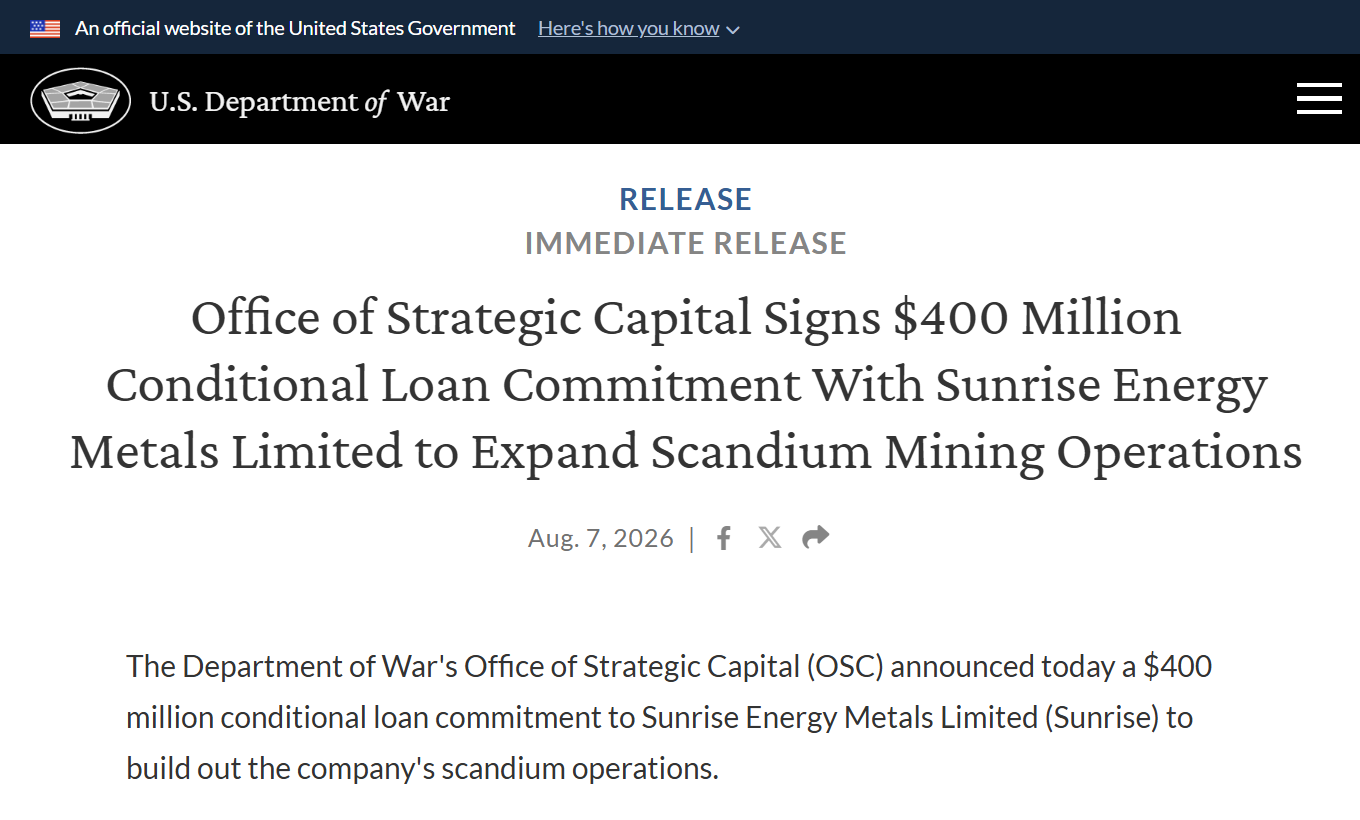
Syerston is designed to make 60 tonnes of scandium oxide a year against global production of about 80 tonnes, and the market now values Sunrise at $2.8 billion.
We first covered Surise in April, then again in July, when it had already risen more than 2,000% in a year and signed a supply option with Lockheed Martin. What it shows is the price the market puts on a Western scandium story once it starts to work.
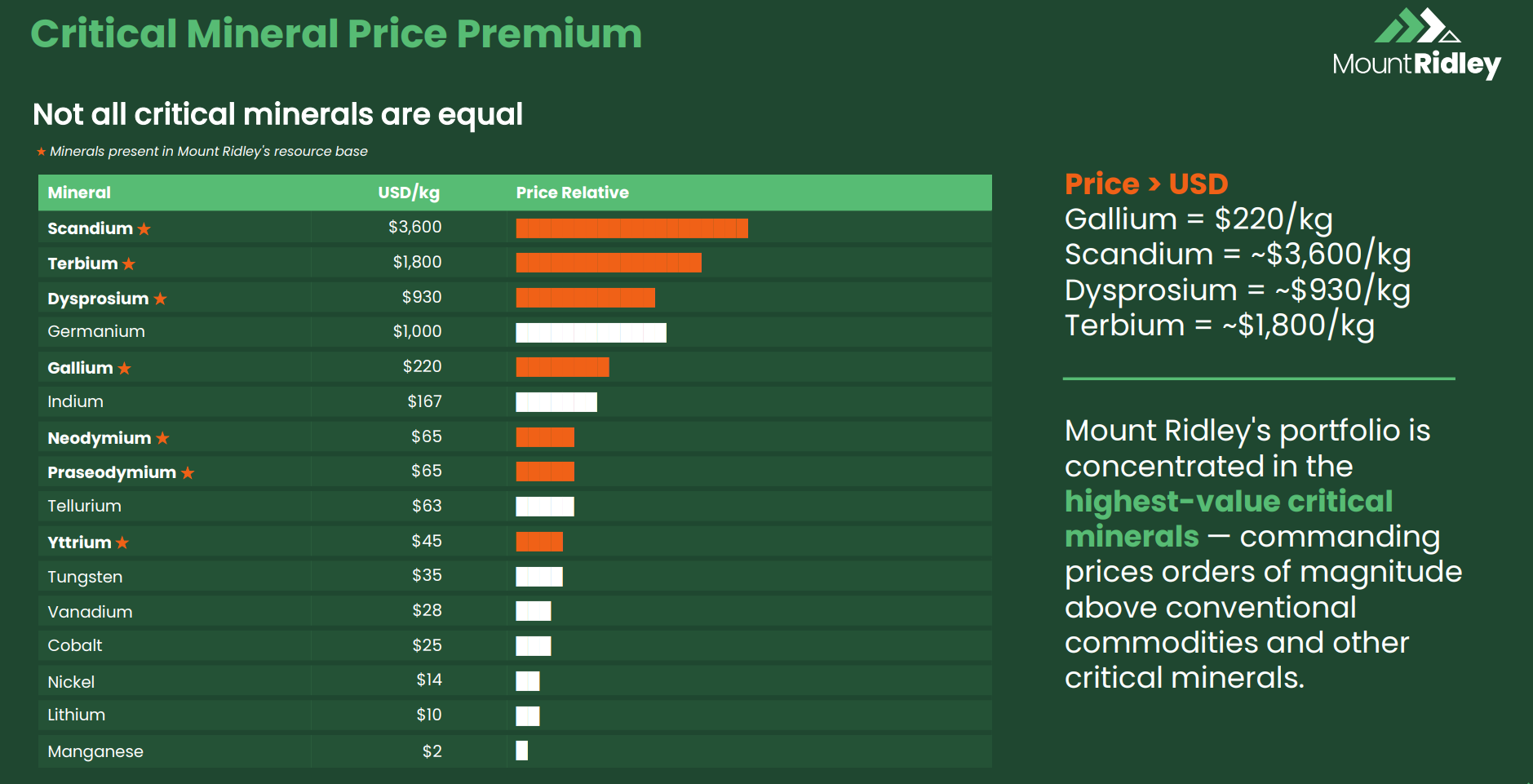
Mount Ridley sits at $42.5 million, roughly one 66th of that, holding the largest reported scandium resource on the planet.
Sunrise is ahead, with an ore reserve and a flowsheet, plus a US government loan behind it. The gap between $2.8 billion and $42.5 million is the whole reason we own MRD.
What We Are Watching
Mount Ridley has put out four announcements this month, the phosphate mineralogy work, the Selectro results, the patent lodgement and now this resource.
Several work programs are running at once, so the next few months should keep producing news.
Density testwork sounds like the dullest line in the announcement and it is the one that lifts this resource out of the inferred category, the softest classification the JORC code allows.
Phase 2 of the re-assay program is already underway across the rest of the Grass Patch pulps, and after what Phase 1 delivered we like our chances.
Flotation testwork comes next to check the mineralogy, and then Selectro gets run over the upgraded ore to see how much further those recoveries stretch.
Scoping study talks are running with several engineering firms to cost a demonstration plant. Mount Ridley has also started testing the Selectro chemistry on other deposit types, and if it works on someone else’s deposit, MRD can license it.
A batch of Grass Patch ore is sitting on a bench at Fraunhofer in Germany right now. Oak Ridge National Laboratory has signed a materials transfer agreement, and Lawrence Livermore is still in the mix.
It’s a lot of serious laboratory attention for a $42.5 million company.
Managing director Allister Caird and his team found the biggest scandium resource in the world in boxes of drill samples the company had already paid for. We're happy to sit tight and wait for the rest of the shed.