


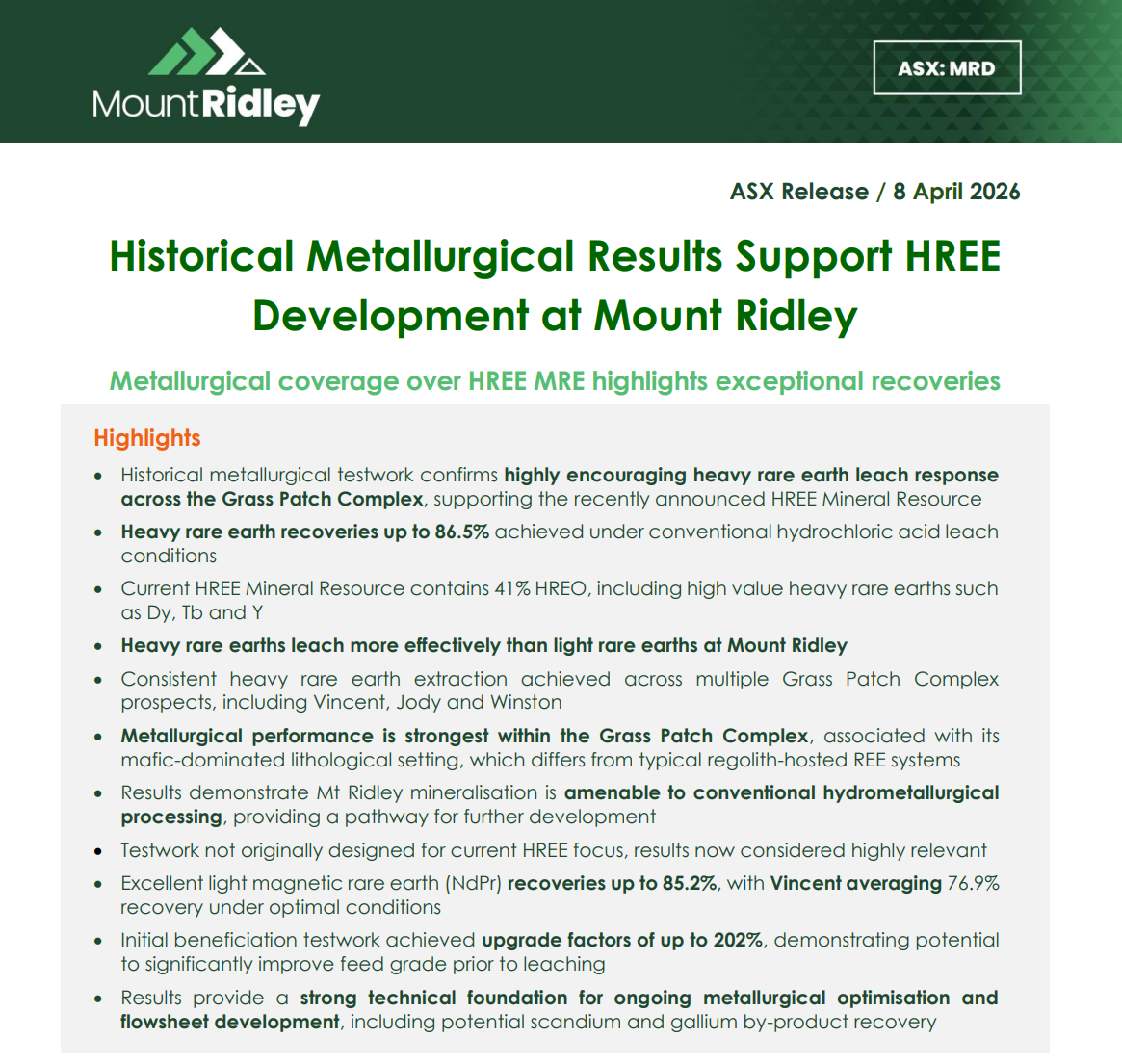
Mount Ridley Mines (ASX: MRD) has released encouraging met testwork results from its Grass Patch heavy rare earth project in Western Australia.
Met work can often be a project killer, but the results from Grass Patch show MRD has cleared that hurdle.
Using a simple acid leach, up to 86.5% of the heavy rare earths were extracted from the clay, with dysprosium and terbium - the two most valuable elements in the deposit - responding strongest.
For a stock where the big question is "can you actually get the valuable metals out," this is a solid first answer.
MRD trades at 3 cents with a $41 million market cap. Victory Metals (ASX: VTM), the most advanced comparable WA clay-hosted heavy rare earth play, sits at around $207 million.
The metallurgy was the biggest unknown hanging over this stock. It's looking a lot less unknown today.
Why Are Dysprosium and Terbium a Big Deal?
There are 17 rare earth elements. Many of them are relatively common, and plenty of projects around the world are chasing them.
Dysprosium and terbium are a different story.
Terbium oxide trades at around US$970/kg inside China. Western buyers pay closer to US$1,200/kg after export duties and licensing costs. Dysprosium oxide runs about US$220/kg domestically, with Western prices carrying a similar markup.
Those prices reflect the fact that every EV motor, every offshore wind turbine, every guided missile system and every industrial robot needs dysprosium or terbium to stop its permanent magnets from overheating. Standard magnets lose their strength as temperatures climb, and a small addition of either element fixes that.
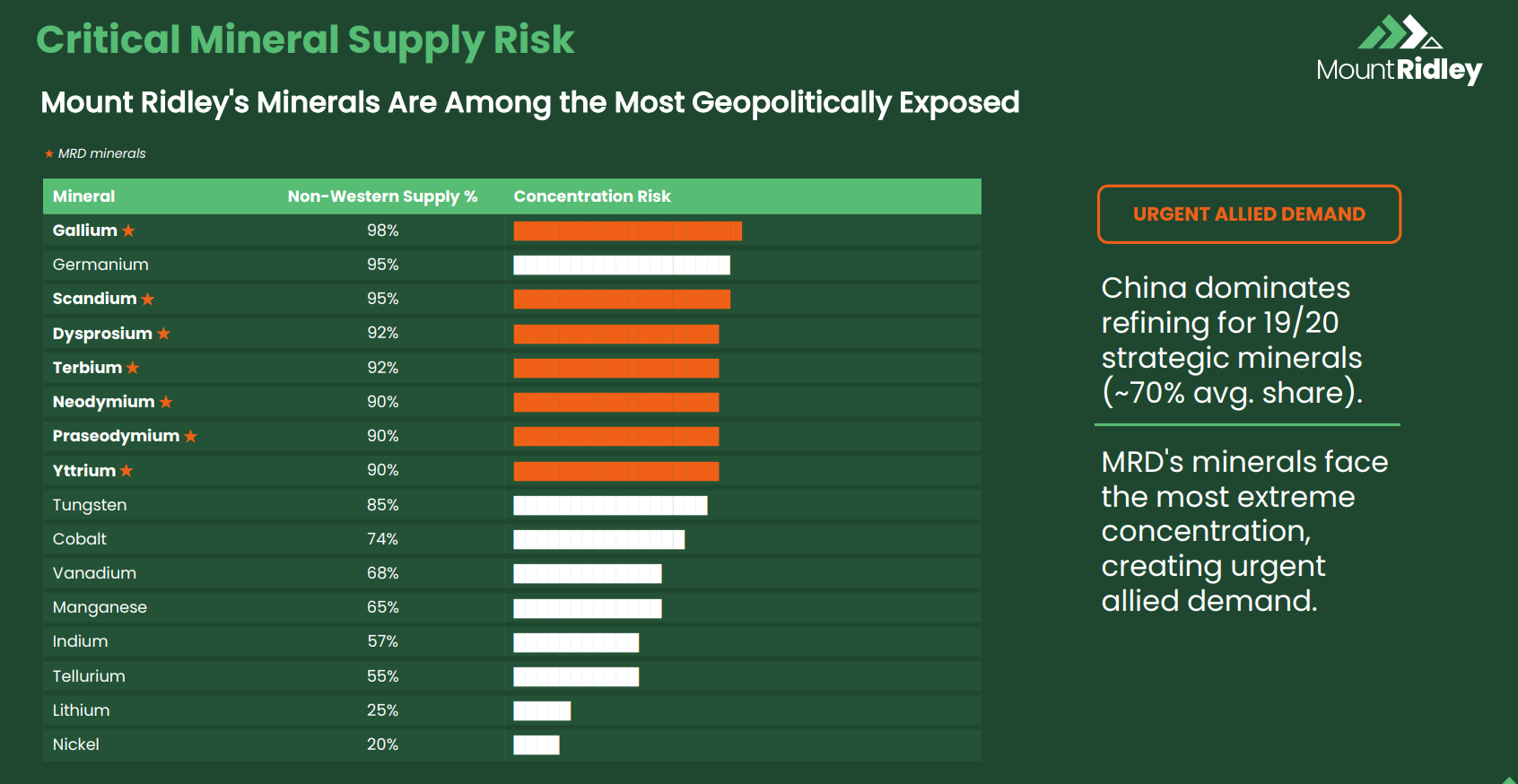
Beijing decides who gets supply and how much they pay for it. That premium has been widening since April 2025, when China imposed export controls on both elements.
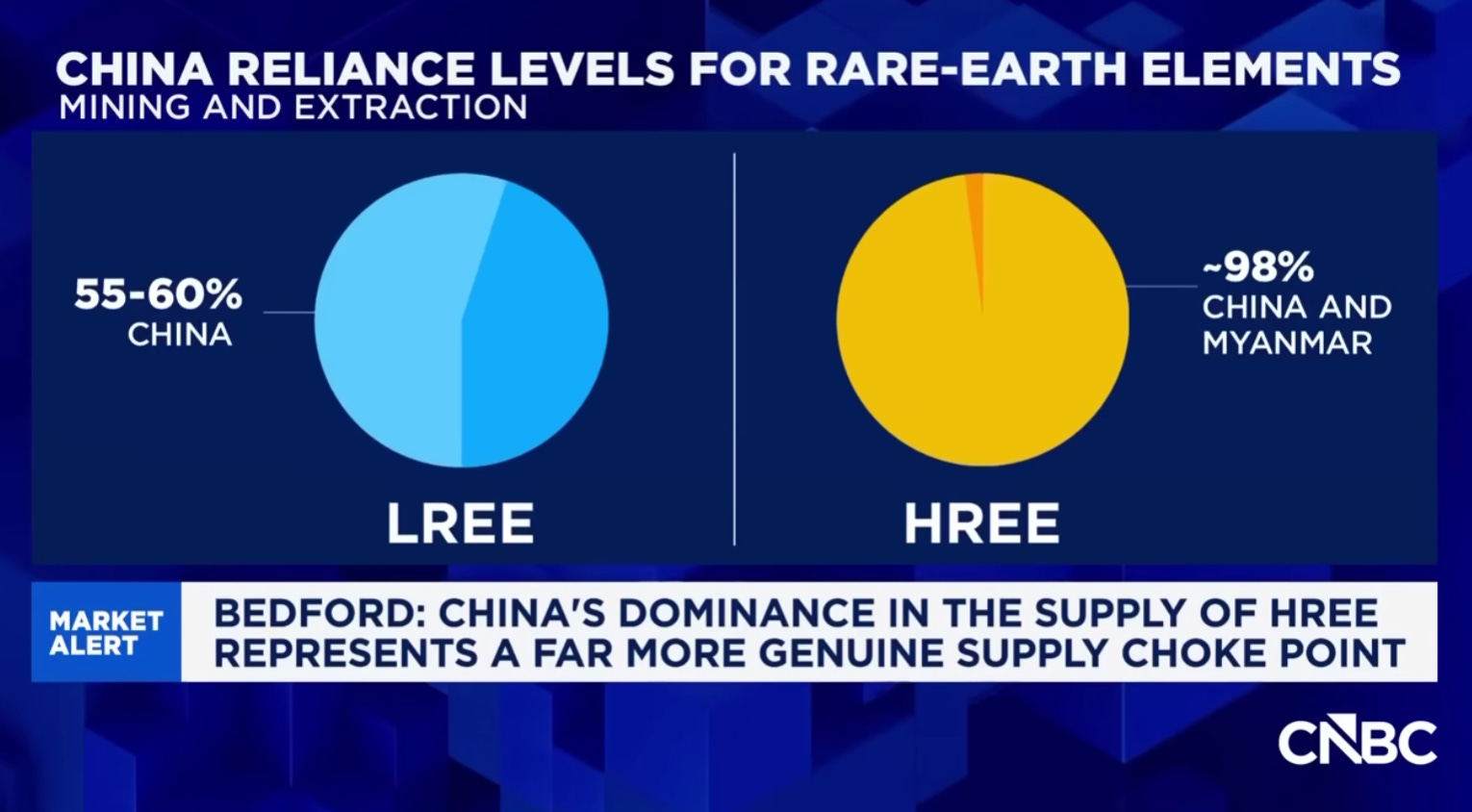
There’s no substitute for either element, and China controls almost all global supply.
European prices nearly tripled within weeks after China’s export control. A temporary suspension followed, but it expires in November 2026, and nobody is confident about what comes next.
Western governments are desperate for alternative supply. The US, EU and Australia have all flagged heavy rare earths as critical and billions of dollars in government funding is flowing toward building supply chains outside Chinese control.
That’s the backdrop for Mount Ridley.
What Grass Patch Actually Carries
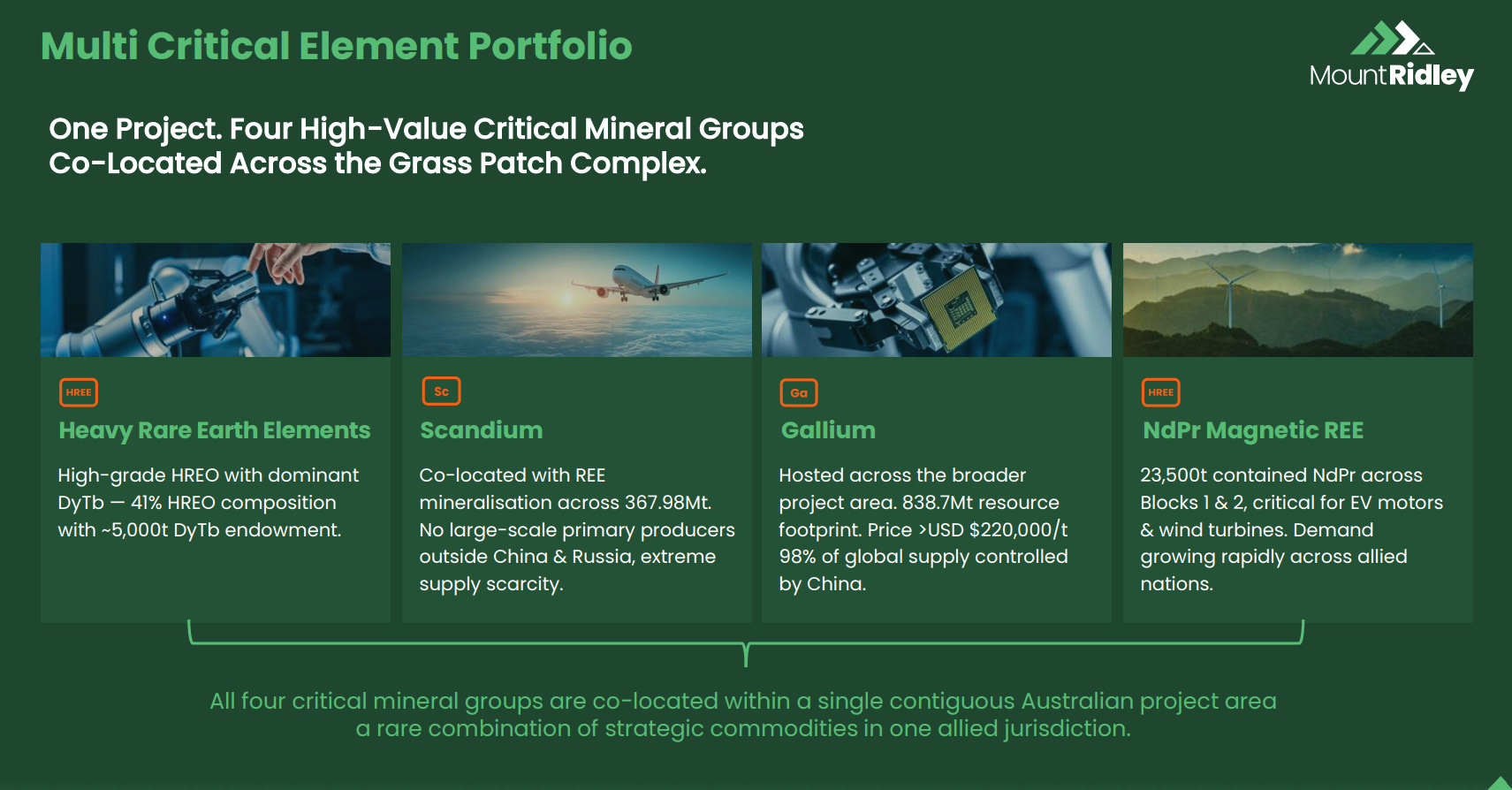
The Grass Patch Complex sits about 55km northeast of Esperance in WA. MRD's HREE mineral resource across Blocks 1 and 2 comes in at 122.5 million tonnes grading 889 ppm total rare earth oxide, with 364 ppm of that being heavy rare earth oxide.
Grass Patch runs a 41% heavy rare earth ratio. That's 364 ppm of heavy rare earth oxide out of a total 889 ppm, meaning nearly half the rare earth content at Grass Patch falls in the high-value basket.
In most clay-hosted deposits around the world, light rare earths dominate. At Grass Patch, nearly half the rare earth content is the expensive stuff - with dysprosium and terbium sitting at the top of the value chain.
Victory Metals at North Stanmore runs about 39%. That puts MRD at the top end for this style of deposit on the ASX.
MRD also holds the Mia resource (Block 3) at 168 million tonnes grading 1,201 ppm TREO, though that block skews toward light rare earths rather than heavies.
And MRD is sitting on a 367.9 million tonne scandium resource and an 838.7 million tonne gallium resource across the broader project. Both metals have their own supply problems, and both could add by-product value if the processing pathway works.
We’ll come back to those later.
The Met Results: Old Data, New Relevance
The testwork released today was originally run between 2021 and 2023 across several Grass Patch prospects including Vincent, Winstons and Jody.
It was designed before MRD pivoted to heavy rare earths, so the programs were targeting total rare earth extraction rather than dysprosium and terbium specifically.
That's actually what makes the results so interesting. The conditions weren't set up for the heavies, and the heavies still came out best.
Here's what came back:
At Winstons, which sits inside the current mineral resource, heavy rare earth leach recoveries hit 86.5%. Across the broader Grass Patch Complex, HREE recoveries averaged around 50%, with multiple samples coming in well above that.
Magnet rare earths - that's the combination of neodymium, praseodymium, dysprosium and terbium that goes into permanent magnets - recovered at up to 85.2% at Vincent, averaging 76.9% under the best conditions.
“The terbium price has surged 20.7% month-on-month to $970.18/kg as of April 1, 2026 — up 38.6% year-to-date from the ~$700/kg January open — driven by sustained EV demand growth and a structurally supply-constrained HREE market dominated by Chinese ionic clay production.”
- Rare Earth Mining Editor
In most clay-hosted rare earth deposits, the light rare earths leach more easily than the heavies. At Grass Patch it's the other way around.
The geology here is different from the typical clay-hosted systems you see elsewhere in Australia and globally, and that different geology appears to make the valuable elements easier to extract.
For a company trying to build a project around heavy rare earths, that's about as good a starting point as you could ask for.
The next round, designed specifically around dysprosium and terbium extraction, should tell us how much further those recoveries can go.
Making Sense of Beneficiation
Beneficiation is about removing waste material before you start the expensive chemical extraction process.
Think of it like panning for gold, you’re getting rid of the stuff you don’t want so you can concentrate what you do want into a smaller, richer package.
At Grass Patch, MRD tested a simple screening process using a 75-micron sieve, roughly the thickness of a human hair. The rare earths passed through the screen into the finer material, while the coarser barren waste sat on top.
The results showed that more than 80% of the rare earth content ended up in roughly half of the sample mass. The other half, mostly barren silica, can be tossed out before processing even begins.

Grade improvements averaged 164%, with one sample more than doubling its grade just by screening, turning 498 ppm rare earth oxide into 1,007 ppm.
Processing costs money. Every tonne of clay that goes through a chemical leach circuit costs money in reagents, energy, water and processing time.
If you can bin half the material upfront and still keep 80% of the rare earths, you've taken a big chunk out of your operating costs before you've even started on the chemistry.
Scandium and Gallium: The Extras in the Basket
We mentioned these two earlier. Here's a quick primer on why they matter.
Scandium is basically a steroid for aluminium. A small amount turns standard aluminium into something dramatically stronger and lighter, which is why aerospace and defence manufacturers have been trying to get their hands on as much of it as possible.
The problem is supply. The entire world produces about 25 tonnes of scandium a year.
MRD’s scandium resource sits at 367.9 million tonnes grading 57.3 ppm.
Gallium is the metal behind the next generation of semiconductors - the chips going into 5G networks, EV fast chargers and military radar.
China dominates production and has already imposed export controls. MRD's gallium resource runs to 838.7 million tonnes grading 29.3 ppm, which on paper represents roughly 34 years of current global production.
Neither metal has been part of the leach testwork yet. MRD flagged in today's announcement that it's planning met studies to see whether scandium and gallium can be extracted alongside the rare earths through the same processing pathway.
If that works, it means extra revenue without a separate processing circuit. That's a meaningful addition to the project economics.
What Comes Next
Today's results are a baseline. The testwork was run before MRD had defined its Blocks 1 and 2 mineral resource, and before the company had zeroed in on dysprosium and terbium as the main game.
That means the next round carries more weight - it'll be designed specifically around those two elements, using material from inside the defined resource rather than broader prospect samples.
Here's what's ahead:
Fresh metallurgical testwork specifically targeting the HREE mineralisation within the defined resource, with conditions optimised for dysprosium and terbium extraction rather than total rare earth recovery.
Combined recovery studies assessing whether scandium and gallium can be extracted alongside rare earths, potentially through a single processing pathway producing a mixed rare-earth carbonate product.
Flowsheet development, building on the beneficiation and leach results to design an integrated processing route from raw clay through to a saleable product.
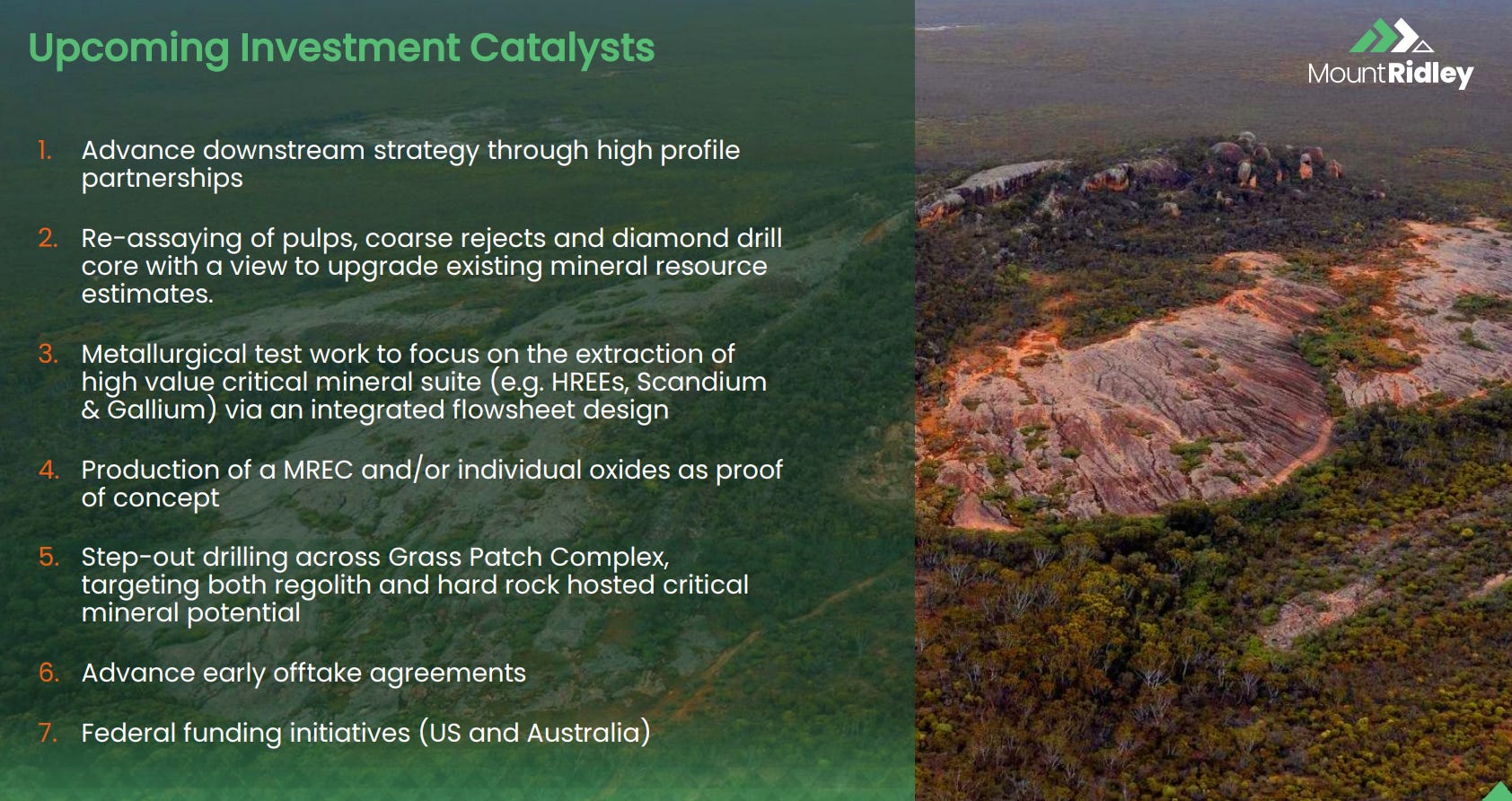
Behind the scenes, the company is bringing in outside expertise. Discussions are underway with Australian and international specialists in rare earth processing, and the Lawrence Livermore collaboration feeds directly into this next phase.
Lawrence Livermore is one of the US Department of Energy's premier labs. The collaboration is part of the forward met work program.
Most juniors at this stage can't get a meeting with a lab like that, let alone a formal partnership.
And once you're in that ecosystem, the funding pathways that come with it - US government grants, defence procurement channels, critical minerals financing - open up fast.
The heavy rare earths leach. The beneficiation works. The next question is how far optimised testwork can push the numbers - which MRD will be answering through 2026 - and whether Grass Patch can start the transition from resource to development.
At this valuation, the market is giving you a lot of room if it does.