


We called Black Horse Mining our Small-Cap Pick of the Year on Tuesday. By Friday it had run 72%.
Not a bad way to kick off December.
The rest of the portfolio kept moving too. BUS raised $1.5m ahead of drilling, FMR started testing its best target, and AZ9 dropped visuals that make the Oval story easier to follow. All while the blue chips on the ASX200 sat on their hands.
Plenty still to play for before Christmas winds things down (will we see a Santa rally in 2025?)
What caught our eye this week:
BHL surges on debut
Gold forecasters turning openly bullish into 2026
Bubalus raises $1.5m ahead of its first Avon Plains drilling
FUN strengthens the rutile story as US policy shifts toward robotics
AZ9’s new visuals show the Oval system widening
Record silver prices breathe life back into small-cap valuations
AI-driven data centre growth is sending global energy demand soaring
FMR begins drilling directly into its most prospective target
BHL: Our Pick of the Year Starts Exactly How We Hoped
Black Horse Mining (ASX: BHL) listed at 20 cents on Tuesday and wrapped up its first week at 34.5 cents, a 72.5% gain straight out of the gate.
You can find our full breakdown of why we invested in BHL here, which also clocked in as our most read article ever.

The company’s flagship project is Mt Egerton, a historic Victorian gold mine that produced 1.29 million ounces at around 12 grams per tonne before water forced it to shut in 1906. (The gold didn’t run out, the old pumps just couldn’t keep up.) The deeper parts of the system were left behind, and more than 90% of historical drilling stopped above 150 metres.
BHL listed at a $13 million valuation with $8 million in cash and drills already turning. The project sits in the same structural corridor as Fosterville, Costerfield and Sunday Creek, and the ground hasn’t been properly tested in over a century.
Lowell Resources Fund and Endeavor Asset Management both landed in the top 20 on listing. They’re very picky with early-stage explorers and have solid track records backing discoveries early, so seeing them on the register says something.
Why we invested
Historic 12 g/t mine that was never properly tested below 150 metres
Drills already turning
Clean structure and smart money on the register
Same corridor as Fosterville, Costerfield and Sunday Creek
Real discovery leverage in a rising gold market
Early hits here and 2026 gets interesting fast.
Could Gold More Than Double? Some Think So
The forecasters are starting to get a lot louder heading into 2026.
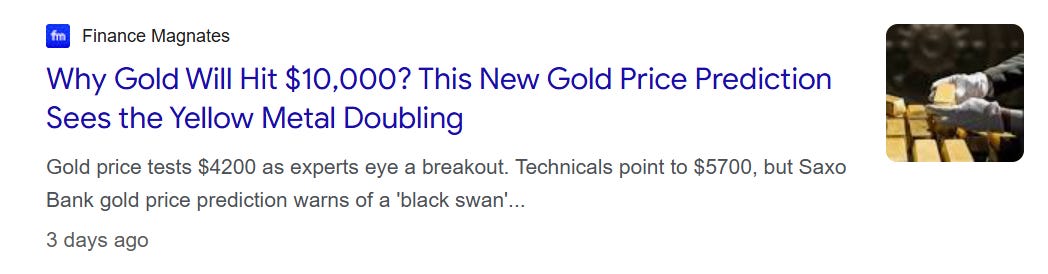
Saxo Bank, known for running big-picture scenarios each year, has sketched out a case where gold reaches US$10,000 an ounce.
Their logic starts with bond markets under pressure, sovereign debt piling up, and investors scrambling for hard assets when the cracks start showing.
In that world, gold becomes the landing spot for capital looking for somewhere to hide.
It’s a stress test, rather than a forecast, but the fact a major bank is working through five-figure gold says a lot about how people are thinking about 2026.
Bank of America remains with its well known US$5,000 target, built on the view that gold eventually reflects a decade of monetary expansion and the steady move from central banks to spread their reserves beyond the US dollar.
A rising gold price pulls capital back into the sector, and when that happens, discoveries get rewarded properly. Companies drilling now are doing so in front of an audience that’s already paying attention.
Any solid results will land in a market ready to buy it.
Bubalus Raises For High-Impact Exploration
Avon Plains is a historic high-grade gold mine that hasn’t seen a drill bit in over 100 years. That will soon change.
Bubalus Resources (ASX: BUS) locked in a $1.5 million raise this week, giving the company the cash to push ahead across its Victorian gold ground and its critical minerals portfolio in the Northern Territory.
Avon Plains is the one everyone’s watching, as the presence of a historic high-grade gold mine suggests the system has already delivered grade once before.
With gold running hard and sentiment coming back to the sector, any confirmation of structure or mineralisation could see the share price move north quickly from 15c.
For investors who want exposure to gold and critical minerals without paying up, Bubalus still screens as one of the cleanest opportunities in the junior space.
FUN’s Rutile Story Meets the Robotics Push
The Trump administration is reportedly preparing an executive order to fast-track a national robotics strategy. The Independent and Politico both ran stories this week about plans to build robotic manufacturing capacity onshore and lock in long-term supply of the metals that feed it.
Titanium sits high on that list, and high-purity rutile is one of the cleanest ways to supply it.
Which brings us to Fortuna Metals (ASX: FUN), who released new results from Mkanda this week, with the latest work adding more weight to the idea that this could grow into one of the standout rutile projects globally.
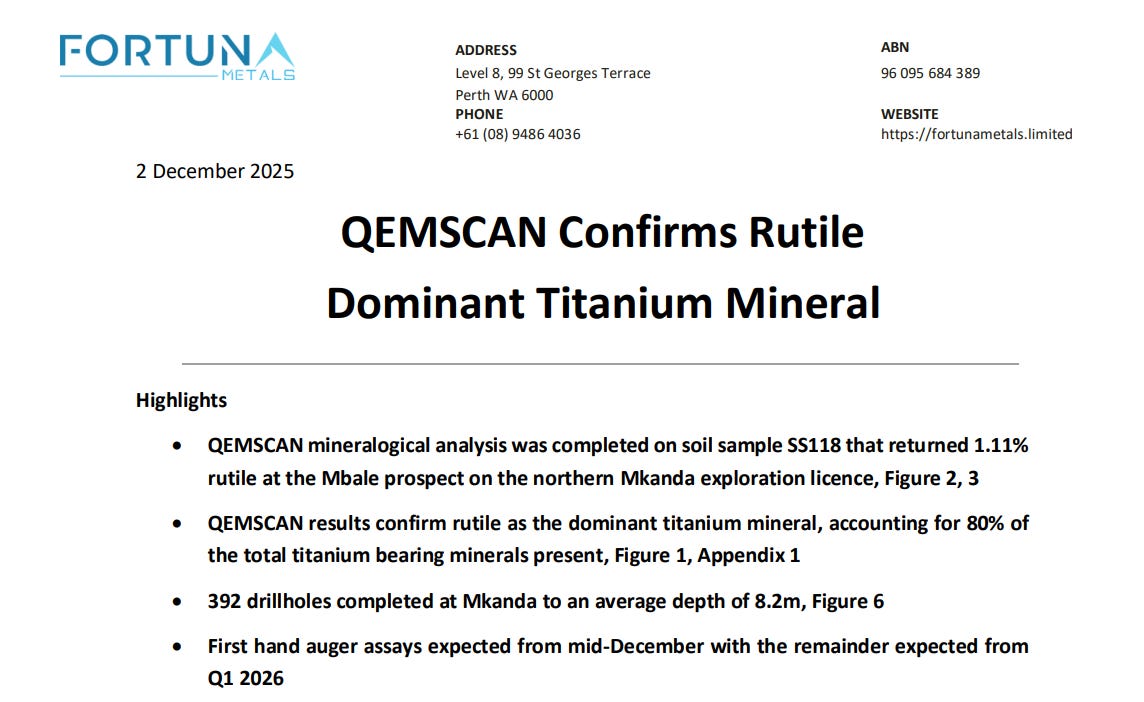
The QEMSCAN work has now confirmed rutile as the dominant titanium mineral, making up around 80% of the titanium content in the heavy mineral concentrate. It’s a strong outcome for this corridor of Malawi, where rutile systems often show this kind of makeup.
FUN has completed 392 drillholes at shallow depth and the first hand auger assays are due from mid-December. Those early numbers will begin to show how evenly the near surface rutile carries across the system.
Trump’s focus appears to be on AI-enabled humanoid and industrial robots, a direction that leans heavily on metals like titanium.
If the US plans to scale robotics at speed, it needs reliable supply of the minerals it doesn’t produce in volume.
FUN is drilling directly into that backdrop right now.
AZ9’s New Visuals Show Oval Widening
Asian Battery Metals (ASX: AZ9) put out a fresh set of visuals this week that make it easier to see how the Oval system is growing and why the scale keeps pointing larger for this copper-nickel target in Mongolia.
Sulphide zones are carrying through multiple drill positions now. The imagery shows where the next holes are stepping out and how the footprint continues to open up.
You usually see this kind of growth when the geology starts behaving the way the early modelling hinted it might, and the Oval intrusive is starting to show that shape.
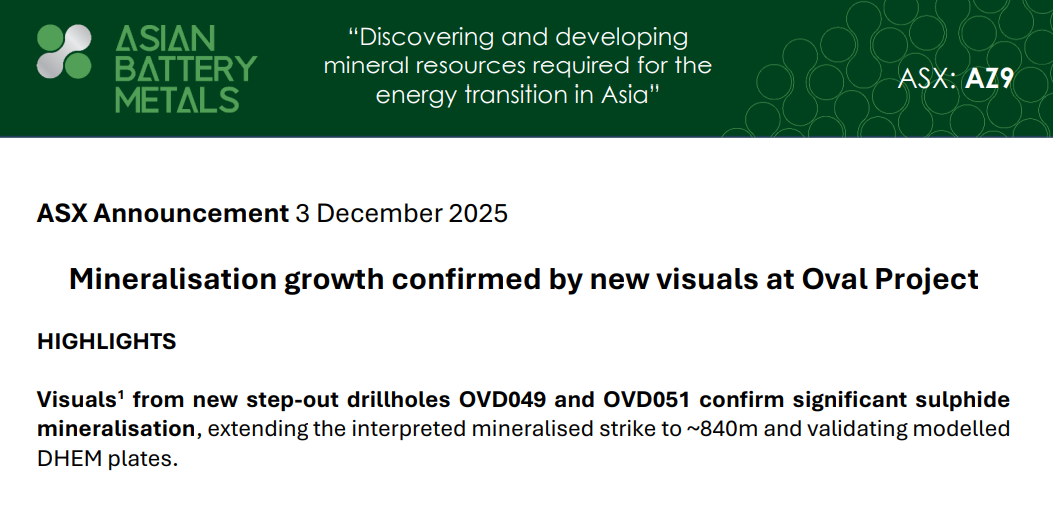
The body looks more coherent, the strike is stretching out, and the deeper positions are emerging as obvious follow-up targets.
From here it’s assays, tighter geological modelling, and planning for the holes aimed at the thicker, higher-grade sections of the system.
Management is running flat out across modelling, fieldwork and prep work, pushing to keep pace with a discovery story that still feels early in its life.
Record Silver Puts Junior Valuations Back in Play
Silver has pushed into all-time high territory, and the pace of the move has been quicker than most expected.
Silver carries as much torque as gold once momentum takes hold, sometimes more. Prices at these levels change the way investors think about the precious metals space. Projects that looked difficult to fund twelve months ago suddenly look cheap against the new pricing backdrop.

The industrial side is pulling harder than ever with solar demand, power electronics, even battery-related applications, all needing more metal than the market was pricing in a year ago.
Producers and juniors with a clear pathway to development are set up well, and sharp re-ratings from here wouldn’t surprise anyone watching this market closely.
AI Data Centres Are Hungry and Juniors Could Feed Them
The data centre buildout has now moved well past niche tech trend, and it kept gathering pace this week.
More than US$150 billion is already committed to new AI-driven capacity globally, with analysts expecting that to double before 2030.
Australia is part of the build with The Australian Financial Review noting that data centres already consume around 4% of the country’s electricity, which is forecast to rise sharply as AI workloads scale.
NextDC’s $7 billion hyperscale development at Eastern Creek announced this week, with OpenAI as anchor tenant, shows how deeply Australia is being pulled into the global compute infrastructure map.
These facilities require staggering amounts of raw materials, copper for cabling and transformers, nickel and aluminium for hardware and cooling infrastructure, and rare earths for efficient power systems. These centres are energy THIRSTY.
And they drain grids at a scale traditional infrastructure was never built for.
Overseas, small energy developers have re-rated sharply once investors realised they could supply power directly into data centre corridors.
No reason that can’t play out here.

That’s why any junior with a shot at supplying future energy needs for these projects sits in an interesting position. The demand curve steepens as AI adoption builds, and every new facility announced pulls more capital toward the companies that can ease either the metals bottleneck or the energy bottleneck.
Juniors that move early, secure the right ground and show a clear route into data-centre supply chains are walking into real upside.
FMR Begins Drilling Into Target C With the Core of the System Still Ahead
FMR Resources (ASX: FMR) has started drilling Target C at its copper porphyry project in Chile.
This is the target investors have been waiting for as the geophysics suggest it could hold the kind of copper system that changes the scale of the whole story.
The first holes are designed to test the upper parts of the target and give the team a better feel for the rocks, the structure and the early signs of mineralisation.
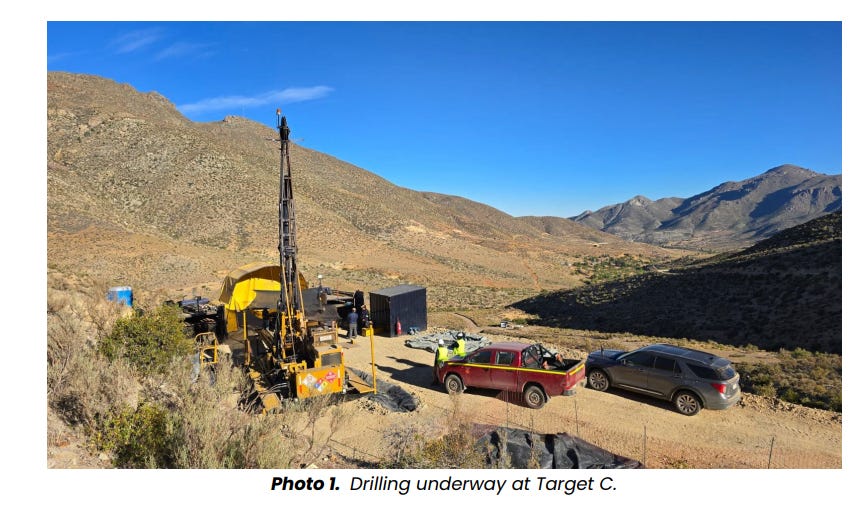
The previous deep hole only clipped the edge of Target C, but still showed the system runs bigger and deeper than expected. The centre remains untouched.
By drilling into Target C properly, FMR can start working its way toward the area where the main copper position is most likely to sit.
If the early holes come back with the right signals, the next step is drilling straight into the heart of the target.
That’s the moment shareholders are watching for.
The start of the silly season
This week showed why we spend so much time in the small-cap end of the market. You get catalysts and real movement long before the broader index wakes up.
Our Pick of the Year delivered straight out of the gate, gold sentiment is heating up, and several of our coverage names stepped forward with the type of news that can shape the next leg of their stories.
The bigger thematics are only getting stronger. Robotics, energy demand from AI and record precious metal prices are all pushing capital back toward the parts of the market where leverage actually lives.
Plenty of runway left as we head into December.
Till next week.
