


Gold’s had a rough few weeks. Down from above US$5,700/oz in early March to around US$4,400/oz today, and it’s spooked some of the junior mining space.
Between the war, rising oil prices and the usual post-spike profit-taking, gold’s been pushed through a correction that looks ugly on a two-week chart.
Zoom out though and gold is still up 45% over the past year. And if you’ve been around small-cap mining long enough, you know that pullbacks in the gold price tend to be where the better entry points show up.
Exultant Mining (ASX: 10X) just dropped rock chip results from Undoo Creek in NSW, and we think this is one of them.
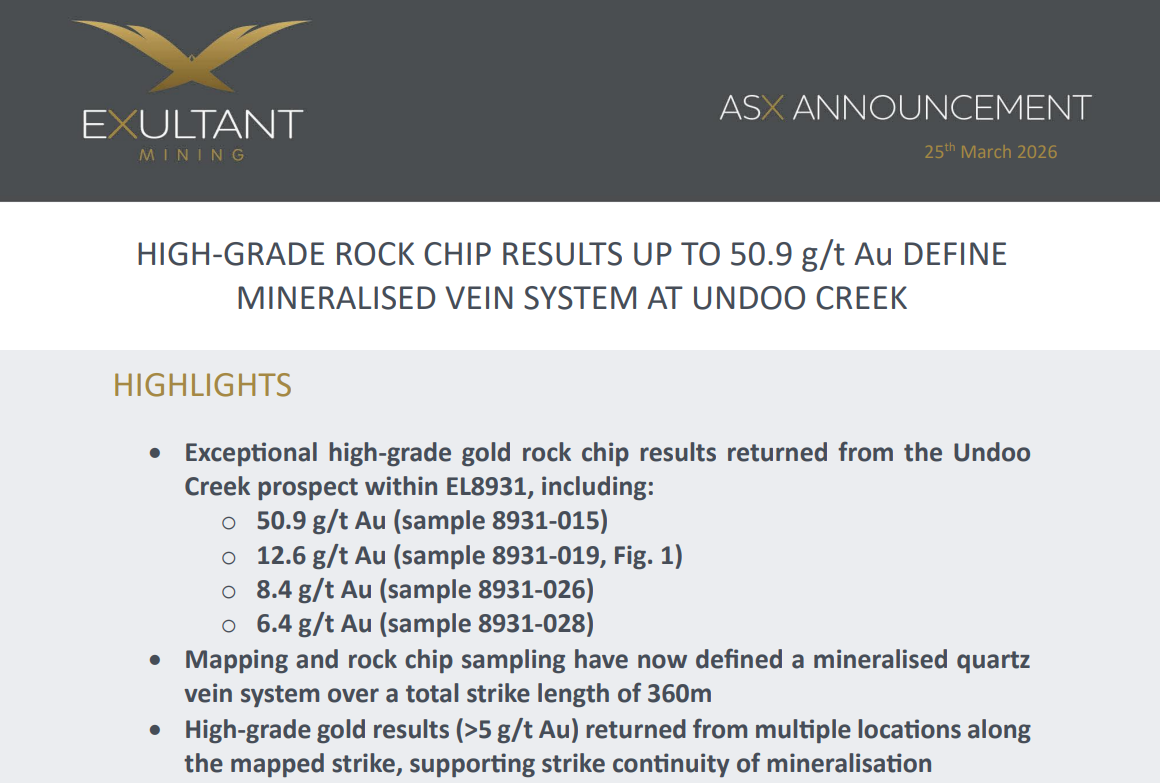
Rock chips have returned assays of 50.9 g/t, 12.6 g/t, 8.4 g/t and 6.4 g/t gold, all sitting along a quartz vein system that’s now been mapped over 360 metres of strike.
For a company trading at 18.5 cents with a market cap of roughly $7 million and more than $4 million in cash, we think they’re worth a lot more attention.
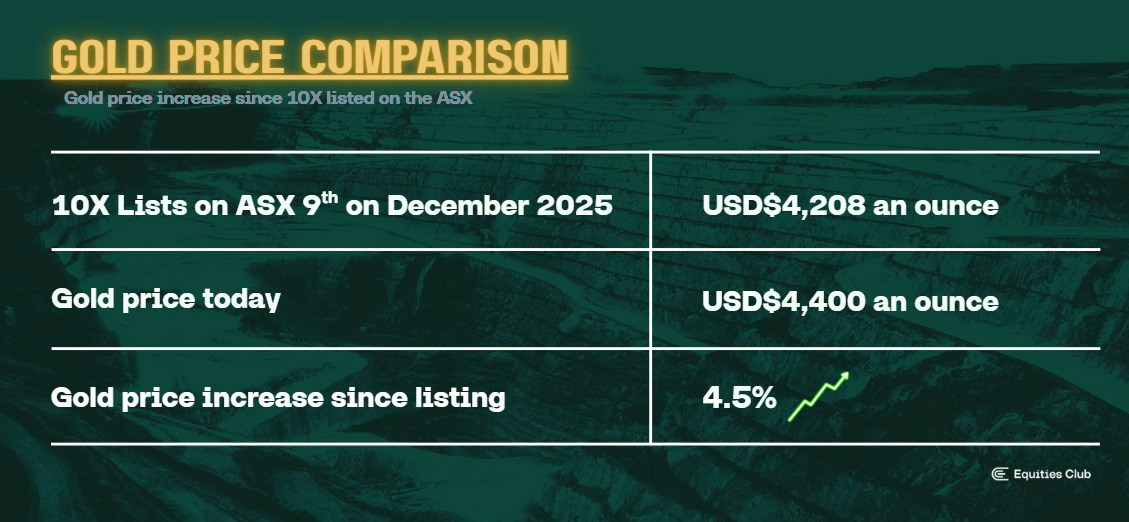
10X listed in December at 20c per share with no exploration results to its name. Fast forward to today and the company has confirmed high-grade gold mineralisation, the gold price is 4.5% higher than it was on listing, and the share price has drifted back 7.5%.
Smells like opportunity to us.
We wrote about why we're still bullish gold on the weekend. Gold's nearly tripled in two years and the forces behind that run - the debt, the geopolitical mess, central bank buying and the relentless money printing, haven't gone anywhere.
The oil shock and a stronger dollar have knocked it around in the short term, but the bigger picture is intact.
If gold gets moving again, funded explorers putting out 50 g/t rock chips at sub-$10 million valuations don’t stay there for long.
High-grade Gold Across 360m of Mapped Strike
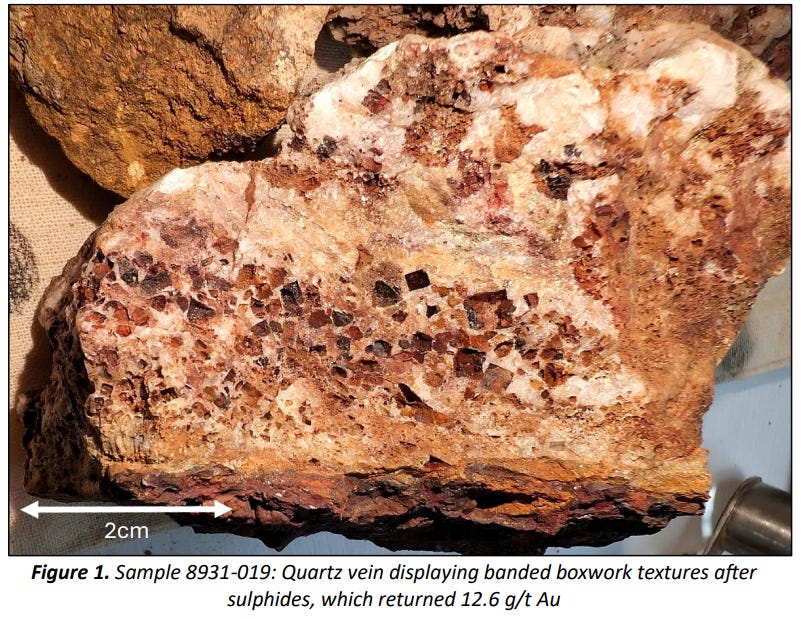
Rock chip sampling is selective by nature, but when you see multiple results above 5 g/t gold spread across 360 metres of mapped quartz veining, with historic shafts and pits dotted along the same corridor, the picture starts to build.
At the Undoo Creek prospect within their Peak View project, Exultant’s latest round of sampling has returned four standout results:
50.9 g/t Au
12.6 g/t Au
8.4 g/t Au
6.4 g/t Au
To be clear, rock chips are the best-looking bits of rock on the surface. They don't tell you what grade the system will run at when you drill it. What they do tell you is that the system carries serious gold, and at these grades, it warrants a much closer look with a drill rig.
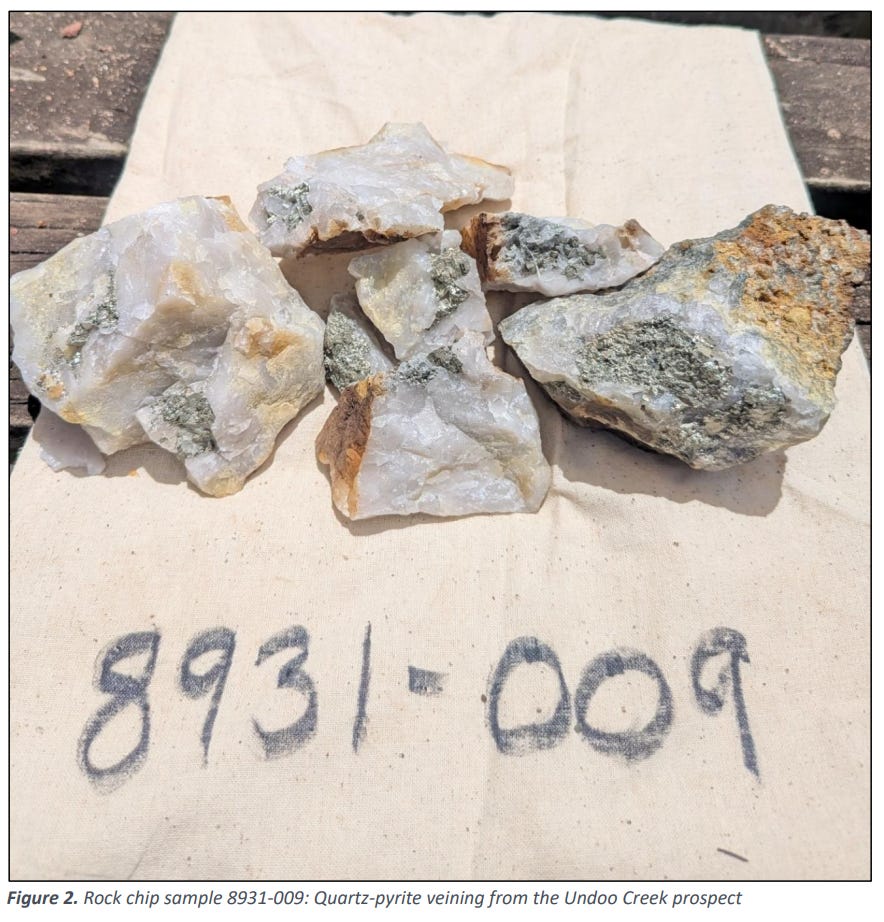
These sit alongside earlier results of 5.42 g/t and 2.61 g/t Au from the same prospect, reported in January. In our write-up on 10X a few weeks ago, that 5.42 g/t result was one of the things that caught our eye. The grades have now jumped up considerably as the team has mapped more of the system.
Early results said there was gold here. These results say there might be a lot of it.
The vein sits within granite (the Devonian Glenbog Granodiorite, for the geo nerds) that’s common in this part of NSW and a known host for gold mineralisation.
Some sections of the vein crop out at surface, some sit just below, and some are completely buried under soil and vegetation.
Where the vein disappears underground, old shafts and pits mark the trend, telling you where the historical miners were chasing gold.

Those old-timers were clearly picking off the richest pockets they could find along the vein.
Exultant’s modern mapping has stitched those isolated workings together into a single structural picture.
What looked like a handful of separate small mines turns out to be different access points into the same mineralised system running over 360 metres. And that number is still growing - the vein hasn’t been mapped to its limits in either direction.
Where the Veins Cross
There's a detail buried in this announcement that most people will skim past, but it caught our eye.
The system runs as a main NNW quartz vein cut by several NW-SE veins coming in at an angle. (Stay with us here, this is the bit that tells you where the gold is.)
Where those veins cross each other, you get zones of disruption in the rock, and in gold systems like this, those junction points act as traps.
Hot, gold-bearing fluids moving through the rock pool up at those intersections and drop their gold. That’s where high-grade shoots form.
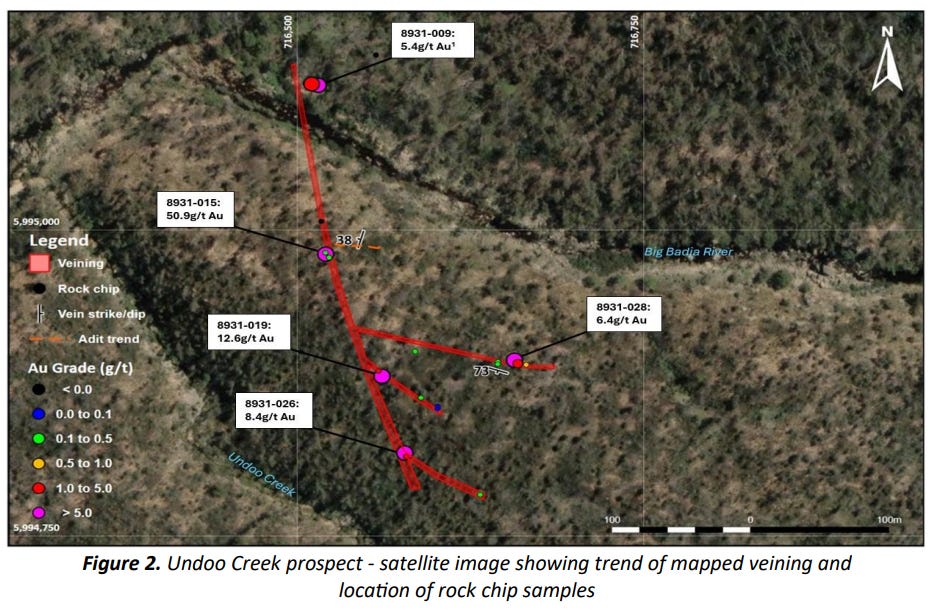
Several of the strongest rock chip results sit right at or near these intersections. It gives the company a geological reason to aim a drill at specific spots along the vein rather than just punching holes and hoping.
The historic workings at Undoo Creek are all relatively shallow, and the depth extent of the mineralisation is completely untested by modern drilling.
High-grade shoots in systems like this tend to plunge, angling downward into the earth along predictable orientations. If that’s the case here, and the surface data is building a case that it could be, the real prize sits below the old workings at depths that have never seen a drill bit.
At $7 million market cap, you're looking at a gold system that's untested at depth and now has a roadmap for where to point the rig. Every shaft those old miners dug was chasing gold near the surface. Nobody has ever looked underneath them.

What Happens Next
10X is working Undoo Creek toward drill targets.
More mapping, more rock chip sampling to test whether there are parallel veins sitting nearby, and geophysical surveys to figure out how deep the system goes.
None of it is glamorous, but it's the work that makes the difference between a good drill hole and a wasted one.
Plenty of juniors at this market cap would have had a rig on site already, punching holes into underdone targets.
10X is doing the homework first. That tends to produce better holes, and better holes are what move a $7 million company.
Undoo Creek sits within the broader Peak View project corridor. We covered several of Peak View’s prospects in a recent write-up on 10X, and Undoo Creek was one of them. Back then it was early days. These results have put it firmly in the spotlight.
With more than $4 million in cash, 10X has the runway to advance these targets without needing to raise capital in the near term.
In a market where dilution is the silent killer for micro-caps, a funded explorer with no pressure to issue shares is already ahead of most of its peers.
Our Take on 10X
Gold’s pullback has pushed small-cap explorers off most people’s radar. We think that creates a window.
At $7 million market cap with over $4 million in cash, 10X is sitting on an enterprise value of around $2.7 million while putting out rock chip results that would get attention on a company five times this size.
Rock chips are early-stage data, and the grades will need to be confirmed by near-term drilling. But high-grade results keep showing up across a 360-metre system that's untested at depth, and the geology is now giving them clear targets to drill.
For a $2.7 million enterprise value, that's a lot of upside sitting in the ground waiting to be tested.
The market is looking the other way right now, and for a funded explorer putting out 50 g/t rock chips at a $7 million valuation, we’ll take that all day.
Drills are getting closer, and we think the ground will do the talking.